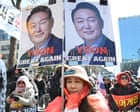
A South Korean court on Thursday sentenced former President Yoon Suk-yeol to life in prison over a failed declaration of martial law in December 2024, convicting him of leading a coup and becoming the first elected head of state to receive the maximum custodial sentence in the country’s democratic era.
Under South Korean law, the crime of leading a rebellion carries three possible punishments: death, life imprisonment with hard labor, or life imprisonment without labor.
Prosecutors sought the death penalty, arguing that Yoon “seriously sabotaged the constitutional order” by mobilizing troops to surround parliament and attempting to arrest political opponents during the six-hour standoff.
Yoon maintained his innocence at trial, describing the investigation as a “political conspiracy”. He said he declared martial law to alert citizens to what the then opposition Democratic Party described as an unconstitutional parliamentary dictatorship.
Yoon has accused election fraud without providing evidence and claims the opposition has paralyzed his government through budget cuts and impeachment proceedings.
He argued that he had deployed a small, largely unarmed force with the intention of suppressing Parliament. His legal team argued: “There was no intention to disturb the constitutional order and there was no riot.”
The ruling comes 14 months after the coup, which has been the most serious threat to South Korean democracy in decades.
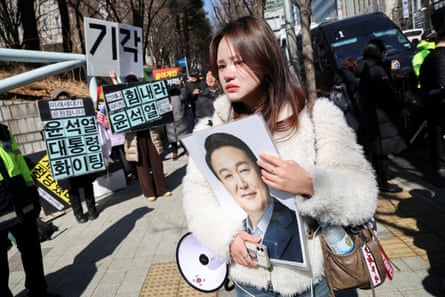
Allegations stemming from events on the night of 3 December 2024 that prosecutors alleged that Yun attempted to use military force to freeze the legislature, arrest political opponents and seize control of the National Election Commission. Yoon claimed he was rooting out “anti-state forces” and accused him of election fraud without providing evidence.
Within hours of the announcement, 190 lawmakers broke military and police cordons and passed an emergency resolution lifting martial law. Parliament impeached Yoon within 11 days, and the Constitutional Court removed him from office four months later.
Thursday’s verdict followed a series of related verdicts in which the events of December 3 officially established the coup.
In January, former Prime Minister Han Duk-soo was sentenced to 23 years in prison for what he described as a “self-insurgency” by an elected authority that was more dangerous than traditional coups. The sentence exceeds prosecutors’ demand of 15 years, which indicates a judicial willingness to impose severe penalties.
On February 12, former Interior Minister Lee Sang-min was sentenced to seven years in prison for his role in the coup, including broadcasting Yoon’s orders to cut power and water to media outlets.
Legal experts said the verdicts created the environment for the harshest sentence in Yun’s case.
Former President Park Geun-hye was initially sentenced in 2018 to a concurrent 32-year prison sentence for corruption and related crimes, which was reduced on appeal and later wiped out by a presidential pardon in 2021.
In 1996, military dictators Chun Doo-hwan and Roh Tae-woo received death sentences and 22-and-a-half-year sentences, respectively, for their roles in the 1979 coup and massacre in Gwangju, although they were commuted on appeal and both were eventually pardoned.
Every South Korean president who has served prison terms has eventually been pardoned.