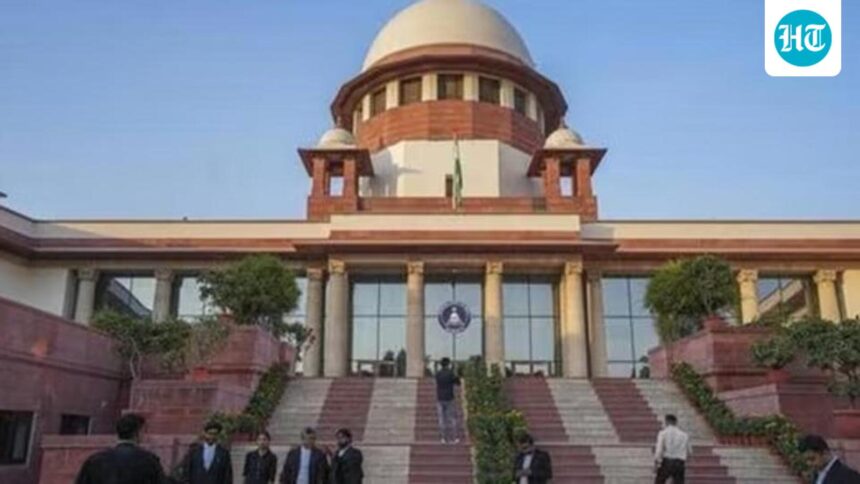
The Supreme Court has set aside an order of the Gujarat government directing recovery of 108 hectares of grazing land allotted to Adani Ports and Special Economic Zone Ltd in Mundra, holding that the process has been botched due to clear violation of principles of natural justice.

A bench of Justices JK Maheshwari and Atul Chandorkar ruled that the state’s July 4, 2024 order resuming the land, as well as subsequent directions issued by the Gujarat High Court to implement that decision, had been passed without giving opportunity of hearing to the aggrieved allottee.
“The order dated 04.07.2024 passed by the State which violates the principles of natural justice is liable to be set aside with freedom to issue a fresh order,” the court said. The detailed order was issued following court proceedings on January 27 last week.
Senior Advocate Mukul Rohatgi appeared for Adani Ports, while Solicitor General Tushar Mehta represented the Gujarat government.
The controversy goes back to a Public Interest Litigation (PIL) filed in 2011 in the Gujarat High Court challenging the allotment and sale of Gochar land in Navinal village in Mundra taluka, Kutch district.
The PIL sought to set aside the June 27, 2005 decision of the Gujarat Revenue Department and the July 15, 2005 order of the Collector allocating about 231 acres of Gochar land to private entities associated with the Mundra Port Project. It also sought restoration of lands to Navinal Gram Panchayat or provision of alternative grazing lands in view of the 18th Gujarat Zoological Survey (2007-08).
Additional prayers included restricting development activities such as filling of streams, dredging and clearing of mangroves in Mundra Port and SEZ area pending environmental clearances.
The Supreme Court had initially disposed of the political isolation law in 2014 with directions to demarcate the boundaries of Gochar lands. However, upon subpoena by the state, the petition was restored.
While awaiting proceedings, the Gujarat government issued an order on July 4, 2024 resuming a total area of 108 hectares and 22 ar of Adani ports. The Supreme Court noted that this appeal was in implementation of oral directions issued during the Supreme Court proceedings.
Read also: What is “industry”? Nine Supreme Court justices will decide next month
The Supreme Court, in its impugned order, directed that the appeal process be carried out in accordance with the state order issued on July 4, 2024.
However, the Supreme Court found that neither at the stage of decision of the State Government nor during the directions of the Supreme Court, the appellant company was not given an opportunity of being heard.
The Division Bench recorded that the State had not heard the appellant while passing the appellate order and likewise he was not given due opportunity before the High Court passed consequential directions. The bench further observed that the Supreme Court did not decide the claims raised in the PIL on merits but effectively directed the implementation of the state appeal decision.
The appeal remained pending before the Supreme Court for more than a year and a half, during which the implementation of the Supreme Court order was suspended. In view of this lapse, the Bench set aside the appellate order of July 4, 2024, but granted liberty to the state government to pass a fresh order after following due process.
“Needless to say, both parties should exchange their objection/pleadings within six weeks. The court directed the state government to give opportunity to the parties and decide the question of appeal as soon as possible again,” it said.
The court also directed that the PIL 2011 before the Gujarat High Court be treated as disposed of. However, she clarified that once the state government issues a fresh order after hearing all stakeholders, the parties will be free to pursue remedies permitted by law.
Challenging the Gujarat government’s land reclamation, Adani said in his appeal that the Supreme Court cannot direct the enforcement of an “inherently illegal order” passed in violation of natural justice, especially in the 13-year-old PIL seeking cancellation of land allotment paid more than two decades ago.
The company indicated that it invested more than that $23,586 crore by 2011 after the sale, while 2,284 were directly and 15,921 indirectly employed in the SEZ. Adani stressed that his “acquired and legal rights”, built over 20 years, could not be summarily affected.