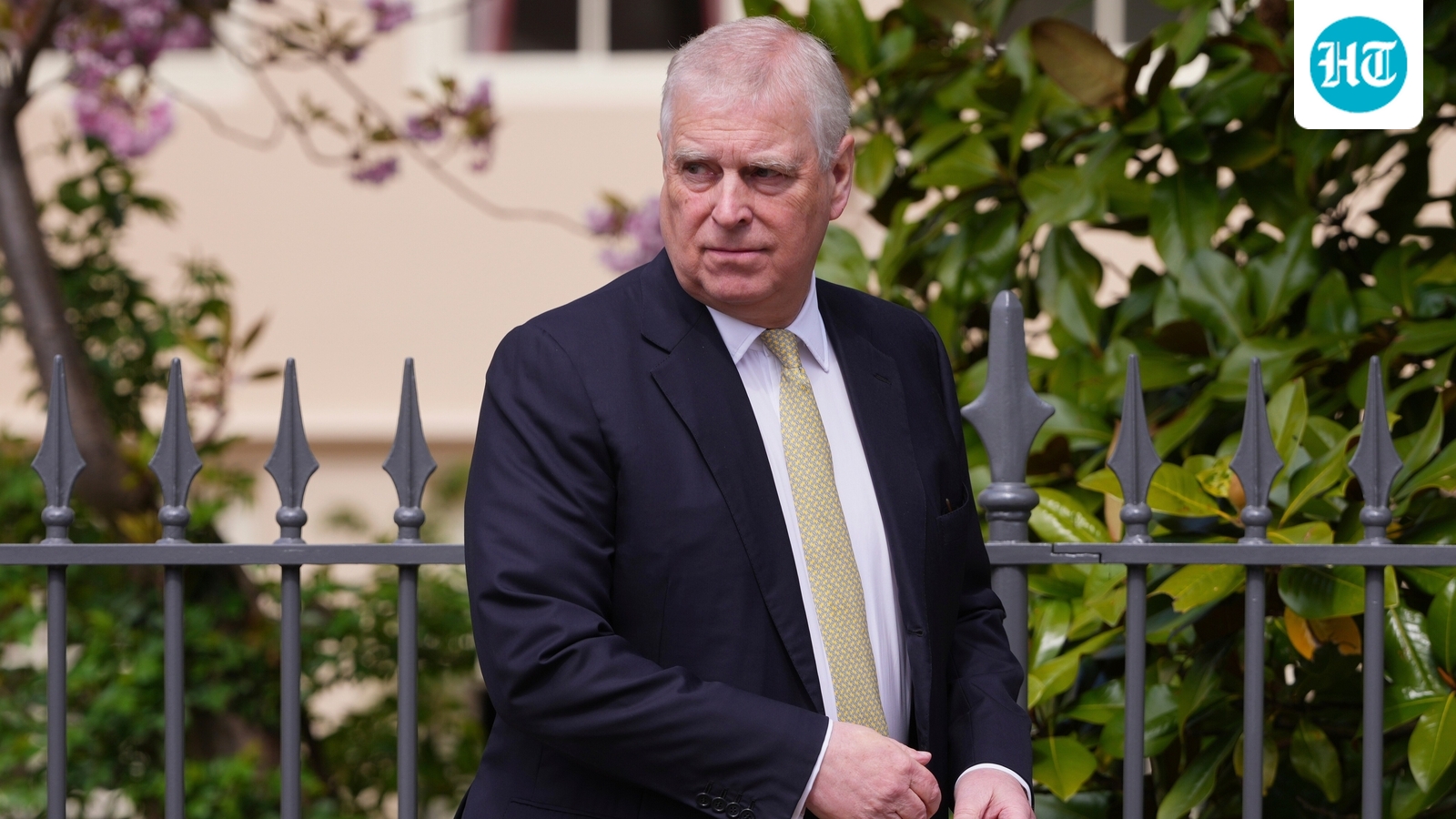
The emails show the extent of the disgraced financier’s relationship with former Prince Andrew and his ex-wife.
LONDON – Prince Andrew, Duke of York, was preparing to board a flight to London in September 2010 when Jeffrey Epstein emailed to change the couple’s plans for a quiet dinner at Buckingham Palace.
The former prince is now known only as Andrew Mountbatten-Windsor. (AP)The American financier, convicted in 2008 of soliciting a minor for prostitution, said he was accompanied by three women, including a Russian model. “Should I bring them all. To add some life,” he wrote. Andrew agreed. Later that afternoon, Epstein wrote back to add another guest, whom he described as “Romanian, very nice.”
The next day, Epstein wrote: “Great fun, more later.” Andrew replied: “Yes please!”
The British royal family met just over a year after Epstein finished serving a 13-month long sentence for his crimes.

It was one of several new revelations in a cache of emails and texts—many featuring irregular capitalization and punctuation—recently released by the Justice Department that shed light on the extent of the relationship between Epstein and the younger brother of Britain’s King Charles III.
The revelations threaten to tarnish the image of the British monarchy. Charles has heckled Epstein in recent public events, an almost unheard-of act in the UK’s Buckingham Palace, which said in a statement that the monarch was “deeply concerned” about the allegations against his brother and said the palace would cooperate with any police investigation.
In 2022, Andrew reached a settlement with one of Epstein’s victims, Virginia Giuffre, who alleged that Prince abused her on several occasions when she was a teenager in the early 2000s, according to court filings. Although the terms of the deal were not disclosed, it is said to be a multi-million dollar settlement. There has been an intense media investigation into whether then Queen Elizabeth and the royal family funded the settlement. Buckingham Palace declined to comment.
More Read

Andrew has not commented publicly on the recently released emails, but has previously denied wrongdoing. She was stripped of her royal title last year and has been kicked out of her palace in the grounds of Windsor Castle outside London in recent weeks. The former prince, now known as Andrew Mountbatten-Windsor, did not respond to emails seeking comment.
Windsor Castle is reflected in the window of the gift shop.In 2019, Andrew gave an interview to the BBC in which he said he had cut off all contact with Epstein since early 2010. He became apologetic, saying he was unaware of any criminal behavior by Epstein and had no recollection of ever meeting Geoffrey. Soon after, the queen ordered him removed from his duties as a member of the royal family.
Newly released documents show that Epstein, years after his release from prison, helped the prince and his debt-ridden ex-wife Sara Ferguson manage their finances and scout new businesses. In return, Epstein used his royal connections to influence young women as well as business contacts.
The new layer of emails show that Epstein kept in touch with Andrew in late 2018, through messages from a close business associate, David Stern, who was working as a business adviser to Andrew. “Give him a hug,” Epstein emailed Stern, when she was on her way to Singapore to visit Andrew in June 2018.
Stern, who recently resigned from his position as an adviser to Cambridge Judge Business School in the wake of the emails, did not respond to requests for comment. Sarah Ferguson did not respond to emails requesting comment. He previously said he was taken in by Epstein’s “lies.”
‘The Duke’Andrew, Queen Elizabeth’s third child, had known Epstein on and off since 1999. Despite Epstein’s conviction, Andrew resumed contact shortly after the disgraced financier left a Florida county jail, the emails show.
A few months after Epstein was released in 2009, he received an email from a man listed in his contacts as “The Duke.”
“It’s been too long,” wrote Andrew, who went to ask if he could use Epstein’s apartment in Paris for the weekend. “If it’s inappropriate or unavailable, I Apologies for asking,” he explained.
Epstein quickly replied: “It will be organized…”
Sarah Ferguson was also in touch. Ferguson, who divorced Andrew in 1996 but remained on amicable terms, met Epstein while he was serving his sentence, according to the email. Three weeks before Epstein’s release, he sent her an email detailing how he had fallen into debt after starting a US wellness business.
“I was very sad,” he wrote. A few days after his release from prison, Ferguson brought his two daughters to his home in Palm Beach for lunch.
Sarah Ferguson in 2024.To help sort out his finances, Epstein introduced him to Stern, who ran an advisory business called Asia Gateway and had previously worked at Deutsche Bank, according to a biography written in a business pitch. He collected details of the Duchess of York’s debts—putting $6.6 million in a September 2009 email to Epstein—and worked out a plan to consolidate them. “It’s time to get serious, to be very tough… like a girlfriend who cheated,” Epstein advised Stern.
In early 2010, Ferguson emailed Andrew, suggesting that Stern could help the prince with a new plan to create a wealth fund in China. Stern and Prince then began discussing working together. In the emails, Stern referred to Epstein as his “boss” and said “I do what he tells me.”
Stern wrote to Epstein in July 2010 about an idea to open a private wealth manager in London that would attract wealthy Chinese clients. “We very discreetly make PA part of it and use his ‘aura and access,'” Stern wrote, referring to Prince Andrew. Later that year, Stern took Andrew on an official visit to China to visit Beijing and Shenzhen, taking instructions from Epstein that the Prince should meet there.
Andrew also gave Epstein a window into the activities of the UK government. He forwarded to Epstein’s confidential government briefings about some of the Asian countries he visited as a trade envoy.
That fall, Epstein emailed Jess Staley, then CEO of JPMorgan Chase’s investment banking unit, about Andrew’s interest in a role with the bank in China, setting off a string of meetings between Stern and JPMorgan executives about a possible joint venture led by Stern.
According to the email, Staley, a close confidant of Epstein, showed active interest in the idea. Stern met with JPMorgan executives in Europe and visited Hong Kong and Beijing. The plan was to pay Stern and Andrew through a company called Wittan, an ancient council called the “Wittengemot” that advised Anglo-Saxon kings. However, the plan never came to fruition.
JPMorgan declined to comment. Staley did not respond to a request for comment, but previously said he knew nothing about Epstein’s crimes.
In July 2013, Stern emailed Epstein to say that he and Andrew Cantor had met with Fitzgerald’s then-CEO Howard Lutnick. The emails show draft agreements for a joint venture, introducing sovereign-wealth funds sharing revenue from Andrew and the firm’s wealthy associates. A draft deal negotiated a £1 million advance to the prince. The emails did not show whether the plan ever happened.
A spokesman for Cantor said: “Cantor Fitzgerald had no business dealings with Andrew Mountbatten-Windsor.” Last week, the Commerce Department, which Lutnick now heads, said in a statement that Lutnick and his wife met Epstein in 2005 and had very limited contact with him over the next 14 years. In recent congressional testimony, Lutnick admitted to visiting Epstein’s private island with his family in 2012.
‘Wonderful Night’In August 2010, a month before Epstein brought the four women to Buckingham Palace, he emailed Andrew: “I have a friend you can enjoy dinner with.” Andrew replied, “Glad to see him.”
“She’s 26, Russian, cute, cute, loyal and yes she has your email,” added Epstein. The day after the proposed dinner with the prince in London, the woman, named Irina, emailed Epstein saying “I had an amazing night.”
Email between Andrew Mountbatten-Windsor and Jeffrey Epstein.British police say they are now assessing reports that a woman was taken to an address in Windsor in 2010 for “sexual purposes”. They are evidence of published emails And it’s reviewing whether Andrew forwarded confidential government information to Epstein
In recent days, former prime minister Gordon Brown said Andrew should face police questioning. “Britain cannot escape its role in enabling this web of exploitation,” Brown wrote.
In late 2010, Andrew visited Epstein in New York for a week, where the two were photographed walking together in Central Park, and scheduled a private viewing of “The King’s Speech” — an Oscar-winning film about Andrew’s grandfather, King George VI, according to the email. When Andrew returned to England, he wrote to Epstein: “God it’s cold and scratchy here! I wish I was still a pet in your family!”
This was the high water mark of their relationship. In early 2011, British tabloids published a photo of Andrew with his arm around 17-year-old Guiffre. Amid a media outcry, Andrew quit his position as UK trade ambassador. Andrew didn’t seem too worried at first. “Don’t worry about me!”, he wrote to Epstein. “We’ll be playing some more soon!!!!”
As the media frenzy intensified, Epstein kept tabs on the prince by contacting Stern about “PA.”
Despite the media spotlight, Epstein continued to try to arrange private meetings for the prince. “A very nice friend of mine is coming to London on Tuesday. Andrew might want to have him over for dinner,” Epstein wrote to Stern in October 2013. The emails do not show whether the dinner took place.
Meanwhile, Stern kept Epstein informed of the 2018 trip he took with Andrew to Tokyo and Singapore to meet with the then prime minister. In March 2018, an acquaintance of Epstein’s texted that he was going to Buckingham Palace for a reception. “Shall I offer your regards to our host, the Duke of York??”
“Yes,” Epstein replied.
A year later, Epstein was found dead in jail.
Write to Max Colchester at max.Colchester@wsj.com and Margot Patrick at margot.patrick@wsj.com