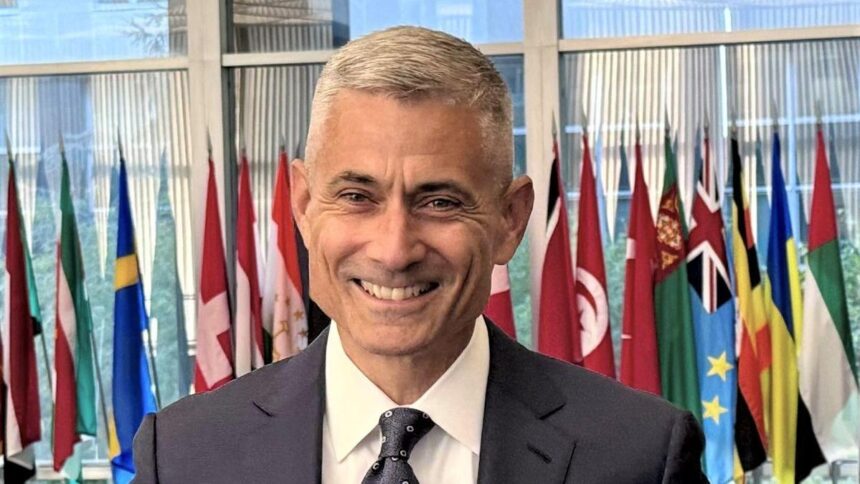
The US observes the quad (Quadrilateral strategic dialogue India, the US, Japan and Australia) as a “very important forum” in the South and Central Asia region, said the Trump administration’s top diplomat S. According to Paul Kapoor.
“… the Quad is a very important platform. It has worked well,” Assistant Secretary Kapoor told the US House Foreign Affairs Subcommittee on South and Central Asia on Wednesday (February 11, 2026), characterizing India as an “active” and “key” participant.

Mr.
“We have some potential purchases of weapons systems in the pipeline that will help India better defend itself and assert its sovereignty. Also (it will) create American jobs (and) be good for both sides,” he said.
In addition to trade, the Trump administration is deploying targeted investment, diplomatic and defense cooperation to build strategic capabilities in the region, according to Mr. Kapoor, after he recently completed US-India trade agreement And new momentum in the relationship.

“Following the trade framework that President Trump reached with Prime Minister Modi last week, we can now focus on other shared priorities, reducing barriers to trade in one of the world’s largest economies and opening the way for even fuller cooperation,” he told a handful of lawmakers at a hearing in Washington, DC.
Despite the uncertainty surrounding trade, according to Mr. Kapoor, India and the US are moving forward on “most axes” of the relationship.
Opinion | India-US trade deal is a blow to India’s strategic autonomy
On energy, Mr Kapoor said India was reducing its purchases of Russian oil and “diversifying” away from it. “…what we wanted them to do,” he added.
“And they (India) are actually buying more US energy. And I think that’s a promising possibility … to substitute some US energy for Russian energy … and also to buy from other places around the world,” he added.
Pakistan-US working together on critical mineral resources: Kapoor
A Trump administration official described Pakistan as “another important partner” in the region.
“We are working together with Pakistan to realize the potential of its critical-mineral resources,” he said, adding that energy and agricultural trade were expanding and counter-terrorism cooperation was underway.

on Elections in Bangladesh on February 12Mr. Kapoor said it was a “great thing” and the US was “very optimistic” about it, as was Nepal, which is expected to hold general elections in early March.
He characterized the change in Nepal and Bangladesh as “youth movements overthrowing old governments and now creating an opportunity for democratic participation.”
“So with Nepal, we believe we will have a safe and peaceful … election process and we are ready to work with whoever wins,” he said.
At one point in the hearing, Mr. Kapoor said that a strong and hostile power in South Asia was not desirable for America.
“A hostile power dominating South Asia could exert coercive leverage over the world economy. The United States must prevent this from happening and keep the region open and free,” he said, adding that the US needs to cooperate with partners. There were many references to China during the roughly hour-long hearing, which revealed different attitudes among members of Congress about the Trump administration’s handling of India-US relations.
During the hearing, Representative Ami Bera, an Indian American Democrat from California, said that in late September 2025, Mr. Trump was in India after the 50% tariff and $100,000 fee on certain H-1B visas. From the point of view of the US Congress, he explained, “nothing has changed” with respect to President Bill Clinton’s previous “three-decade strategy”.
India’s Strategic Puzzle in Stabilizing the Indo-Pacific: Ami Bera
“We see India as a strategic part of stabilizing the Indo-Pacific. They (Indians) still see that. We see the economic relationship,” Mr Bera said, adding that he was “cautiously optimistic” about the trade deal.
Mr. Kapoor acknowledged that the strategy for India transcends Republican and Democrat administrations.
Mr Bera asked Mr Kapoor to “push” India to use its diplomatic communications with Moscow to help the Trump administration in bringing peace to Ukraine.
According to Mr Kapoor, India “doesn’t have to go far to support our (US) strategic interests”.

“An independent, strong, prosperous India will take a large chunk of the Indo-Pacific away from China and that is indeed a task for us. A strategic victory,” he said. Mr. Kapoor was responding to Keith Self, Republican of Texas, who had asked him what India was doing to counter China’s Belt and Road initiative.
During the hearing, Mr. Kapoor said the US goal was not to keep China out of the region, but to prevent China or any other hegemony from seizing the region or using its coercive influence over the region.
The ranking member of the committee, Democrat Sidney Kamalager-Dove, asked Mr. Kapoor if he thought there were any preconditions that should be addressed before the US would agree to participate in the Quad Leaders Summit. Mr. Kapoor did not address this part of his question.
Ms. Kamalager-Dove expressed concern that the Quad was only mentioned twice in the Trump administration’s 2025 National Security Strategy. (This, in the Strategy, is mentioned only once in its full form and in abbreviated form).
India will host the Quad Summit this year.
Democrats described the 50% tariff on India as causing an “unnecessary rupture” in relations that would delay the Quad Summit and “sacrifice decades of hard-earned trust-building” between India and the US.
He said Mr Trump’s insistence that he was responsible for a ceasefire in the four-day war between India and Pakistan in May 2025 and his offer to mediate over Kashmir had overshadowed the role of US diplomacy.
Ms. Dove pushed Mr. Kapoor on the protection of Afghans resettled in the United States and criticized the Trump administration’s policies on Afghanistan and Afghans, which focused on the status of women and girls. Committee Chairman Bill Huizenga (Republican) criticized the Biden administration’s chaotic withdrawal from Afghanistan in 2021, calling it a “true betrayal” of America’s Afghan allies.