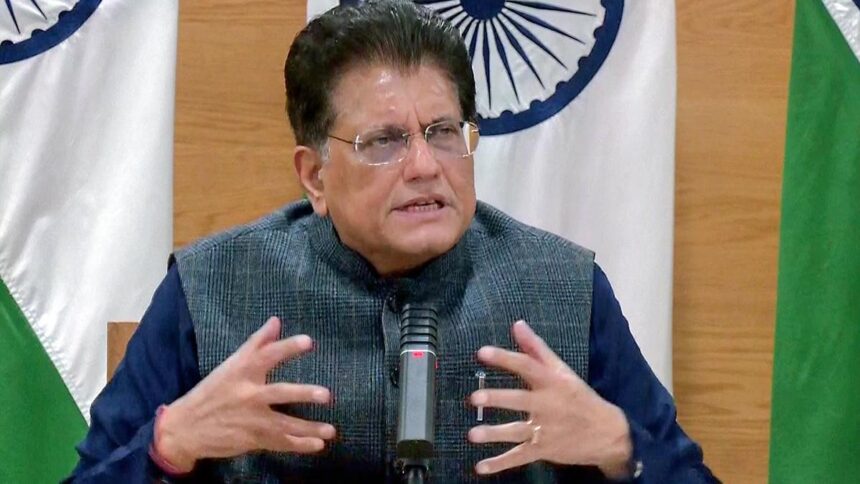
India will have no trouble buying $500 billion worth of goods from the US over the next five years as envisaged under the bilateral trade agreement, and indeed, this is an “extremely” conservative number for a country that aspires to be a $30 trillion economy. Commerce Minister Piyush Goyal said on Sunday (February 8, 2026).
Mr. Goyal said in an interview. PTI Videos.

According to a joint statement issued by both sides on Saturday (February 7, 2026) as part of the framework for the first phase of the bilateral trade agreement, India has expressed its intention to purchase US$500 billion in energy products, aircraft and aircraft parts, precious metals, technology products and coking coal over the next five years.

Indian goods facing 18% tariff have a competitive advantage over products from China and other competing countries that face even higher tariffs in the US markets, the commerce and industry minister said. China is charged with tariffs of 35% and other Asian countries face 19% and above.
At present, he said, India can get about $300 billion worth of imports from the US which it currently buys from other countries.
“We’re importing $300 billion worth of goods from the US today, we’re importing from around the world. That’s going to grow to $2 trillion in the next five years… I told my colleagues, look, I can assure you there is demand in India, but you have to be competitive,” he said.
As the country’s economy is growing rapidly, demand for a variety of goods ranging from semiconductor chips, advanced machinery and data center equipment to aircraft, aircraft parts and energy goods is increasing, Mr. Goyal said.
He said that currently India imports about $40-50 billion worth of goods from the US every year.
Citing examples where purchases from the US could increase, he said, big tech firms have announced big investments in India and so, “I mean we will see 10 gigawatt data centers in the country” and for that India will need equipment that can be supplied by the US.
“We need planes. We need engines for planes. We need spare parts. We already have $50 billion worth of orders with Boeing for planes. We have orders for engines,” he added.
“So, about $80-90 billion (dollars) are already on order in the next five years. We actually need more than that. I read the other day that Tata plans to place some more orders,” Mr Goyal said.
Besides, the country needs cooking coal for its steel industries. India already imports about 17-18 billion tonnes of coking coal.
“When we reach $300 billion, which is the stated target, the expansion in the steel industry is going on at a breakneck pace. We need $30 billion a year to cook coal. And all these products that I am proposing have already been imported since the time of the Congress, since the UPA was in power. There is nothing new,” he said.

“There is growth in demand and consumption of all these products. Additionally, we have announced in the budget that we want to promote data centres, promote AI mission and promote critical manufacturing and processing of critical minerals in India. Where will all this high quality machinery, ICT products and Nvidia chips and machinery go. From?” He said.
The most powerful technology supplier is the United States, he said.
“So, $100 billion is very conservative. I think it is very conservative for a country that wants to be the $30 trillion economy that India aims to be,” Mr. Goyal noted.

Asked whether the $500 billion purchase plans from the US included the orders India had already placed for Boeing aircraft, he said: “Everything we are talking about is ongoing and includes what we are already buying”.
Further, the Reciprocity Tariffs (RTs) on India are now very low as compared to its competitor countries, he said.
These countries include China (35%), Thailand (19%), Myanmar (40%), Cambodia (19%), Bangladesh (20%), Indonesia (19%), Brazil (50%), and Vietnam (20%).
With lower tariffs, India’s labor-intensive sectors such as textiles, leather and footwear, handicrafts, chemicals, and gems and jewelry are priced more competitively in the US market compared to these countries.
“So, we have to look at our competitive advantage over others. And comparatively, our equal countries, Udayon India’s RTs are among the lowest among face market economies and developing countries.
“So, we have an advantage over China’s 35% and we are 18%,” the minister said.
On safeguards against sudden imports from the US, he said there are enough safeguards in place in the trade agreement to protect the interests of farmers and domestic industry from surge in imports.
The trade agreement with the US will “ultimately help our farmers”, he said, adding that they are already exporting $50-55 billion worth of agricultural and fish products.
“It’s a two-page document (India-US joint statement),” Mr Goyal said, adding, “It still has a lot to come up with. And it cuts both ways. I’m sure the United States would want to be equally protected if we flood their market… This is a normal outcome of any negotiation”.
“So, it is a work in progress…safeguards are always there. So, if anyone is trying to highlight that it is not in this two-page joint statement, is trying to mislead people and still needs a lot of clarity,” he said.
He said India and the US have sensitivities about certain products and both have safety concerns for the products.
“We have preserved everything,” he said, adding that India has not given any tariff concessions on dairy products, GM (genetically modified) products, meat, poultry, soya meal and corn.