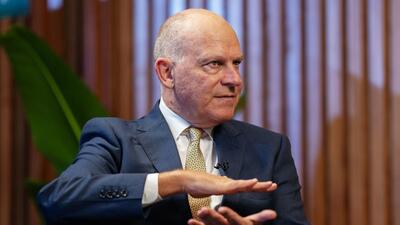
New Delhi: Air India’s transformation plan has been delayed by global supply-chain disruptions, with aircraft deliveries and cabin retrofits postponed for up to two years, Chief Executive Officer (CEO) Campbell Wilson said on Wednesday.
Chief Executive Officer (CEO) Campbell Wilson said Air India’s transformation plan has been delayed by global supply-chain disruptions.Inaugurating Air India’s first flagship lounge, the Maharaja Lounge, at Terminal 3 of New Delhi’s Indira Gandhi International Airport, Wilson said the airline had expected to receive around 39 new aircraft at this stage but had taken delivery of only two.
Air India is undertaking a $400 million program to refit aging wide-body aircraft with new seats and cabins. Wilson said the project remains on budget but behind schedule due to delays in manufacturing and certification of seat suppliers.
Wilson said the delay has pushed back product upgrades and expansion plans. “Unfortunately, when you layer in retrofit delays and delivery delays, it sets back our product upgrade and expansion plans,” he said.
“For the 787, it’s about a year behind where we expected it to be. For the 777, it’s about two years behind,” he said, adding that many airlines are facing similar post-Covid constraints.
More Read

The CEO recalls a major seat manufacturer pulling out after building prototypes, forcing Air India to restart the process. “It was very disappointing for one of the world’s largest OEMs (original equipment manufacturers) to walk away from a commitment. It cost us two years,” he said.
Also read: Tata Group has begun looking for a successor to Campbell Wilson’s Air India
Despite the setbacks, Wilson maintained that most elements of the Vihaan.AI transformation plan are nearing completion. “Most work streams are either complete or almost complete. The mechanical part of rolling it out across the fleet still takes some time,” he said.
More Read

The airline plans to induct 20 wide-body aircraft with new or refurbished cabins this year, while the retrofit program will continue for several more years.
Air India recently took delivery of its first factory-fresh Boeing 787 configured for the carrier and will soon deploy the first refitted aircraft from its legacy fleet.
New lounges in Delhi and San Francisco are also part of the upgrade, which Wilson described as “another manifestation of the new Air India on the ground”.
The Maharaja Lounge, unveiled on Wednesday, will be open to business and first class passengers, Gold and Platinum Maharaja Club members and eligible Star Alliance members from February 16.
“The Maharaja Lounge at Delhi Airport is a significant milestone in our transformation journey. It is a tangible and proud representation of the ‘New Air India Experience’. We strive to set a benchmark in aviation hospitality and this is just the beginning. Our strategic expansion plan includes significant investments so that we can build more platforms, which can create comfortable platforms for our guests across the country,” said the CEO.
“We are seeing material improvements in the A350s we fly to New York and London, and to Dubai and Singapore, where we operate the ex-Vistara aircraft,” he said, talking about how the investments are beginning to reflect in performance.
More Read

Profitability, however, has been affected by external factors. Wilson cited airspace closures, visa restrictions and political changes in several markets as headwinds.
Wilson added that there are plans to introduce first class on select Airbus A350-1000s and Boeing 777s but noted that premium seat development typically takes five to seven years. “We want it to be faster, but unfortunately that’s how long it takes to do well in first class,” he said.
The supply situation is slowly improving, although challenges around engines and components remain. “At this point, we’re not hearing anything from manufacturers that is cause for concern. They seem to be in a better position than ever,” Wilson said.