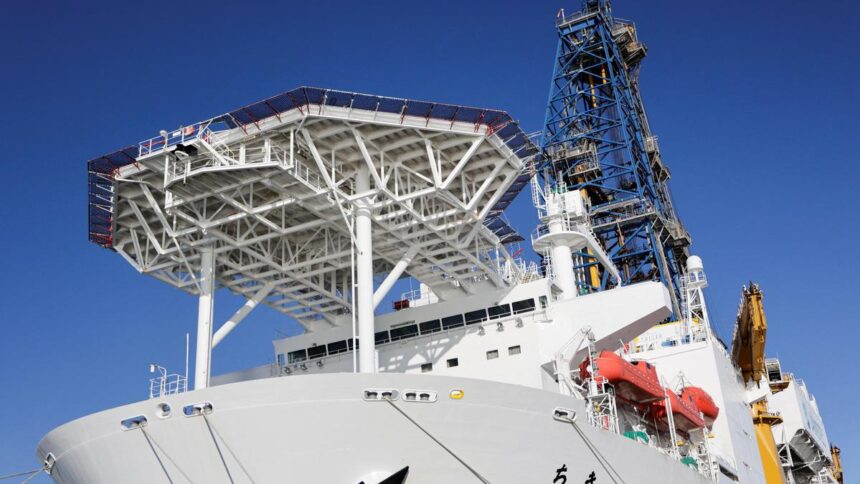

Japan’s drill-equipped research vessel Chikyu conducted a test recovery of rare-earth-rich soil near Minamitori Island before leaving Shimizu Port, marking the world’s first attempt to continuously lift rare-earth seabed sediment from a depth of about 6 km to a ship. 2026. | Image Credit: Reuters
Japan’s government said on Monday (Feb 2, 2026) that it successfully retrieved rare-earth-rich seafloor soil for the first time from a depth of about 6 km (4 miles) during a test operation.
A Japanese scientific drill ship left for remote Minamitori Island on January 12 to explore rare-earth-rich clay deposits, part of Tokyo’s bid to reduce its reliance on China for critical minerals as Beijing cuts supplies.
The month-long operation of the test vessel Chikyu near Minamitori Island, about 1,900 km (1,200 miles) southeast of Tokyo, is the world’s first attempt to continuously lift rare-earth-bearing seafloor mud from such depths into a vessel.
After arriving at the site on January 17, the vessel began recovery operations on January 30 and confirmed the first successful recovery of rare-earth soil on February 1, according to the Cabinet Office’s National Forum for Innovative Marine Development.
As of Monday (Feb 2), recovery operations at three locations had been completed, said Ayumi Yoshimatsu, a spokeswoman for the Japan Agency for Marine-Earth Science and Technology (JAMSTEC), which operates the vessel.
Analysis of the recovered material, including its volume and mineral content, will be conducted after the ship returns to the port of Shimizu in central Japan on February 15, Yoshimatsu said.
The soil is believed to contain dysprosium and neodymium, which are used in electric vehicle motor magnets, as well as gadolinium and terbium, which are used in a range of high-tech products.
“Barring major issues, Japan plans to proceed with a full-scale mining experiment in February 2027,” he said.
China last month banned exports of dual-use items that could be used for military purposes to Japan, including rare earths, amid a diplomatic row.
Japanese components maker TDK said on Monday (Feb 2) that it is being affected by Chinese export restrictions on rare earths and is taking steps to diversify its procurement sources.
Published – February 03, 2026 04:38 pm IST