As Finance Minister Nirmala Sitharaman prepares to present Union Budget 2026 in Parliament at 11 am on Sunday, the annual exercise once again draws attention to lesser-known moments and traditions that have shaped India’s budgetary history over decades.
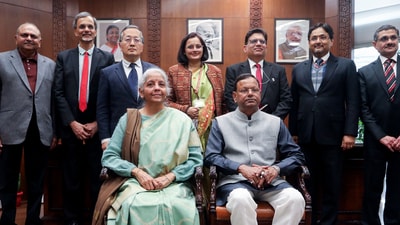
Union Finance Minister Nirmala Sitharaman and Union Minister Pankaj Chowdhury in a group photo with Chief Economic Adviser V Ananth Nageswaran, CBDT Chairman Ravi Agrawal and Finance Ministry officials after giving final touches to the Union Budget 2026-27 at Dutta Bhavan in New Delhi on Saturday. (ANI)1. India’s first budget after independenceIndia’s first budget after independence was presented in 1947 by then Finance Minister RK Shanmukham Chetty. The task came at a challenging time, when the newly independent country was grappling with economic uncertainty and strong financial headwinds while laying the foundations for its fiscal framework.
2. Longest budget speech on recordFinance Minister Nirmala Sitharaman holds the record for the longest budget speech in Indian parliamentary history. In 2020, his Budget address lasted 2 hours and 42 minutes, a record that remains unbroken.
3. Halwa ceremonyOne of the most recognized budget traditions is the Halwa ceremony, which marks the final stage of the budget-making process As part of the ritual, just before the start of the lock-in period, halwa is prepared and served to finance ministry officials and staff involved in drafting the budget.
4. When the budget was leakedIn 1950, the budget leaked during the printing process, prompting a major change in how documents were handled. After the incident, the budget printing was shifted from Rashtrapati Bhavan to Minto Road, and later, in 1980, again to the basement of North Block, where it remains.
More Read

5. Bilingual from English onlyTill 1955, the Union Budget was presented exclusively in English. From the 1955-56 fiscal year onwards, budget documents began to be presented in both English and Hindi, reflecting a wider push to make fiscal policy more accessible.
Together, these moments provide a glimpse of how the Union Budget has evolved. Traditionally, Indian businessmen used ‘bahi khata’, a cloth ledger, to maintain accounts. In 2021, due to COVID-19 restrictions, Sitharaman replaced the physical ledger with a digital tablet, signaling both security and a move towards the Digital India approach.