

nNew Year’s Eve has always struck me as the most treacherous of nights. Not because of the drink, the fireworks, or the stress of staying up past midnight (although that alone should be considered an endurance sport). Like Valentine’s Day and your birthday, what makes New Year’s Eve so fraught is the collective insistence that tonight must deliver: the best meal, the best party, the best version of ourselves. High expectations will inevitably lead to disappointment, and haven’t we had our fair share of that already?
There was one year in the restaurant when we convinced ourselves that the only way to rise to the occasion was with a set menu of great offerings. We thought we had it all figured out, and assumed (boldly or wrongly) that everyone would choose chocolate candy. It made sense: who wouldn’t want chocolate on the most festive night of the year? So Tarte Taten appears on the list as a polite substitute, as a backup singer, not as a star. Except, of course, everyone wanted tarte tatin.
What followed was a caramel-filled nightmare. We would make individual tarts to order; The kitchen turned into a swamp of apple peels and sugar, with bubbling molten sugar, apple wedges threatening to jump out, and warm, buttery pastries sliding like a mischievous toddler on an ice rink. The caramel burns, the chefs panic, and the hot trays hit the aisle with a smack. Happy customers, though.
Another year, we convinced ourselves to go “high concept” with a surprising menu: mysterious, ambitious and theatrical. We loved the idea so much that we forgot to do the sensible thing: plan, prepare and test it properly. The kitchen deteriorated so quickly that we felt as if we were trapped inside a living cautionary tale, except this time the customers were not happy at all. I was doing floor work that night, and even though I knew what things were like in the kitchen, I was going to do my best to have a door between me and the angry mob in the dining room. That was more than a decade ago, but the experience is still too raw and the details too embarrassing to share, even in therapy. Let’s just say one table was so upset that I offered to order them a pizza. Or sushi. Or whatever they wanted. Anything that makes them happy, and anything that’s not about us.
And then we swore (loudly and dramatically) that we were done with New Year’s Eve — and we were done for a while. One of those quiet years coincided with the first New Year’s Eve in our current apartment. We managed to forget everything and went to sleep early, only to be woken up by loud explosions and a glow shining through the curtains. We sat up and realized we could see fireworks from our bed – big fireworks in London, the city lit up like a giant glitter bomb. It turns out you can see fireworks from almost every window in our apartment. From the front, you can see Battersea, Clapham and Brockwell Park – multiple displays with slightly different rhythms, like a fireworks conversation. From behind you see Waterloo and London Bridge, and those enormous orchestrated displays that shake the sky. However, for those, you have to stand in a bathtub, which seems ridiculous until the first golden chrysanthemum bursts over the river and suddenly it feels like the most magical place in the world. Maybe that’s why we never move.
Such a treasure must be shared, and that is what we are doing now – when we can afford it. Because we always invite so many people, and the apartment is small and the bathtub isn’t big enough to accommodate everyone, we stick to the one New Year’s Eve strategy that actually works: something simple, plentiful, and indulgent. Set up buffet style with one large, generous plate and plenty of pieces to place on and around it.
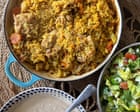
Our favorite is the chicken and rice number Ambaan Iraqi condiment that should win some sort of global diplomacy award for making everything taste better. Made with mango and fermented sour spices, amba is refreshing, funky and bright, a bit like fireworks for your taste buds. If you knew him, you knew how good he was; If you haven’t, treat yourself to something that will make next year even more delicious. If you can’t find it or don’t care to look at it, use piccalilli instead: same spice, different fermented biomass.
We throw in the pickles, chili sauce, fresh chopped salad, and a bowl of tahini sauce (my default which never fails). People scoop rice into their bowls, top it with some chicken with squiggly lines of amba and tahini, plus pickles for crunch, freshness and heat. It’s perfect when you have more bodies than chairs and no chance to sit down, and it’s the place to be for our New Year’s: festive without the fuss, homely comfort – but with fireworks.
Chicken with amba or piccalilli in one pot
serves 4Or 8 as part of a larger spread
To season the chicken
1 kg boneless Chicken thighs (about 8 pieces), ideally with skin
1 tablespoon ground cumin
1 teaspoon paprika
1 teaspoon towerEric
2 tablespoons sea salt
2 tablespoons olive oil (If using skinless chicken)
3-4 leeks– Peeled and cut into thin slices (250 grams)
3 islands– Peeled and cut into thin slices (250 grams)
2 fennel seedsTrimmed, halved and thinly sliced (250g)
4 Garlic clovespeeled and slightly ground
For amba rice
1 tablespoon olive oil
2 leeks– Peeled and cut into small cubes (120 grams)
3 islandsPeeled and grated on a coarse grater (250 grams)
500 grams of jasmine rice
400 ml of boiling water
100 grams AMBA Or 100g chunky piccalilli
For service
Chopped flat parsley leaves
Lemon wedges
Mix chicken pieces with spices and salt until coated, then place skin side down in a large ovenproof skillet with a lid. If you are using skinless chicken, add 2 tablespoons of olive oil to the pan before adding the chicken. Place over medium-low heat and fry for eight to 10 minutes until the skin is golden all over. Remove the chicken with a pair of tongs to a bowl.
Add all the chopped vegetables and crushed garlic to the pan, mix well and fry over low heat for six minutes. Empty into bowl with chicken.
Preheat the oven to 200°C (180°C)/390°F/Gas 6. Return the pan to the heat and add a tablespoon of olive oil, the chopped shallots and the grated carrots. Mix the ingredients well and cook over medium-high heat for about five minutes, until the carrots begin to break down. Add the rice and mix well to coat, then return the contents of the chicken pot to the pan along with all the juices – this is very important because this is the only salt and flavor you are adding to the dish. Mix a little to bury the vegetables and chicken between the rice grains.
Mix boiling water with amba or picalili, and pour it over the rice. Bring the mixture to a boil, then remove from the heat, cover first with a sheet of baking paper and then with a lid (or silver foil) and transfer to the oven for 25 minutes.
We take it out of the oven and leave it to rest for 10 minutes, before uncovering it and serving it with lots of fresh chopped parsley, as well as a few lemon slices.






![root-vegetable-hash-with-avocado-cream-[vegetarian]-–-one-green-planet](https://globalindiabroadcastnews.com/wp-content/uploads/2026/02/19793-root-vegetable-hash-with-avocado-cream-vegetarian-one-green-planet-300x200.jpg "root-vegetable-hash-with-avocado-cream-vegetarian--one-green-planet | GIBN")