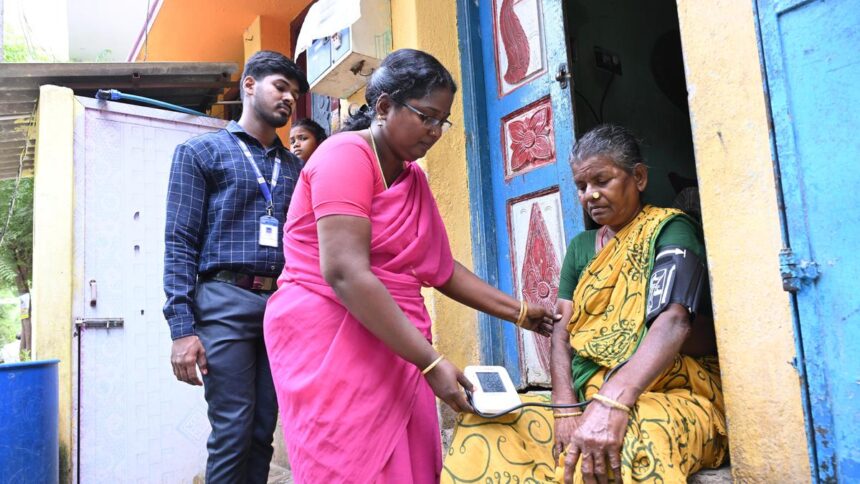
A study has found that the Tamil Nadu government’s ‘Makkalai Thedi Maruthuvam’ (MTM) initiative has improved access to non-communicable diseases (NCD) care – primarily diabetes and hypertension – among marginalised populations, particularly women, rural residents, and individuals from Scheduled Castes and Scheduled Tribes. The study also called for strategies to address gaps in cancer-screening uptake, disease control, and the programme’s reach in urban areas.
The study found that nearly 80% of the 6,856 individuals surveyed, aged 30 years and above, were screened for diabetes (79.4%) and hypertension (81.25%), with over two-thirds of the services delivered by the MTM field staff. While more than 95% of those diagnosed were on treatment, effective control remained poor, at 9.8% for diabetes and 35.4% for hypertension.
The State-wide cross-sectional household survey was conducted across all 38 districts to evaluate the reach and effectiveness of services provided under MTM, an initiative that delivers home-based screening and care for NCDs. Conducted by faculty of Community Medicine of government medical college hospitals and Directorate of Public Health and Preventive Medicine [Subramaniam, S., Somasundaram, A., E, C. et al], the findings were published in an article – Makkalai Thedi Maruthuvam: evaluating equity in non-communicable disease care through a doorstep primary health program in Tamil Nadu – in the journal BMC Primary Care.
What the numbers say:
A total of 6,856 individuals from the selected 5,760 households across all 38 districts of the State participated in the study
They were aged 30 years and above
The largest age group was 30 to 40 years (26.7%)
Women comprised 62.4% of the sample, and the majority (60.6%) were residents of rural areas
78.8% of participants were familiar with MTM; 72.8% confirmed they had been visited by a field-level MTM functionary
Findings summed up:
Across both diabetes and hypertension cascades, coverage was highest for screening (>80%) and treatment (>95%), while diagnosis rates remained modest at nearly 20% and control rates were the weakest points (9.8% for diabetes; 35.4% for hypertension)
Cancer screening coverage was substantially lower. Rural and SC/ST communities had greater programme reach, but urban areas lagged
Some key observations:
A significant proportion of participants (29.3% for diabetes and 26.4% for hypertension) had shifted from private to government care in the past year
Women were better covered than men across services; this is likely due to MTM’s structure, which is based on household outreach, thereby limiting its reach to working men
Rural areas showed near-universal coverage, while urban regions lagged in MTM-specific services
The study called for certain policy refinements:
Expanding cancer screening coverage through targeted outreach
Strengthening urban implementation strategies, including evening visits for working men
Providing performance-based incentives for field workers (Women Health Volunteers and Village Health Nurses) to enhance motivation and accountability
Source: Makkalai Thedi Maruthuvam : evaluating equity in non-communicable disease care through a doorstep primary health program in Tamil Nadu published in BMC Primary Care
Women comprised 62.4% of the sample. The majority (60.6%) were residents of rural areas. The study noted that 80.8% of women and 80.5% of rural residents had undergone diabetes screening.
Of those screened for diabetes, 67.6% were screened under MTM, largely through field workers. About 20.7% of all participants had been diagnosed with diabetes, with nearly two-thirds of recent diagnoses attributed to MTM. While 97.3% of those diagnosed were on treatment, over half received their medicines through the programme. Nearly 30% reported shifting from private to public sector services in the past year. Similarly, 75.4% of the new hypertension cases were identified through MTM, with treatment coverage at 96.2%, and nearly two-thirds receiving treatment through MTM services, the authors said.

“MTM has fundamentally shifted NCD care from a facility-dependent model to a community-owned, doorstep model that actually reaches the most marginalised. It is solving the problem of access. At present, MTM is largely positioned around secondary prevention. The next phase has to deliberately move towards primary and primordial prevention. That means not just finding the disease early, but preventing disease itself by addressing lifestyle, behaviour, and risk environments within households and communities. In other words, MTM has succeeded in reaching people. Now, it must succeed in keeping people healthy,” one of the authors, Sudharshini Subramaniam, professor in Community Medicine, Government Vellore Medical College, said.
Critical gaps
The study, however, noted that cancer screening coverage was substantially lower, with notable disparities across caste and economic groups. About 11.1% of women reported undergoing cervical cancer screening at some point, while 14.2% had been screened for breast cancer. Oral cancer screening was reported by only 3.9% of all participants. Urban women were more likely to undergo cervical cancer screening than rural women. SC women had the highest breast cancer screening rates at 41.2%, while ST women had the lowest (20.5%). The authors noted that socioeconomic status strongly influenced screening uptake, with women from higher income classes more likely to have been screened for both cervical and breast cancers.

The authors emphasised that future efforts should prioritise strengthening cancer screening services, ensuring continuity of care, and designing urban-specific interventions, while underscoring the importance of community health workers.