

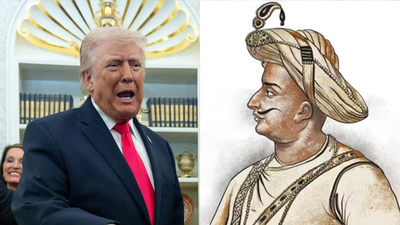
TOI correspondent from Washington: In the hallowed halls of the White House and the Elysee Palace, the United States and France have managed to upgrade a centuries-old alliance into something vastly more contemporary: a full-fledged transatlantic collective conversation has failed.The latest rift in this historic alliance – a bond dating back to the time when the French helped Americans evade British tea taxes at India’s expense – did not arrive through a row over wine or a row over cheese. Instead, it was delivered with the flair of a man who treats the world stage like a homegrown argument. During a private lunch on Tuesday, US President Donald Trump suddenly turned from the complexities of a naval blockade in the Persian Gulf to the dynamics of Macron’s marriage.Mocking President Emmanuel Macron’s reluctance to commit French forces fully to the offensive mission, Trump unleashed a wave of personal jabs, claiming that Macron’s wife was treating him “very badly” and that he was “still recovering from his right jaw.” These statements, delivered in the theatrical French accent he uses to mock Macron, were in reference to a widely circulated video clip of a local quarrel between Macron and exploited by popular media.
From the Elysee Palace, the response to Macron was: cold, cultured, and devastatingly mean. “Not elegant and not up to par,” Macron quipped, telling the leader of the free world that he was acting like a man putting ketchup on a Michelin-starred steak. He said in French: “We all need stability… calm. This is not a TV show!”Beneath the personal sniping lies a growing geopolitical divide.
While Washington beats the drums of war on Iran, Paris has adopted a stance of strategic independence, with Macron insisting that NATO — an organization that Trump affectionately describes as one usually reserves one’s reserve in case of constant rashness — is a “Euro-Atlantic” alliance, not a global delivery service for American incursions.The irony of this ingratitude is not lost on those who remember that the United States might today have been a collection of very polite British colonies were it not for the French.
In 1778, King Louis XVI not only sent thoughts and prayers; He sent a fleet that effectively defeated the British at Yorktown.However, French generosity came at a price in Deccani, India. While France was helping the Americans, it was at the same time tracking down Tipu Sultan, who was famous for requesting French assistance. But Louis XVI spent so much money on the Americans that he had little left for his allies in the East.
By 1783, the Americans had gained their freedom, and France had paved the way for British dominance in India by failing to support Tipu.
It seems that the American dream was partly funded by the abandonment of the Mysore tiger. Fast forward to 2026, and the Brotherhood of French-American Revolutions looks more like a messy public divorce. In the halls of the Elysee, there is a growing feeling that the Statue of Liberty was a gift that should have come with a 250-year return policy. However, despite all the theatrics, Franco-American relations have proven remarkably resilient. It is, after all, a partnership that has survived revolutions, world wars, trade disputes, and long arguments over cheese. What makes the current moment unusual is not only the difference in policies, but also in style. Macron speaks the language of norms, institutions and carefully considered diplomacy. Trump operates with the tone of rallies, headlines and off-the-cuff remarks about other people’s marriages. It is less a clash of political cultures than a clash of nations.