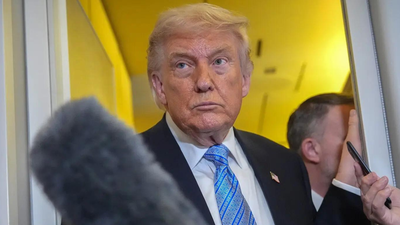
Archive photo: US President Donald Trump
US President Donald Trump returned from China on Friday, facing mounting pressure over the Iran war, with his top aides preparing options for renewed military action against Tehran if diplomacy fails.According to a report in the New York Times, Pentagon officials have been formulating plans for a possible resumption of strikes as part of a renewed military campaign after “Operation Epic Fury” was halted during a ceasefire in April. But Trump has not made a final decision yet.
“I looked at it, and if I don’t like the first sentence, I’m going to throw it away,” Trump told reporters aboard Air Force One while referring to Iran’s latest peace proposals.The report said that American, Israeli and regional officials are trying to broker a settlement that could lead Iran to reopen the Strait of Hormuz, allowing Trump to claim a diplomatic breakthrough amid growing domestic criticism over the costly conflict.
The Pentagon is preparing escalation options
War Secretary Pete Hegseth told lawmakers this week that the U.S. military has a “plan to escalate if necessary,” while also keeping options open to scale back deployments.
The report stated that the Pentagon prepared multiple military scenarios, including intense bombing campaigns targeting Iranian army sites and infrastructure.Another option is said to involve deploying US special operations forces to secure highly enriched uranium believed to be stored deep underground in Iran’s Isfahan nuclear facility.According to the New York Times, several hundred special operations personnel were transferred to the Middle East earlier this year to prepare for such emergencies.
However, officials acknowledged that any ground operation would carry a “significant risk of casualties” and require thousands of support forces.At the same time, Iran has signaled its readiness for renewed hostilities. Iranian Parliament Speaker Mohammad Bagher Qalibaf said, “Our armed forces are ready to give a worthy response to any aggression.”
The Strait of Hormuz remains a major concern
The Strait of Hormuz remains at the heart of the crisis, with Iran refusing to fully reopen the key oil transit route while the United States maintains blockade measures.Trump said after talks with Chinese President Xi Jinping that Washington and Beijing agreed on the need to reopen the Strait.While in Beijing, Trump said: “We do not want them to have a nuclear weapon, but rather we want to open the Strait.”Trump said his patience with Iran was “running out” and warned Tehran not to “reach an agreement.”However, China has stopped short of publicly indicating that it will pressure Iran directly.Iranian Foreign Minister Abbas Araqchi said Tehran remains open to diplomacy but does not trust Washington after previous negotiations were followed by air strikes.
There is still a huge military presence in the region
More than 50,000 US troops, two aircraft carriers, several destroyers and multiple warplanes remain stationed throughout the region.US General Dan Keane said that military officials “retain and continue to reserve a range of options for our civilian leaders,” according to the report.Despite weeks of attacks, US intelligence assessments indicate that Iran has regained access to most missile launch facilities and underground military infrastructure.The report also noted that Tehran has regained operational access to 30 of its 33 missile sites along the Strait of Hormuz.Oil prices continued to rise amid fears of escalation. Brent crude rose about three percent to about $109 a barrel, while concerns about the disruption of shipping lines in the Gulf for a long period pushed US Treasury bond yields to their highest levels in about a year.