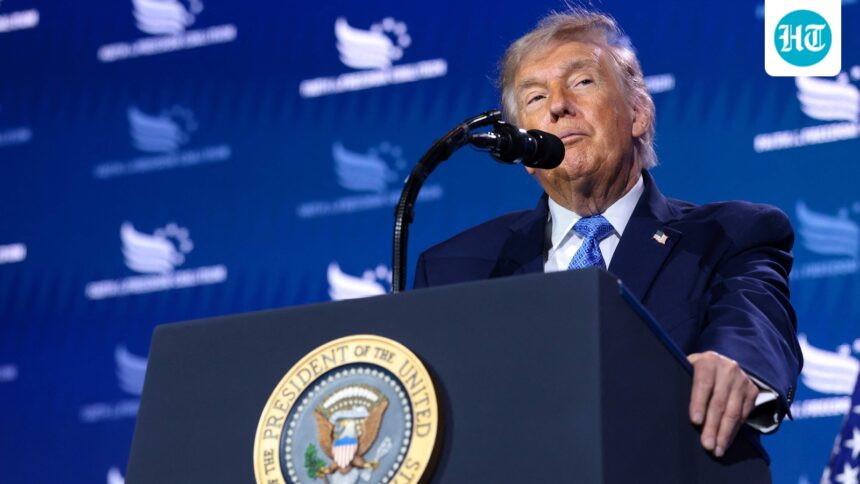
US President Donald Trump warned on Friday that he would impose a 100% tariff on goods coming from any country that imposes a digital services tax on US companies, adding that existing trade agreements with those countries would also be cancelled.

In a post on his Truth Social platform, he wrote: “Any country that imposes such a tax will immediately be met with a 100% tariff on any and all goods sent to the USA.”
He added, “This tariff will replace the trade agreements concluded with the state, whether they are implemented or signed or not.”
The Trump administration has been a strong opponent of the digital services tax, which the US president has repeatedly said unfairly targets major US technology companies, including Alphabet Inc. and Meta Platforms, Inc.
Will India be affected?
Probably not.
India has already withdrawn both parts of the equalization tax, known as the “Google tax,” which mainly applies to foreign technology companies, including those in the United States.
The “Google tax” is the Indian equivalent tax, which was introduced in 2016 on payments made to non-resident digital companies for providing online advertising services.
The tax was set at 6% and was applied to offshore technology companies that received advertising income from Indian companies, even if they did not have a physical presence in India.
Last year, the tax on digital advertising services provided by foreign technology companies was scrapped through changes made in the Finance Bill, 2025, with effect from April 1, 2025. At the time of the withdrawal, government officials told HT that the decision to scrap the tax was partly aimed at reducing trade tensions with the US.
India had already eliminated the 2% equalization tax on non-resident e-commerce operators through the Finance Act, 2024.
Who will be affected?
Mostly, European Union (EU) countries.
Trump’s announcement came a day after European Union member states approved a trade agreement negotiated with the United States last year. The agreement limits customs duties on European imports to 15%. However, digital services taxes were left out of the deal and have remained a major point of contention between the US and the EU.
Since most of the world’s major technology companies are based in the United States, Trump believes that digital services taxes create barriers to American exports.
Earlier this month, he warned that he would impose a 100% tariff on French wine and champagne unless France withdraws the digital services tax imposed on technology companies.
It is worth noting that France imposed a 3% tax in 2019 on revenues generated by technology companies within the country, including American companies such as Facebook, Amazon, Apple, and Alphabet, the parent company of Google.
In response to Trump’s latest warning, the European Union said on Friday that it “will respond quickly and decisively to defend its rights and regulatory independence,” Agence France-Presse quoted a European Commission spokesman as saying.
The Office of the US Trade Representative has for years warned France, Britain, Austria, Spain and several other European countries that they could face retaliatory tariffs if they tax digital services.
With input from agencies