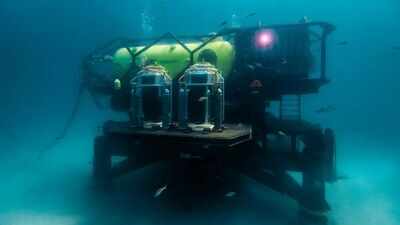
DEEP has completed the installation of Vanguard, its experimental undersea human habitat, at Tennessee Reef in the Florida Keys National Marine Sanctuary. The system is now located 17 meters below the surface after a complex offshore operation, marking a major milestone in subsea engineering and long-term underwater research capacity.The installation enables multi-day subsea missions, allowing crews of up to four aquanauts to live and work underwater for extended periods. These missions are designed to support marine science research, coral reef restoration, environmental monitoring, climate impact studies, and research on human performance in extreme environments.With Vanguard now in place, the project moves to its next phase: commissioning, sea acceptance testing and operational training prior to initial manned missions.
Underwater habitat The system was installed at a depth of 17 meters in the Florida Keys
Vanguard is deployed through a phased offshore operation that includes laying a foundation for the ocean floor, securing the habitat structure to it, and attaching a nearby surface support buoy to maintain operational connectivity.The complete system now lies on the sandy seabed at a depth of 17 meters (56 ft). The habitable module is 10.7 meters long and 2.5 meters wide, and is designed to support small underwater teams for missions lasting five days or more.
The deployment was carried out within the Florida Keys National Marine Sanctuary, a protected marine environment of scientific importance where careful stabilization was required to minimize disturbance to the surrounding coral reef ecosystem.
The final testing phase of the Vanguard underwater habitat system begins
With installation completed, Vanguard is now undergoing sea acceptance and commissioning testing, the final stages before formal operational use. These operations will evaluate system performance under real underwater conditions, including life support systems, structural stability, communications, and pressure regulation.The habitat is also moving towards the DNV classification. DNV, the world’s leading marine certification company, was involved in all stages of the design and construction process, providing independent verification that the system meets applicable engineering and safety standards for subsea infrastructure.After successful completion of this phase, DEEP will begin training support crews and aquanauts ahead of the first research missions at Tennessee Reef.
Vanguard is advancing DEEP’s vision for permanent underwater living infrastructure
According to DEEP, Vanguard represents a foundational step in a broader program to create long-term ocean infrastructure designed to support a sustainable human presence underwater. Norman Smith, DEEP’s chief technology officer, called the installation a major milestone after 18 months of design, construction and testing work. He noted that the successful deployment brings the organization closer to its goal of enabling continued human activity in the ocean and expanding access to undersea environments for science and exploration.Eddie Curtis, superintendent of the Florida Keys National Marine Sanctuary, highlighted the importance of marine habitats in supporting long-term research and improving understanding of marine ecosystems. He pointed out that the project depends on decades of scientific cooperation within the campus.
Scientific and practical applications
Vanguard is expected to support a wide range of underwater research and operational activities, including coral restoration work that includes expanded monitoring and deployment of nursery-grown corals, as well as ongoing assessments of coral reef condition covering coral health, bleaching, diseases, sedimentation and environmental change.
It will also enable long-term ecosystem studies, including species surveys and food web analysis, along with climate impact research focusing on global warming, acidification and storm-related changes.
How important are undersea habitats like Vanguard to marine research?
More than 3 thousand users shared their opinion today
More than 5 thousand users voted today
Share your opinion
In addition, the habitat will support human physiology and performance studies in isolated environments, development and testing of undersea sensors and sampling techniques, and training programs for astronauts and teams working in extreme conditions.
Live educational outreach is also planned, allowing real-time communication from the seabed to classrooms and the general public.
Vanguard becomes the first operational step in DEEP’s modular underwater habitat program
Vanguard is positioned as the first operational step in DEEP’s broader vision for modular subsea habitats. Insights gathered from its deployment and early missions will help develop Sentinel, a larger, next-generation system designed to expand the ability and duration of underwater living.For now, the habitat lies quietly on the seafloor at Tennessee Reef, connected to the surface by its support buoy, while preparations for the first manned missions continue beneath the Florida Keys.