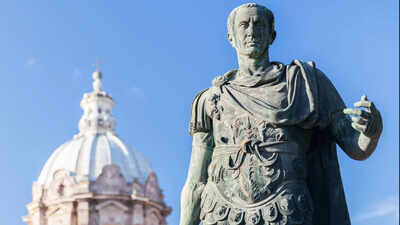
“The greatest power is not in defeating the enemy, but in making him no longer want to fight you.”
In March of 49 BC, Julius Caesar stood by the Rubicon River with a single legion, facing a decision that would change Roman history forever. The Roman Senate had warned that if he crossed the river he would be declared an enemy of the state.
By crossing the Rubicon, Caesar began a civil war against his greatest rival, Pompey the Great, and the powerful Roman aristocracy. However, as Caesar moved across Italy, his most powerful weapon was not the sword, but a precise psychological strategy aimed at defeating his enemies before he fought them.Instead of executing captured enemy soldiers and senators, Caesar chose to forgive them, return their property, and allow them to return home. This strategy reflects the meaning behind a famous idea often circulated today: “The greatest power is not in defeating the enemy, but in making him not want to fight you. The statement expresses an important truth about the conflict: True security comes from changing the opponent’s reasons for fighting, not just destroying his forces. Defeating someone through violence alone can leave behind anger and resentment, which may create conflicts in the future. Changing their desire to fight could change the entire situation.
Screening comments
Although many modern sources link this exact phrase to Julius Caesar, historians have found no evidence that Caesar actually uttered these words. Caesar was a skilled writer, recording his military campaigns in Comment by Bello Gallico and Commentary on civil war. None of his surviving letters, letters, or writings contain this exact sentence.
However, the idea closely matches Caesar’s real strategy, especially his famous policy ClementiaIt means mercy or forgiveness. In a surviving letter to his advisor Gaius Opius during the early days of the civil war in March 49 BC, Caesar explained this approach:“May this be our new way of conquering, to strengthen ourselves with mercy and generosity.”Caesar understood that killing his political enemies would create martyrs, increase hatred, and prolong civil war.
By forgiving them, he hoped to remove the causes of their resistance and return them to his vision of a united Rome.Historians such as Suetonius later recorded that this strategy also created risks. Many of the people whom Caesar pardoned, including Marcus Junius Brutus, eventually joined the conspiracy that killed him in mid-March of 44 BC. Although the famous quote is not a direct statement from Caesar, it represents the main idea behind his larger political strategy.
Empty sword strategy
The idea of defeating an enemy by removing his desire to fight goes back even further in history. During the Eastern Zhou Dynasty around the 5th century BC, he was a Chinese strategist Sun Tzu Explain this concept in Art of war.Sun Tzu believed that destroying an enemy’s army through direct battle was not the highest form of victory. books:“Subduing the enemy without fighting is the height of skill.”This strategy relies on understanding human behavior and using resources wisely.
When an army destroys a city, it gains a devastated land and a population filled with rage. But when a leader defeats an enemy through diplomacy, economic pressure, or psychological influence, he gains stability instead.This idea later influenced Western political thought. Thomas Hobbes wrote in Juggernaut War is not only actual fighting, but also the possibility of fighting and constant readiness to fight. Therefore, true peace is not merely the absence of violence; It is the removal of the reasons that drive people to war.
Modern diplomatic architecture
In 2026, this principle will still be important in international relations and conflict resolution. The different endings of the two world wars show the importance of this idea.In 1919, after World War I, the Allied powers punished Germany through the Treaty of Versailles. Germany was forced to pay huge reparations and give up the territory. However, this punishment did not remove Germany’s desire for revenge. Instead, it created economic hardship and public anger that helped Adolf Hitler gain support and contributed to the start of World War II.After World War II in 1945, Western leaders took a different approach. Through the Marshall Plan, the United States provided more than $13 billion to rebuild damaged economies in Europe, including Germany.By linking Germany’s future success to cooperation and democratic institutions, the Allies reduced the appetite for another war. This helped create lasting peace between Western European countries for more than eight decades.
Application in corporate ecosystems
This principle also applies beyond politics, especially in business and negotiations. In the corporate world, aggressive lawsuits or attempts to destroy competitors often hurt the winner as well.This is demonstrated by research conducted by Professor Johan Subramanian on negotiation at Harvard Law School “Profit and loss” situations. It can create long-term problems. When a powerful company forces a smaller supplier into an unfair agreement, the weaker side may continue to feel resentment.
This can manifest itself later through poor cooperation, decreased quality, or attempts at resistance when circumstances change.Successful business leaders often use interest-based negotiations to find solutions in which both parties gain value. When the weaker party gains real benefits from an agreement, it has less reason to resist or seek revenge.Julius Caesar was a famous Roman general, politician, and writer who lived from 100 BC to 44 BC. He became one of the most powerful figures in Rome through his military victories, especially his conquest of Gaul. He was assassinated in mid-March 44 BC by a group of senators, including Marcus Junius Brutus. His death led to further conflicts and ultimately contributed to the rise of the Roman Empire.