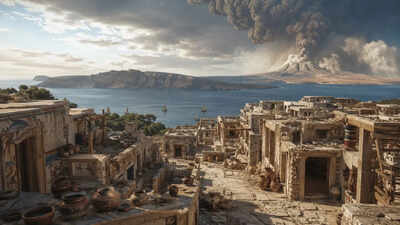
The evacuation of Akrotiri remains one of the most uncomfortable mysteries in archaeology, because it does not behave like a disaster site. On Santorini, where a massive volcanic eruption buried entire settlements in ash around 1600 B.C., researchers predicted a Bronze Age version of Pompeii, chaos freezing mid-moment, bodies left where they fell, and daily life violently halting.
Instead, they found something much quieter and more difficult to explain: empty streets, intact buildings, still-filled storage jars, and almost no trace of the people who once lived there.As reported by the Journal of World History, excavations that began in 1967 revealed a remarkably preserved urban environment, including multi-story houses, paved walkways, fresco walls, and sewer systems that still show architectural sophistication.
The orderly evacuation of Akrotiri indicates warning signs before the volcano erupts
The most striking feature of the Akrotiri evacuation is not simply the absence of bodies, but the completeness of the departure. The rooms were not ransacked after the collapse. The gold and silver items are largely missing, while heavier or less portable items remain, SpaceDaily reported. In disaster archeology, this type of selective abandonment usually indicates organized movement rather than sudden panic. Compare this with Pompeii in 79 AD, where bodies were preserved in ash bricks, and valuables were often still found in homes.
Akrotiri behaves differently. It looks deserted, not deserted mid-flight.Another layer of evidence comes from building conditions. Some homes show repaired earthquake damage, including cracked walls and partially collapsed structures that were patched before the final departure. These details are important because they point to a period of instability before the explosion itself, rather than a single catastrophic event.
How volcanic warning signs may have built over time
Santorini lies on a very active volcanic arc in the Aegean Sea, and modern volcanology is helping to reconstruct what Bronze Age inhabitants experienced. The eruption, known as the Thera Minoan eruption, did not begin suddenly. Geological studies indicate a series of past activities that likely unfolded over weeks or months. These included:
- Earthquake monsoons are strong enough to destroy buildings
- Minor volcanic emissions, including the release of ash and gas
- Ground deformation is linked to the movement of magma under the island
The eruption that reshaped the islandAccording to SpaceDaily, when the eruption finally escalated, it became one of the largest explosive volcanic events in the past 10,000 years.
Studies comparing it to the Krakatoa eruption of 1883 suggest similar or greater explosive energy.The physical transformation was extreme:
- Ash and pumice deposits reached up to 60 meters in parts of Santorini
- The island collapsed into a caldera, forming its modern crescent shape
- Lava flows destroyed everything on the surface of the island
- The tsunami waves spread across the Aegean Sea, affecting distant coasts
This was not a single explosion. It unfolded in stages, starting with a steady fall of ash and spiraling into destructive lava density streams. The initial phase is the most relevant to the evacuation of Akrotiri, because it most likely occurred after the city had already become empty.
The mystery of the missing inhabitants of Akrotiri
As the archaeologist reported, the absence of human remains is the strongest evidence of the evacuation of Akrotiri. But this is where the explanation becomes fragile. It is a common misconception that ancient societies either fully understood natural hazards or were unable to confront them. Akrotiri holds this duet. The residents may not have been aware of what was happening geologically, but they likely realized that their environment had become unsafe.Another complication is conservation bias. Could the bodies have been removed through later operations, or destroyed in ways we cannot detect? Archaeologists generally consider this unlikely at Akrotiri because the preservation conditions are so favorable. Ash burial tends to preserve organic traces rather than erase them. The contrast with Pompey reinforces this expectation.