

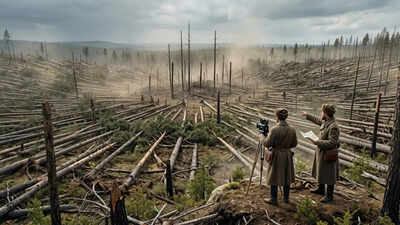
A massive explosion rocked the Tunguska region of Siberia in the early morning hours of June 30, 1908. The Tunguska explosion is the largest cosmic explosion known to mankind, and it flattened all the trees in an area of about 2,150 square kilometers due to a powerful blast wave resembling a large nuclear explosion.
Witnesses described the fireball as resembling the sun and extending across the sky with intense brilliance. Although the force of the explosion released between 3 and 50 megatons of TNT, making it about a thousand times more powerful than the atomic weapon used in Hiroshima, all of the energy released during the explosion was deposited directly into the atmosphere, at an altitude of about 5 to 10 kilometers, thus producing no visible impact crater and contributing to an enduring mystery that challenges humanity’s understanding of planet Earth and the objects that have been colliding with the planet ever since.
the Tunguska event It was 1,000 times more powerful than Hiroshima
According to the Institute for Creation Research, the destructive power of the Tunguska event is often cited as being comparable to a nuclear explosion due to its overall power. Scientific estimates indicate that the energy release ranges from 3 to 50 megatons. This is much greater than the power of the atomic bomb dropped on Hiroshima, which amounted to 15 kilotons. This enormous amount of energy created seismic waves that were recorded on seismometers across Eurasia and generated atmospheric pressure waves that were detected as far away as the UK and USA, as observed in a study on advanced physics.
Unlike the impact of solids as occurs with a surface impact, this explosion was an air explosion, meaning that the kinetic energy of the object was deposited directly into the atmosphere, and as a result, the thermal radiation from this explosion burned everything in a circular area around the site of the explosion (the epicenter) and created a circumferential (circular-shaped) pattern of damaged vegetation due to the force of the shock wave.
Mechanics of the Tunguska explosion
According to the study published in Origins, early missions to find the Tunguska crater, including one by Leonid Kulik in the 1920s, did not detect the impact crater because the object that created the crater (a stony asteroid or piece of a comet about 50 to 60 meters across) had vaporized before reaching Earth. Because the object was moving toward Earth at an estimated speed of 27 kilometers per second (about 100,000 kilometers per hour), the high pressure and friction generated by the object’s interaction with Earth’s atmosphere caused the object to explode explosively within the dense layers of Earth’s atmosphere, 5 to 10 kilometers above the Earth’s surface.Because there was no physical crater on Earth as a result of the object’s disintegration, the heat and shock waves generated by the object’s disintegration caused extensive damage to the surrounding area near the Tunguska event.
Environmental and chemical fingerprints of Tunguska
The impact of the explosion was felt far beyond the immediate vicinity of the Siberian taiga. In the days following the event, debris and aerosols filled the upper atmosphere, creating unusual “bright nights” in Europe and Asia.
Observers noted that the night sky appeared dark red with an imperceptible brightness, allowing for activities such as reading outdoors at midnight.Research indicates that these phenomena were caused by rising dust and ice crystals reflecting sunlight, an important environmental sign of a large cosmic airburst event. Further evidence of a cosmic origin comes from periodic sampling of sediments from the area, which has turned up microscopic magnetic fields containing nickel and iridium – two elements known to occur naturally only in extraterrestrial materials.