

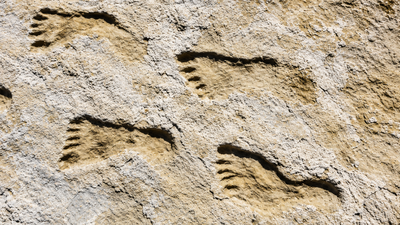
For most of the twentieth century, the story of humans’ arrival in North America was stable. They came from Siberia, crossed a land bridge called Beringia, then moved south as the ice sheets retreated and, about 13,000 years ago, gave rise to the Clovis civilization, the oldest widely accepted evidence of human presence on the continent.
It was a neat and well-defended consensus. Then, in 2019, archaeologists digging into the gypsum dunes of White Sands National Park in New Mexico unearthed something from the ground that the consensus couldn’t comprehend: a set of very ancient fossilized human footprints, pressed into the mud during the height of the last ice age, when the land bridge these same humans were supposedly still waiting to cross had not yet opened.
How did scientists date the footprints and why did they cause controversy?
The original 2021 study, published in the journal Science, dated the footprints using radiocarbon analysis of seeds of an aquatic plant called Ruppia cirrhosa found in the sedimentary layers directly above and below the tracks.
The results placed the footprints between 21,000 and 23,000 years ago within the Last Glacial Maximum, the coldest and most extreme phase of the last Ice Age, when massive ice sheets covered much of the Northern Hemisphere.The dates were immediately contested. Critics have argued that seeds of aquatic plants are unreliable radiocarbon markers because they can absorb ancient dissolved carbon from groundwater, a phenomenon known as the reservoir effect, which can make materials appear older than they actually are.
The discussion was substantive enough to raise real doubts about what would otherwise be a historical conclusion.
How white sand footprints have remained for 23,000 years
Located in the Tularosa Basin of southern New Mexico, White Sands National Park is a natural area defined today by undulating sand dunes of fine white gypsum, one of the most striking geological features in North America. Beneath those dunes lies a very different world: the dried-out bottom of an ancient lake called Lake Otero, which existed during the last ice age when the region’s climate was wetter and cooler than it is today.
And along the muddy shoreline of that disappearing lake, footprints have been preserved and preserved.The tracks were excavated by a team from Bournemouth University in collaboration with the US National Parks Service. They were found buried in multiple layers of sediment, pressed into the mud of the ancient lake floor and left there by people who walked, stood and moved along the shoreline tens of thousands of years ago. Many of the scores were made by children and teenagers, details that struck researchers as quietly extraordinary, preserved evidence of young people going about their lives in a landscape that no longer exists.
How independent studies finally settled this debate
The controversy prompted researchers to return to the site with completely different dating methods. A study published in Science in 2023, led by Jeff Bigatti of the USGS, dated pollen and quartz crystals from the same sediment layers using two separate techniques: optically stimulated luminescence and radiocarbon dating of the pollen itself. Both methods returned dates of between 20,000 and 23,000 years ago, and were statistically indistinguishable from the original seed-based results.
What do the footprints mean for the Clovis I theory?
The implications of the long-standing first Clovis model are significant and irreversible. The Clovis culture, named after a site near Clovis, New Mexico, where distinctive stone tools were found in the 1930s, has long been understood to represent the oldest known human presence in North America, dating back to about 13,000 years ago. The white sand footprints are at least 8,000 years older than we thought.Even more surprising is what the timing means geographically.
During the last Ice Age, the two main routes by which humans are believed to have migrated to the Americas, the ice-free route east of the Rocky Mountains and the coastal route along the Pacific Ocean, were either blocked by ice sheets or were not yet accessible. If humans were indeed present in New Mexico 23,000 years ago, they must have arrived before those routes closed, suggesting either a much earlier migration than any existing model suggests, or an alternative route to the continent that has not yet been identified.
What was roaming the White Sands 23,000 years ago
Footprints do not exist alone. Sediments at White Sands also showed traces of animals that shared the lakeshore with those early humans: mammoths, giant ground sloths, and ancient camels, all of which are now extinct. The picture that emerges is a functioning Ice Age ecosystem: a lake surrounded by grass and wetlands, inhabited by megafauna that were likely hunted by the humans living alongside it.“It’s very clear” that humans made the monuments, said Vance Holliday, who has worked at White Sands since 2012. It was never a question whether the footprints were human or not. It was when. After four years of scientific debate, three independent dating methods, and three separate studies, all arriving at the same answer, this question appears to have finally been settled.