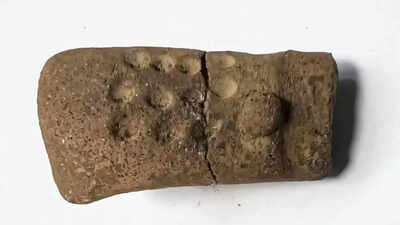
A small piece of fired clay, no larger than a hand, has begun to draw attention away from the grand stone monuments usually associated with ancient Mesoamerica. It was taken decades ago from the remains of the archaeological site of La Blanca, a place that was part of a network of ancient towns along Guatemala’s Pacific coast.
At first, the body doesn’t look like much: a broken statuette, its top flattened, and its face never formed in any realistic sense. But on this upper surface are eleven shallow impressions, each of which was pressed into the clay before it entered the fire. Quiet, deliberate markings that are not exactly ornamental. The question that remains is whether they are counting something, or simply echoing a way of thinking that has not yet settled on writing as we know it.
La Blanca statues: and the problem of losing facial identity
The study published by researchers Julia Guernsey and Stephanie M. Strauss and Michael Love in Cambridge University Press, entitled “Figures and Objects: Possible Early Foliation on a Middle Preclassic Figurine from La Blanca, Guatemala”, state that the piece belongs to a group of so-called figurines, common at La Blanca during the Middle Preclassic period. They tend to show bodies without proper faces, as if identity were expected to be added elsewhere, or perhaps not based on facial features at all. This one follows that pattern.
The “head” is more of a flat projection than a head in any normal sense.What stands out is the set of dots on that top surface. Eleven in total. It was not later scratched, nor was it painted after firing, but was pressed into the clay while still soft. The design is uneven but not sloppy: three on one side, four in the middle, and four on the other. It feels something tidy rather than casually scattered.La Blanca itself was not a marginal settlement. Between approximately 1000 and 650 BC, it served as a local center of gravity, containing household complexes, organized neighborhoods and a steady production of small ceramic figures. Many of those statues were broken before they ended up in the ground. Not every breakage appears accidental.
From Domestic Debris to History: Everyday Life in La Blanca, Guatemala
The dotted statue did not come from a temple platform or buried offering cache.
It was found in a domestic area a short walk from the basic architecture of the site, among broken pottery, obsidian flakes and remains of daily activities. Context is important because it pulls the object away from elite display and into something closer to domesticity.Thousands of fragments of statuettes have been recovered from La Blanca over the years, most from layers of waste rather than carefully arranged sediment.
Only a couple survive intact. The rest was scattered, cut down, and reburied. It suggests frequent, perhaps even routine, but not necessarily gentle use.The layer in which this piece was recovered is usually dated to around 650 BC, although the statue itself likely predates that moment slightly. This pushes it back to about 750 BC or so, a period when many Mesoamerican societies were still working out how to fix symbols, numbers, and identity into permanent forms.
The strange work of eleven signs
Eleven is not a decorative number that tends to repeat itself in older design systems. This is part of the reason why this part attracted attention. The impressions are not symmetrical, nor do they dissolve elegantly into a pattern that appears purely decorative. If someone wanted balance, they might choose ten or twelve, or a reverse spacing. Instead, there is a slightly awkward aggregate, held together by placement rather than symmetry.As reported by Arkeonews, later Mesoamerican systems, especially among the Maya and related cultures, used the point-and-bar method where single dots represented units and bars represented fives. None of this formal structure is visible here. Points only. There are no bars, and no obvious assembly device beyond the arrangement itself.However, there is a possibility that eleven was meant as eleven. Not a symbol of something else, not decorative, but a count.
The ambiguity is part of the difficulty. A dot can be a number, but it can also be a bead, a seed, a mark of emphasis, or something quite more abstract.
Numbers before writing stabilize
Throughout Mesoamerica, early counting and writing systems did not reach a clear sequence. They seem to have grown side by side, sometimes overlapping, sometimes drifting apart from each other. Long before completed inscriptions appear, there are scattered hints: grouped dots on carved objects, repeated marks on seals, drawn sequences that may or may not be digital.The oldest widely accepted calendar notation comes from a much later time, including fragments at sites such as San Bartolo that show specific days associated with a numbered system. The latest published study reveals that by then, numbers had become an integral part of ritual calendars, associated with the 13th and 20th cycles, shaping how time itself was organized.
Bodies, identity and where numbers can sit
It’s hard to ignore the placement of the dots. It is not located on the body of the statue in a random place but is concentrated where the face or headdress would normally be expected.
In later Mesoamerican art, this area of the body becomes a place where identity is declared. Names, titles, or symbols of rank or affiliation are often found near or above the head.There is also a broader thread running through Mesoamerican thought about the body as a counting device. Fingers, toes, and limb structure often inform numerical systems. In some later languages of the region, the idea of a complete person is conceptually linked to twenty, the sum of the numbers of the hands and feet.
It is impossible to confirm whether this type of thinking existed in a recognizable form early, but the logic of body-based counting was clearly available.
Fragments, breaks, and incomplete meanings
La Blanca statues rarely remain intact. Most are found in pieces, and the breakage pattern is consistent enough to feel intentional in some cases. Whether that means ritual destruction, daily elimination, or anything in between is still open to interpretation.