More than a year after a government-appointed reform panel made a “strong case” for moving NEET-UG to computer-based testing — calling it a “sure way forward” against paper leaks — the shift remains stalled, stuck between NTA infrastructure constraints and a health ministry requirement that has proven impossible to meet for a test administered to 2.3 million applicants: that any online test must be taken in a single shift.

The Radhakrishnan Committee, which was formed after the NEET-UG 2024 controversy, had recommended in its October 2024 report that the examination should be shifted from pen and paper to digital mode. “In an age of advanced technology, it is difficult to justify continuing pen-and-paper testing indefinitely. Printing, transportation and physical distribution create multiple leakage points,” said one panelist, who requested anonymity. “Computer-based testing (CBT) allows algorithm-based delivery with minimal manual processing and can therefore serve as a means of preventing paper leakage.”
The recommendation didn’t go anywhere.
NTA Director General Abhishek Singh said the agency was ready to act – but only on instructions. “We will conduct the test in CBT mode if the health department gives us in writing that they want us to conduct the test in CBT mode. It will take about 20 shifts to administer about 2.2 million NEET candidates, and we will have to follow the normalization process to ensure fairness to all students,” he said.
The infrastructure numbers explain why. “About 150,000 students sit CBT exams in a shift conducted by NTA. We conducted Session 1 of JEE Main 2026 in nine shifts for over 1.3 million students and Session 2 in 10 shifts for over 1 million students. NTA scores are normalized across multiple shifts based on relative performance within each shift,” said an NTA official, requesting anonymity.
Twenty shifts for 2.3 million NEET candidates will be more than double what JEE Main requires in both sessions combined.
Meanwhile, the Ministry of Health has taken a position that it communicated to the NTA nearly three years ago: online tests are only acceptable in one shift. “When this was brought before the Health Ministry nearly three years ago, it was already communicated that if NTA can conduct online examinations in CBT mode in one shift, then it should do so. We do not want problems arising later from complaints that one set of questions was different from the other or that the previous paper was easier. To rule out issues related to normalization, the Health Ministry proposed to conduct the examination in one shift,” a senior official said.
The same official acknowledged the size while refusing to change his position: “This year, about 23,000 students appeared for the exam, which is a huge number. But India is capable of progressing to that stage.”
The National Medical Commission Act, 2019 mandates a “common” NEET on an all-India basis; NMC guidelines require it to be ‘uniform’. Neither provision explicitly requires a single change, but experts say the multiple transitions formula could face a legal challenge if candidates argue that normalization harms unification. An Education Ministry official said the decision rests with the Health Ministry, as NTA conducts NEET under NMC regulations. “NTA will conduct the test in the manner requested,” the official said.
The Supreme Court has already considered the single shift issue in a relevant context. On May 30 last year, it had directed the National Board of Examinations to scrap the two-period NEET-PG 2025 plans and require the examination to be conducted in one period to prevent “arbitrariness” arising from different difficulty levels.
Normalization—that is, adjusting scores to compensate for difficulty differences across transitions based on relative performance within each session—is at the heart of the quandary. NTA uses it for JEE Main, but for NEET, where a single mark can decide whether a candidate secures a government or private seat, tolerance for perceived unfairness is close to zero.
The Radhakrishnan Committee proposed a route through: a national network of 400 to 500 standardized examination centers within a year, capable of accommodating 200,000 to 250,000 candidates at each session and eventually expanding to every district headquarters. The construction will gradually reduce the transformations required and bring individual transformation ambition within reach. That plan didn’t move either.
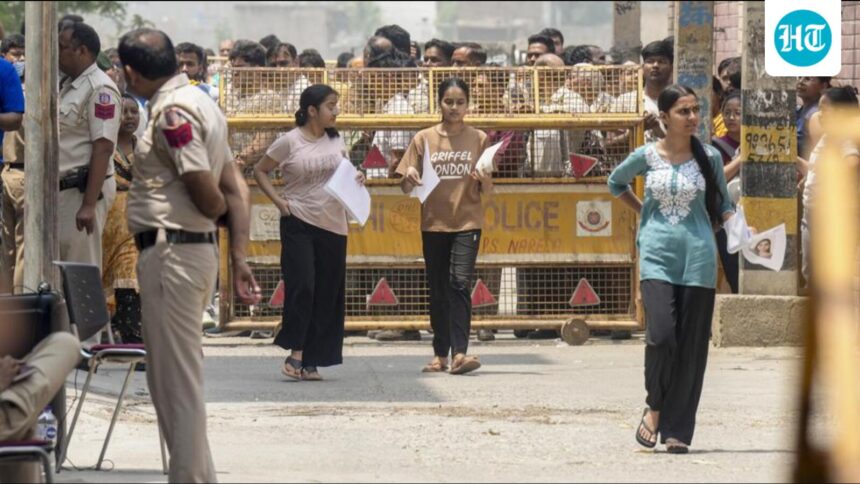
For students who have now sat two hybrid NEET courses, the discussion seems abstract. Anshita Tanwar, who attended the exam in Indore, said technology was not the problem. “Online tests may reduce the chances of dropout, but we are still not entirely sure that it will prevent paper dropout given the NTA’s track record in handling the NEET exam.”
Keshav Agarwal, president of the Delhi Education Union, was less tolerant of the delay. “Online testing eliminates physical paper entirely, making printing press leaks and transportation chain theft structurally impossible. Resistance to going fully online—despite available and proven technology—suggests institutional inertia or vested interests in keeping the physical paper supply chain alive.”