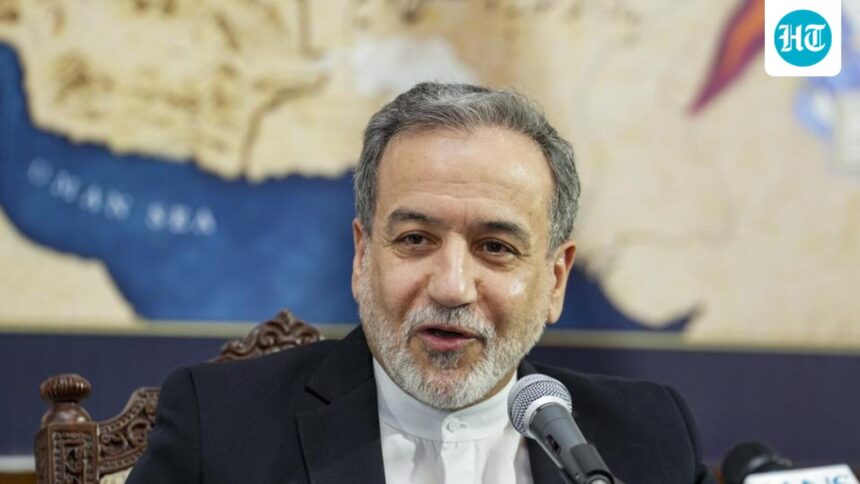
Iranian Foreign Minister Sayyed Abbas Araqchi said on Friday that India could play a “greater role” in diplomacy aimed at ensuring peace and security in West Asia, as it enjoys friendly relations with almost all countries in the region, against the backdrop of the stalemate in negotiations between Iran and the United States.

Araqchi met National Security Advisor Ajit Doval on Thursday and held talks with his Indian counterpart S Jaishankar on Friday on the sidelines of the BRICS foreign ministers’ meeting, which concluded without consensus on a joint statement due to differences between Iran and the UAE over the conflict in West Asia.
The Indian side called for dialogue and diplomacy to end the conflict that affected energy and fertilizer supplies due to Iran’s closure of the Strait of Hormuz, while staying away from any direct role in mediation between the parties to the conflict. New Delhi also had to strike a delicate balance between key West Asian countries such as the United Arab Emirates, with which it has vital energy partnerships, and its long-standing ties with Iran.
“I believe that India, with its good reputation, can play a greater role in this region to assist diplomacy, support peace, and promote peace and security,” Araqchi said in a press conference at the Iranian embassy.
“India is a friend of almost all the Arab Gulf countries, in the north of this Gulf and in the southern part of it. So we appreciate any positive and constructive role that India plays in this region,” he said while responding to a question about the role India can play in helping to end the conflict that began on February 28 with the military strikes launched by Israel and the United States on Iran.
Araqchi asserted that a BRICS member state with “special relations with Israel” — an apparent reference to the United Arab Emirates — had hampered consensus within the bloc, but said it was up to India to decide on its relations with other countries, including the UAE. He said, “What matters to us are the good relations between us and India, which are rooted in history… We have always had them, and we are determined to continue our good relations with India.”
Acknowledging that the Strait of Hormuz had figured in his discussions with Jaishankar, he said the situation in the vital waterway – used to transport nearly 50% of India’s oil imports – was “very complex” and that Iran was trying to help commercial ships transit the strait safely. “Everything will return to normal once the act of aggression is completely and completely over,” he said, adding that only ships of countries participating in the war or those helping Israel and the United States would be allowed to use the waterway.
Araqchi also clarified that only Iran and Oman will decide on the management of the Strait of Hormuz within the framework of any future arrangements regarding the waterway. He said: “Iran and Oman are coastal countries on both sides of the Strait of Hormuz. The Strait is located in the territorial waters of Iran and Oman, and there are no international waters between them. Everything must be managed by Iran and Oman.”
He pointed out that the situation in the waterway will not return to normal until the United States ends its “aggression” and lifts the naval blockade of Iranian ports. He said: “We have a blockade from the United States, and we have insecurity in the region due to American aggression… Once the aggression ends, I am sure that everything will return to normal and we can make the necessary arrangements for the safe passage of all ships through the Strait of Hormuz with Oman.”
In response to a question about a possible arrangement between Iran and India regarding ensuring the movement of energy supplies through the Strait of Hormuz, Araqchi noted that India had stopped buying Iranian crude due to “illegal and unilateral US sanctions,” and said that Tehran was still ready to resume energy supplies to New Delhi. “We are clearly interested in continuing our oil and energy business, and we are willing to sell our oil to India,” he said. “We understand their considerations and we understand the consequences of the sanctions imposed by the United States.”
“We don’t have a problem, it’s up to the Indian government to decide, but I think once the sanctions are lifted, we will immediately go back to the same volume of trade that we had with each other. Before those sanctions, we had more than $20 billion of trade with India. Now the trade volume is much smaller but still in the billions of dollars,” he said.
With the United States ending the sanctions waiver that allowed India’s participation in the development of the strategic Chabahar port, Araqchi said he hoped New Delhi would continue its work at the facility, which he described as the “golden gateway” for trade with countries in Central Asia and the Caucasus region. The Indian side has effectively ended the operations of a state-run company at Chabahar Port’s Shahid Beheshti Terminal to reduce exposure to US sanctions.
“Chabahar Port is one of the symbols of cooperation between Iran and India, and we are very happy that Indians have played an important role in the development of this port. It has now slowed down somewhat due to US sanctions, but I am confident that this port will serve as a golden gateway for India to reach Central Asia, the Caucasus and then Europe,” he said.
“It is a very strategic and important port for us, India and many other countries. Therefore, I hope that the Indians will continue their work in Chabahar Port until it is fully developed.” [to serve the] The interests of India and other countries.”
Amid the stalemate in negotiations between the United States and Iran, which have exchanged several proposals on ending the conflict in recent days without reaching common ground, Araqchi said that Iran is ready for a diplomatic solution or the resumption of hostilities. After nearly 40 days of fighting, the two sides agreed to a ceasefire early last month.
He said: “As a diplomat, I am optimistic that a diplomatic solution can prevail, but we should not ignore the possibility of a return to full-scale war. We, as the Islamic Republic of Iran, are prepared for both scenarios. We are ready to return to fighting… and we are also prepared for diplomacy and a diplomatic solution.”