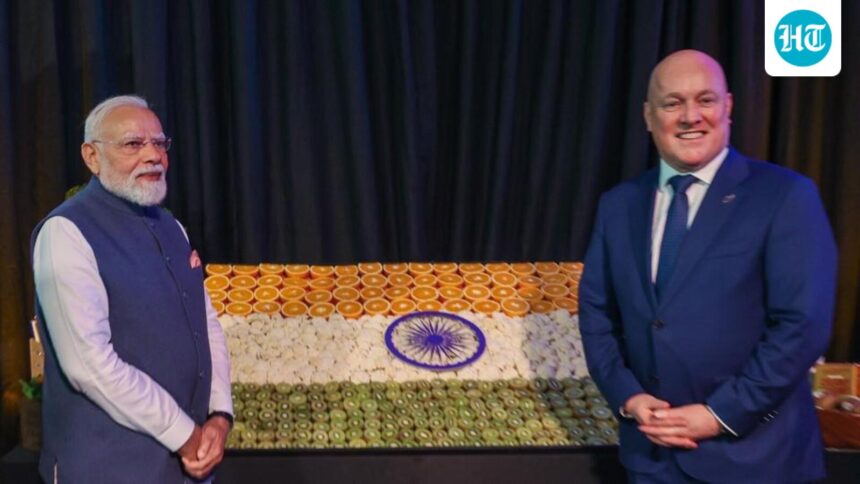
India and New Zealand on Saturday upgraded their ties to a strategic partnership and set a goal of increasing trade in goods and services $35,000 crore (US$4 billion) by 2030 as Prime Minister Narendra Modi and his counterpart Christopher Luxon pledged to deepen cooperation on trade and security and strengthen the rules-based Indo-Pacific region.

New Zealand was the final destination of Modi’s three-nation tour, which also included Indonesia and Australia and focused on forging closer economic and strategic ties with key players in the Indo-Pacific region amid continued volatility and uncertainty on the global stage. Modi was the first Indian Prime Minister to visit New Zealand in four decades.
The two sides concluded dozens of agreements, including measures to enhance maritime cooperation in the Indo-Pacific region, arrange mutual logistical support for warships to access support at each other’s bases, establish a joint counter-terrorism working group, and a joint action plan on sports. They also finalized a roadmap to strengthen relations in various sectors until 2030.
“We have taken the historic decision to elevate India-New Zealand relations to a strategic partnership… We will move forward with clear goals and tangible results in all areas,” Modi said at an event titled “India-New Zealand: A Win-Win Partnership,” which Luxon also attended.
Close cooperation between the two maritime nations will give the Indo-Pacific region new strength, and both sides can act as catalysts for peace, Modi said.
Read also:India expresses concerns over targeting of commercial ships, leading to escalation of tensions between Iran and the United States
Describing the strategic partnership as “an important step forward in an increasingly volatile and uncertain world,” Luxon said it provides a stronger platform for practical cooperation and will enable closer cooperation in the areas of defence, maritime security and law enforcement.
India and New Zealand have a shared interest in a free, open, peaceful and prosperous Indo-Pacific region, and will enhance maritime cooperation, including through a new maritime cooperation arrangement between the Indian Ministry of Defense and the New Zealand Defense Forces and a mutual logistics support arrangement, according to a joint statement. They also agreed to establish an annual dialogue on maritime security to enhance coordination and exchange of information.
Modi and Luxon reaffirmed their commitment to respecting sovereignty and territorial integrity and supporting the rules-based order in the Indo-Pacific region, the joint statement said.
They also reaffirmed their support for freedom of navigation and overflight in line with the 1982 UN Convention on the Law of the Sea and stressed the importance of working together for security and prosperity in the Indo-Pacific region.
Modi’s visit came less than three months after the signing of the free trade agreement with New Zealand, and the two sides set the goal of doubling annual trade in goods and services to New Zealand. $35,000 crore (NZ$7 billion or US$4 billion) by 2030. Bilateral trade will reach US$2 billion in 2024, with Indian exports of goods and services reaching US$1 billion.
“Our trade has grown by more than 50% over the past three years. We are confident that the FTA will provide a strong foundation to double our trade over the next five years. We also welcome New Zealand’s commitment to invest US$20 billion in India. This will provide New Zealand businesses the opportunity to become a long-term partner in India’s growth story,” Modi said.
Luxon and Modi also agreed to work together to ensure the FTA enters into force early. Rudhirendra Tandon, Secretary (East), Ministry of External Affairs, told a press conference that the New Zealand Parliament had completed the first of three readings of the FTA as part of the ratification process. Luxon was quoted as telling Modi that there was bipartisan support for the trade agreement in New Zealand and he did not expect any problem with its ratification.
Luxon described India as an Indo-Pacific partner known for its scale, innovation, ambition and strategic influence, while New Zealand is reliable, globally connected and offers expertise in food production, education and technology. Modi said the FTA will open new doors for industries, farmers and youth and will set a blueprint for trade, confidence, technology and talent.
The joint statement said that Modi and Luxon expressed their concern about the renewed escalation of tensions in the Middle East, and called on all parties to exercise restraint, calm tensions, and ensure the protection of civilians. They called for the full restoration of freedom of navigation and the flow of global trade through the Strait of Hormuz, and opposed “any restrictions on shipping.” They also reiterated the importance of dialogue and diplomacy to achieve a peaceful and lasting solution.
They also discussed the situation in Ukraine and expressed concern about the ongoing war, which continues to “cause enormous human suffering and global consequences.” The joint statement stated that they would support efforts to achieve a comprehensive, just and lasting peace through dialogue and diplomacy, based on the principles of the United Nations Charter and international law.
Modi and Luxon also reiterated their condemnation of all forms of terrorism, including cross-border terrorism, condemned the terror attack in Pahalgam in April 2025 and the terrorist incident near the Red Fort in November 2025, and called for those responsible to be held accountable. They expressed their support for a zero-tolerance and consistent approach to terrorism, and called for the disruption of terrorist financing networks and safe havens and the dismantling of terrorist infrastructure. They also agreed to enhance cooperation in combating terrorism and welcomed the signing of an agreement on establishing a joint working group to combat terrorism that would facilitate the exchange of information and knowledge.
The two leaders discussed the importance of transparent and resilient supply chains, expressed deep concern about unrest across the Indo-Pacific region, and noted that stabilizing global supply routes is essential for the region, the joint statement said.
Other agreements concluded by the two sides include an implementation arrangement on cooperation in the field of hydrography and marine charting, which will enhance cooperation in joint production of nautical charts and exchange of hydrographic data, a memorandum of cooperation between the National Disaster Management Authority of India and the National Emergency Management Agency of New Zealand to cooperate in disaster risk management, earthquake resilience, tsunami preparedness and coastal risk mitigation, and a memorandum of arrangement in the field of tourism that will help strengthen economic relations and increase tourism. Flowing.
The National Center for Polar and Ocean Research in Goa and the University of Canterbury in New Zealand signed a memorandum of understanding to cooperate in Antarctic research and other scientific and educational activities, while another MoU between the National Institute of Food Technology, Entrepreneurship and Management in Kondli and Massey University in New Zealand will enhance cooperation in research, academic exchanges and student mobility.
New Zealand has announced that it will join the Global Biofuels Alliance, and has designated maritime security as a priority pillar under the India-led Indo-Pacific Initiative (IPOI) for cooperation activities focused on combating illegal, unreported and unregulated fishing.