The Writers Guild of America West and its striking employees have reached an agreement that could put an end to a nearly three-month work stoppage.
The Writers Guild has reached a preliminary contract agreement with its unionized employees, the Writers Guild Employees Union (WGSU) announced on The WGA West later confirmed Friday. Its negotiating committee said in a statement that the union would hold a ratification vote “in the coming days.”
The statement continued: “The bargaining committee enthusiastically recommends that our members vote yes.” “Once ratified, the WGSU strike will end and Writers Guild employees will return to doing what we do best: defending writers’ hard-earned gains and helping them build collective power.”
In a short statement, WGA West said it was “pleased to reach a tentative agreement.”
The two sides were able to agree on what were once major sticking points: seniority provisions and the no-strike clause.
Without providing further details, the staff union stated that the seniority provisions in the interim agreement “prioritizes the institutional knowledge and dedication of Writers Guild members” while the no-strike clause “protects coordinated activity.”
The tentative agreement also provides union members with a minimum 12 percent pay increase over the three-year period, including an 8 percent raise for the entire bargaining unit in 2026. The agreement raises the group’s minimum salaries from $43,000 to $57,000 annually retroactive to August 2025 and offers “longevity increases” in pay for employees who have worked in the union for five, 10 or 15 years.
The deal establishes a pay scale similar to that provided to employees at WGA East, enshrines just cause provisions and grievance procedures, provides artificial intelligence and protection for temporary employees and contractors and creates a labor management committee to “establish healthy on-site communication between employees and union leadership.”
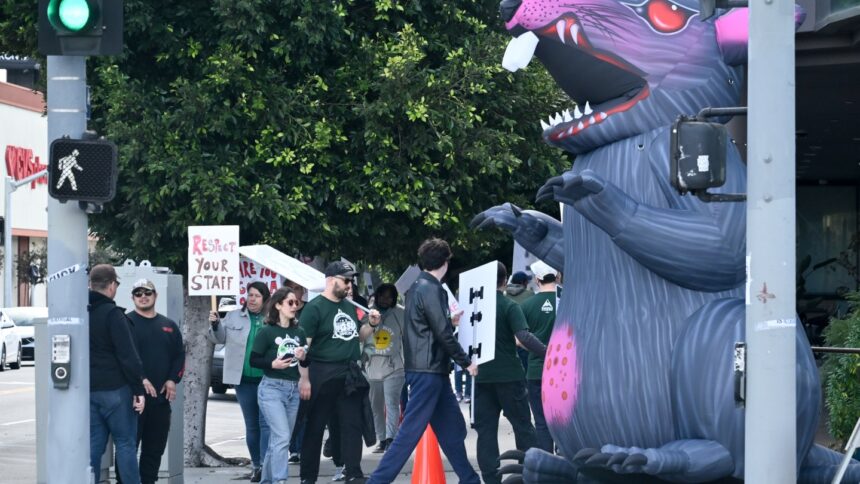
The deal could bring an end to a surprising period for WGA West that has seen the picket line become a fixture outside their headquarters at Fairfax Avenue and Third Street. The inflatable “Scabby” rat, a symbol of labor disputes that sometimes refers to alleged union-busting activity, has also appeared for some time. The Writers Guild Employees Union has accused WGA West of wrongdoing including surveilling and terminating the employment of a union organizer and supporters and bargaining their contracts in bad faith — allegations that are sensational in any circumstance, but especially so when the employer is an advocate for the workers itself.
At times, the conflict between the two labor organizations became ugly. In late April, the WGA West accused some WGSU picketers of shouting abuse and physical intimidation, calling some of their actions “unlawful,” a claim the WGSU denied. Video leaked to diverse In late March it showed a WGA negotiating team trying to enter a film and television bargaining building while WGSU protesters shouted “Shame!” and “Do not cross the picket line!”
Aside from the bad looks, the work stoppage also brought to a halt several major events for the union and its members. Even more excitingly, the federation has canceled its glitzy annual awards ceremony, and plans to hold an “alternative celebration” for the winners at a later date. Ironically, would-be host of the event Atsuko Okatsuka later chaired a fundraiser for striking employees.
After vacating its offices, WGA West canceled events including planned meetings for members to prepare them for contract negotiations with studios and broadcasters.
Some WGA West members loudly expressed their dissatisfaction with the strike, and questioned the union’s strategy. Abbott Elementary Writer Brittany Nichols issued a statement calling the strike “embarrassing” and saying the action “degrades the goodwill we have earned during our strike.” Cast member Seth Rogen joked about the episode at the Actors’ Awards.
Union employees, no strangers to running picket lines, organized performances that were sometimes theatrical, with sage being burned one day on the sidewalk and a sound bath artist visiting another.
WGA West general counsel Sean Graham led the union’s negotiations while Brandon Tippe, president of WGSU’s parent organization, the Pacific Northwest Employees Union, chaired the employees’ side of the bargaining.