Ryusuke Hamaguchi has often demonstrated a fascination with the exchange of ideas as a form of process, negotiation and exploration, whether it be in theater workshops in… Driving my car Or turbulent city meetings with its developers Evil does not exist. Conversation is action. Staff meetings and training sessions make up a large part of the Japanese author’s work suddenly (Sudan), set primarily in a Paris nursing facility run by a woman whose progressive treatment style is at odds with the reality of chronic understaffing and a management dependent on the bottom line.
The fundamental question the film asks is whether individual care and compassion can survive the demographic decline of late-stage capitalism. As wealth concentration accelerates, for-profit sectors pay less, inevitably leading to lower birth rates and labor shortages in health care services needed to deal with aging populations.
suddenly
Bottom line A work that deeply affects humanity.
place: Cannes Film Festival (Competition)
He slanders: Virginie Efira, Tao Okamato, Kyozo Nagatsuka, Kodai Kurosaki, Jean-Charles Cliché, Marie Bonnell, Romain Cottard
exit: Ryusuke Hamaguchi
Screenwriters: Ryosuke Hamaguchi, Leah Demna, freely inspired by the book, When life suddenly takes a turn, By Makiko Miyano, Maho Isono
3 hours and 16 minutes
If this sounds a bit dry, it is, especially when presented as an informal conversation between friends, complete with charts, graphs, and bullet points on a whiteboard. But Hamaguchi has his own approach to the documentary style, and for audiences with the patience to get through the laid-back, very modern first hour, suddenly It develops into a poignant affirmation of the basic human rights of respect and dignity. Whether or not that justifies the three-and-a-quarter hour running time will be up for debate. But either way, the reward is worth it.
Dementia films have proliferated in recent years, but this feels different in their gentle observation of cognitively impaired elderly patients and their responses to the tireless efforts of two women determined to bring comfort and even joy to these seniors’ twilight years. Anyone with experience of parents or relatives suffering from similar illnesses will be deeply affected by the film’s developments.
Marie Lou Fontaine (Virginie Efira) is the director of the Liberty Garden, a franchise of nursing homes in the suburbs of Paris. She is given an extraordinary amount of freedom to run the facility according to the principles of a compassion-based system called “Humanism.” But many of the staff resent this freedom, especially the outspoken senior nurse Sophie (Mary Bonnell), whose work there dates back to when it was a psychiatric hospital.
Sophie and others assert that the amount of time and individual attention required to do daily patient rounds according to Mary Lou’s guidelines is unrealistic, meaning that morning-shift staff will pass on unfinished work to their already overburdened colleagues in the afternoon — not to mention the mandatory three-times-a-year training seminars that deplete the ranks of on-calls. They also argue that the importance given to ‘upright posture’, and convincing patients to walk every day, only increases the risk of falling.
To the text’s credit, the naysayers are not just stubborn opponents of change; Instead, they are practical professionals who recognize the limited resources available to them and are wary of what they see as an overhaul of the treatment program.
It is noteworthy that while Humanitude encourages caregivers to wear their casual clothes and interact on a personal level with each patient, Sophie and other opponents insist that nurses adhere to the uniform and do their work with the high efficiency that was inherent in their professional training.
While thinking about her battles on the streetcar, Mary Lou sees a boy running on the side of the road, seemingly out of control. She goes downstairs to make sure he’s okay and follows him to the park where she waits with him for a sudden heavy rain. When the nonverbal boy’s guardians track him down via a GPS app on their phones, she learns that his name is Tomoki (Kodai Kurosaki), and that his autism makes him prone to unpredictable behavior.
The grateful strangers are Mari (Tao Okamoto), an experimental theater director, and Goro (Kyozo Nagatsuka), Tomoki’s father and the actor in Mari’s solo performance piece.
At their invitation, Mary Lou goes to see the production, a hospital-based reflection on the dismantling of asylums, offering a different perspective on the treatment of mental illness. Audience members are given percussion instruments to interact with, and in most performances Tomoki becomes part of the show. “The impossible is impossible, but only until it becomes possible,” says Gouraud, offering a capsule version of the film’s message of hope and perseverance.
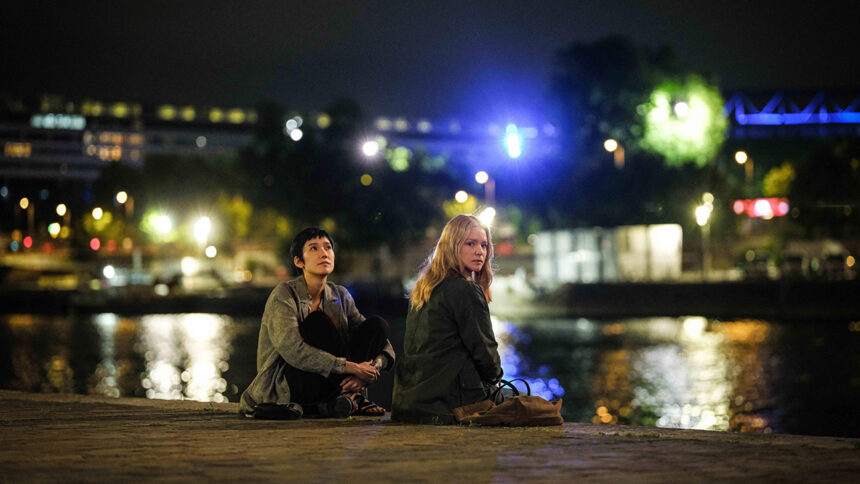
After learning about some of the play’s themes from her own work, Mary Lou stays behind to chat with Mary and the two women spend a long night together walking and talking, and their friendship instantly blossoms. Marie Lou is fluent in Japanese, having obtained her degree in anthropology in Tokyo, while Marie is equally fluent in French, and studies philosophy at the Sorbonne University.
Their backgrounds mirror those of Makiko Miyano and Maho Isono, authors whose collected treatises on illness and sudden changes in health were published in a nonfiction book that loosely inspired the screenplay by Hamaguchi and Lea Le DeMna.
Mary Lou shares her frustration with the tensions at work, while Mary reveals with a realistic absence of self-pity that she has terminal cancer and that her condition could worsen dramatically at any time. Mary begins spending time at the nursing home, where Mary Lou encourages her to engage the staff and patients in simple trust exercises. The bond between the two women becomes almost spiritual, and the caregivers seem to absorb their positivity by osmosis.
Only a director as elegant as Hamaguchi could piece together a testament to the solace of female friendship, a carefully detailed study of the workplace, and a consideration of compassion as a form of resistance and emotional contemplation of mortality.
As always with Hamaguchi, the film is full of shining moments of human connection, whether it’s Mary Lou’s simple joy of waking up from a nap in the sun under a tree in the park, sharing a cigarette with feisty patient Mirai (Evelyn Estrea), or Mary Lou’s detente with Sophie, whose respect among the nurses and other aides means that if she leaves, the others will follow.
Efira has gone from strength to strength in the years since the Belgian actress – her work in the film Rebecca Zlotowski Other people’s children Particularly noticeable – and her natural tenderness shines through here, even when moments of friction cause her to display a fragile side or a tendency towards exhaustion.
She pairs well with model-turned-actress Okamoto (seen extensively in… Wolverine And in parentheses on Western world and Hannibal), whose calm features belie her round-the-clock awareness of her own mortality. Mary Lou accompanies her to Kyoto, where Mary plans to stay in a nursing home. (The scene in which they sit on a mountainside overlooking a sprawling view of the city below while eating pasta is beautiful.)
But Marie-Lou convinces her to return to Paris and take a position as artist-in-residence at the care home, giving a sense of purpose to whatever time she has left, even if her strength is exhausted. Perhaps Mary Lou’s warmest moment of satisfaction was when a colleague told her that Mary’s workshops seemed to be of greater benefit to the staff than the patients.
suddenly It is a strange film, but it is bold in the way it favors subject matter over drama. Those who are not attuned to Hamaguchi’s wavelength may find it stretched and dry. But if you can join this leisurely pace, you’ll find transcendent beauty in her view that all lives have value, no matter how insignificant. As Mary Lou puts it: “An inactive hand is not a dead hand…there is life even when there is no life.”