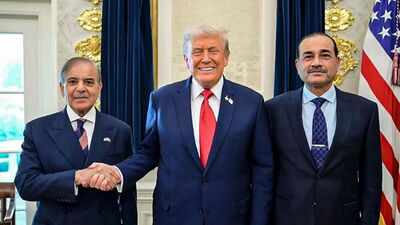
Archive photo: US President Donald Trump with Pakistani Prime Minister Shehbaz Sharif and Field Marshal Asim Munir
Pakistan has quietly reached out to the Trump administration for a $10 billion “exchange stabilization facility,” a financial lifeline that would support its fragile economy even as it seeks to capitalize on its renewed diplomatic importance in the Middle East.The request, which was first reported by Reuters, was submitted directly to US Treasury Secretary Scott Besent and provides for a five-year facility aimed at boosting Pakistan’s foreign exchange reserves and easing pressure on the rupee. American sources say that the proposal is under study and no decision has been taken regarding it.
If this arrangement is approved, it will be unusual, because since 2002 the US Treasury Department has expanded similar exchange rate stabilization facilities to include only two countries – Argentina recently, and Uruguay in the past – making Pakistan’s request exceptional in terms of its size and strategic importance.The timing reflects Pakistan’s attempt to convert the recent diplomatic role into economic gains after it played the role of mediator in facilitating communications between Washington and Tehran, which sparked ridicule in Indian circles about collecting mediation fees or “hafta” (extortion).For Pakistan, the economic risks are high given that the country narrowly avoided a sovereign debt default in 2023 after receiving an IMF bailout and emergency aid from friendly governments.
Although the country’s macroeconomic indicators have improved modestly, foreign exchange reserves remain at risk, external debt repayments are large, and the economy remains highly dependent on frequent fiscal injections from the usual suspects – the International Monetary Fund, China, Saudi Arabia, and the United Arab Emirates.Such frequent dependence has long shaped Pakistan’s economic reputation as a beggarly state.
Since the 1950s, successive governments have relied on foreign aid, multilateral lenders, and bilateral bailouts to plug chronic fiscal and balance of payments deficits.Economists have often described the country as a country that is living on its hands – meeting immediate financing needs through successive bailouts while struggling to implement structural reforms that would reduce dependence on foreign aid.For the Trump administration, any decision will involve strategic and financial calculations, although $10 billion represents chump change in the grand scheme of things. The stabilization facility could strengthen ties with a nuclear-armed state that many Indians view as a “useful idiot.”It could also provide Washington with greater leverage at a time when China has emerged as Pakistan’s key strategic and economic partner through the China-Pakistan Economic Corridor.However, critics in Washington are likely to question the wisdom of providing such support to a country that has repeatedly needed international bailouts despite decades of foreign aid.Some lawmakers may also argue that scarce US financial resources should be directed toward domestic priorities rather than another bailout package for Islamabad, with remaining suspicions and memories of the country harboring and hosting al-Qaeda terrorists.There is also the personal financial angle given the close ties Pakistan has built with American “crypto bros,” including Trump’s family and friends.