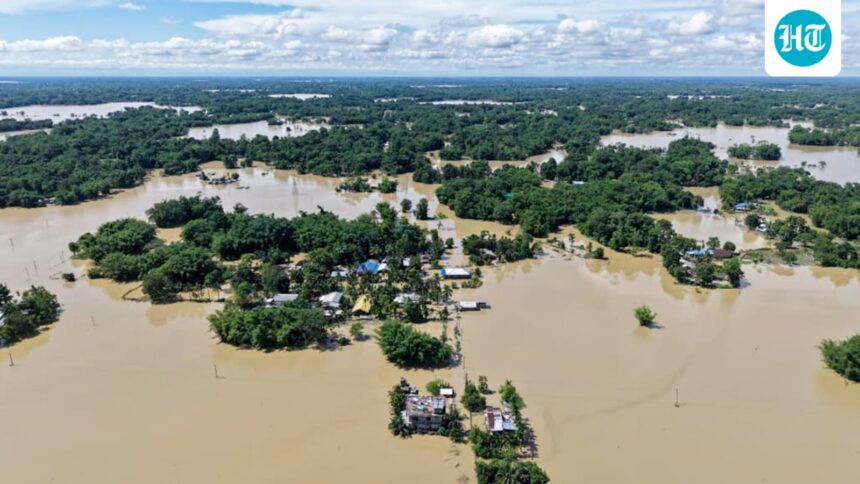
The flood situation in Assam worsened with the government confirming 41 deaths on Wednesday, with the Indian Air Force and Army helping state authorities in rescue work even as more than 727,000 people remained affected in 25 districts of the northeastern state.
According to the Assam State Disaster Management Authority (ASDMA), 10 deaths were reported on Wednesday, taking the death toll in the state to 41.
Prime Minister Himanta Biswa Sarma said on Wednesday that more than 100 people were missing and that the death toll could rise over the next three to four days.
Officials said that more than 727,000 people in 25 districts were affected by the floods.
Read also | Why Assam floods: The obvious answer is the Brahmaputra, but there is much more to it than that
Sarma visited the flood-affected areas, including Charaideo and Sivasagar, and said the main cause of this year’s floods was the heavy inflow of water from the neighboring state of Nagaland.
“We have never witnessed this kind of flood and according to our assessment, heavy inflow of water from Nagaland is the main reason. We will evaluate what went wrong in the neighboring state and take appropriate steps in the future,” he added.
The state government has set up 469 relief camps where 18,000 people have taken shelter in 25 flood-hit areas, officials said.
The Indian Army, National Disaster Response Force (NDRF), State Disaster Response Force (SDRF), Assam Rifles and fire and emergency services have been deployed to carry out a massive rescue and relief operation across the affected areas, officials said.
The army said that as part of Operation Jal Rahat, it rescued more than 700 stranded people. She said that based on requests from the civil administration, four specialized flood relief columns of the Red Shield Division of the Spear Corps were deployed in the flood-affected areas of Sivasagar, Charadeo and Jorhat.
State authorities said Israeli Air Force helicopters are being used in rescue operations while drone surveillance operations are being carried out to assess the flood situation and identify areas that need immediate assistance.
“This morning, the Indian Air Force carried out three sorties, airdropping 627 kg of relief supplies to stranded families in Nazira. Our teams remain on the ground, reaching every family with essential relief,” Prime Minister Sarma said in his remarks on Channel X.
The National Disaster Response Force (NDRF) said it rescued a large number of elderly people stranded due to the floods and moved them to safer areas.
Many roads remain submerged, railway services in the Simaluguri area have been disrupted, and rescue teams rely on boats to reach the affected villages. According to the North East Frontier Railway (NFR), more than 30 trains were rescheduled or canceled after tracks were damaged in various parts, including Mariani.
The Indian Meteorological Department predicted more rain in parts of upper Assam, and state government authorities said they were further enhancing rescue and relief operations with the support of central and state forces.
Several parts of Assam have witnessed heavy rainfall over the past three-four days. Between July 18 and 20, Sonari in Charadeo district recorded 197.5 mm of rainfall, while several districts in Upper Assam and Guwahati also received very heavy rainfall.
According to the Central Water Commission, the Brahmaputra, Burhidhing, Dikau, Desang and Dhansiri rivers are flowing above the danger level, while the Barak, Kopili and Kushiara rivers are also rising.