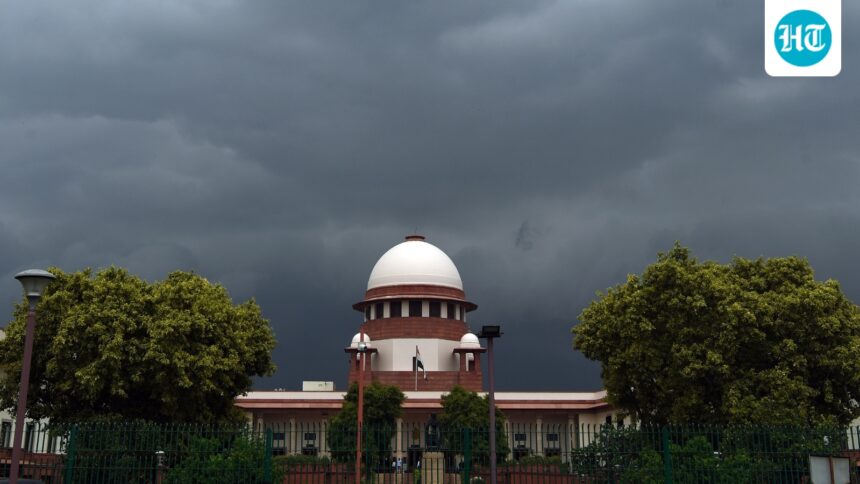
Emphasizing that the constitutional guarantee of a fair trial is “absolutely non-negotiable” even in trials involving terrorism and mass casualties, the Supreme Court on Tuesday annulled Abdul Hamid’s conviction and death sentence in the 1996 Samleti bus bombing case, holding that a conviction carrying the death penalty cannot rely on proceedings in which the accused is effectively left to fend for himself without legal representation.

Explosion details
14 people were killed and 37 others injured in the explosion on a bus on the Jaipur-Agra Expressway on May 22, 1996. The blast came a day after the Lajpat Nagar bomb blast in Delhi, which killed 13 people. The Supreme Court ruling leaves the case without any convicted defendant for the time being, with Hameed facing a new trial while all other defendants are acquitted.
‘Apology to students’: Rahul Gandhi after police brutality during RJD protest, seeks Amit Shah’s resignation
Governance formation
In a 183-page ruling, a bench of Justices Vikram Nath, Sanjay Karol and Sandeep Mehta held that Hameed, who spent nearly three decades behind bars and was on death row for nearly 12 years, was deprived of his fundamental right to a fair trial because he did not have meaningful assistance of law when the prosecution cross-examined his witnesses.
The constitutional guarantee of a fair trial
“The constitutional guarantee of a fair trial is absolutely non-negotiable and cannot be sacrificed on the altar of practical convenience. The administration of criminal justice is based not only on the goal of ensuring conviction, but also on ensuring that every conviction is preceded by a just, fair and reasonable procedure.”
Heavy rains have caused massive flash floods in Johnson & Johnson’s Budgam, and rescue operation is underway
Retrial order
Balancing the rights of the accused with the interest of society in prosecuting serious crimes, the court rejected both options of upholding the conviction despite the flawed trial and completely acquitting Hamid due to the procedural flaw. Instead, it ordered a new trial, arguing that this alone would cure the constitutional deficit while allowing the prosecution to prove its case through a process consistent with the law.
Directions for retrial
The court asked the acting chief justice of the Rajasthan High Court to transfer the retrial to a special court in Jaipur headed by a judicial officer with at least seven years of experience in conducting court hearings, and directed that the proceedings be completed within one year. It further ordered that Hameed be represented either by a lawyer of his choice, or, if he is unable to engage one, by two experienced defense lawyers appointed through the Rajasthan State Legal Services Authority. All prosecution witnesses must be called so that Hamid has a “full and effective opportunity” to cross-examine them.
0% for two years, 100% for one year, 200% after that: Latest US tariff move on generic drugs
Clarification about the decision
The court explained that its decision was limited to procedural fairness and should not be interpreted as expressing any opinion on the merits of the prosecution’s case.
Legitimacy of the trial
“The issue is not merely procedural irregularities, but one of the legality of the trial and the resulting conviction,” the court noted, adding that the denial of effective legal aid raises “serious doubt” as to whether the proceedings meet the minimum constitutional requirements under Articles 21 and 22.
Supreme Court session
The ruling followed an unusual practice carried out by the Supreme Court during the hearing. After Hameed claimed through counsel that he remained unrepresented throughout the trial, the bench directed him to be produced through video conference from Jaipur Central Jail. During the interaction in March 2025, Hameed categorically stated that he was not represented by any lawyer during the trial, that he did not retain any private counsel and that he was never appointed by any legal counsel. The State has been unable to point to any record showing that a legal aid or amicus curiae attorney was provided, or that Hamid waived his right to counsel.
Examination of trial record
After examining the trial transcript, the court found that the matter papers did not show that Hameed was represented by counsel at any stage, and that the cross-examination of prosecution witnesses was conducted by the defendant himself despite the prosecution relying on identification evidence, forensic material, disclosure statements and complex documentary evidence in a case carrying the death penalty. The court said: “The right of the accused to be defended by a legal practitioner is not an empty ritual… What is required is genuine and meaningful representation.”
Lack of judgment
The court also noted that the Rajasthan High Court had earlier found flaws in the sentencing procedure. In 2015, the case was remanded because the death sentence was imposed on the same day as the conviction without any defense attorney present to present mitigating circumstances. The High Court said this gave “considerable weight” to Hameed’s complaint that the lack of legal representation had affected the trial as a whole.
Details of the bomb explosion
The case relates to a bomb explosion on May 22, 1996 on board a Rajasthan State Road Transport Corporation bus traveling from Agra to Bikaner via Dausa district and near Samleti village, in which 14 passengers were killed and 37 others injured.
Acquittal of other defendants
Apart from ordering Hameed’s retrial, the Supreme Court acquitted co-accused Babu alias Salim, who was serving a life sentence, and held that the prosecution had failed to prove his guilt beyond reasonable doubt. It also dismissed the Rajasthan government’s appeals against the acquittal of six other accused, confirming the Supreme Court’s decision in their favour.
There is no surviving conviction
With Hamid’s conviction overturned and a new trial ordered, no conviction has yet survived in the 1996 Samleti bus bombing case.