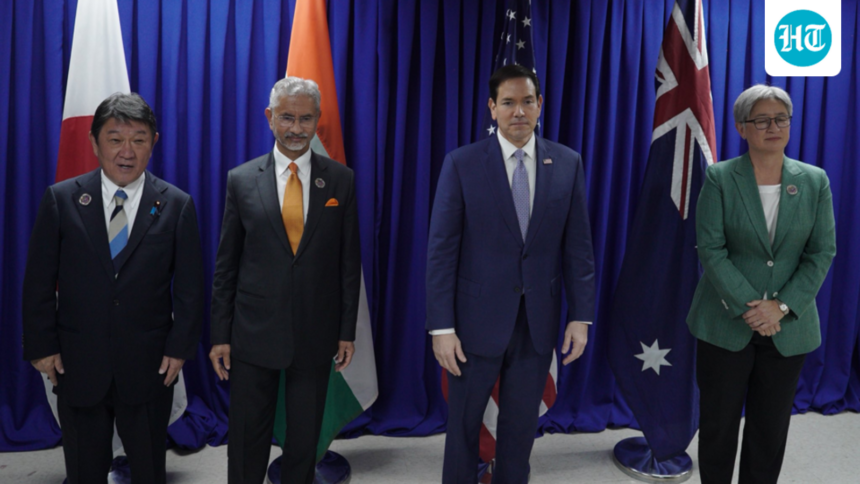
The Quad stressed the need for peace and stability in the Indo-Pacific region against the backdrop of new tensions between the Philippines and China in the South China Sea, as the foreign ministers of India, Australia, Japan and the United States met in Manila on Wednesday to discuss maritime security and regional challenges.
This was the second meeting of the Quad foreign ministers since May, and came two days after a confrontation between ships from the Philippines and China in the South China Sea that led to the injury of a Filipino sailor. India last week affirmed its support for a 2016 ruling by an international court in favor of the Philippines that rejected China’s expansive territorial claims in the South China Sea.
A joint statement on cooperation with ASEAN, issued after a meeting between External Affairs Minister S Jaishankar, Australian Foreign Minister Penny Wong, Japanese Foreign Minister Toshimitsu Motegi and US Secretary of State Marco Rubio, said the Quad “is united in our conviction that peace and stability in the maritime domain of the Indo-Pacific underpins the region’s security and prosperity.”
The four Quad member states, as comprehensive strategic partners of ASEAN, reiterated their “commitment to promoting a free and open Indo-Pacific region and our firm support for ASEAN unity and centrality,” the statement said. The Quartet foreign ministers met on the sidelines of ASEAN-related meetings in Manila.
“We are deeply invested in the success of the region and in cooperation with ASEAN and its member states,” the statement said, adding that the foreign ministers discussed “regional challenges and opportunities” to strengthen support for the practical implementation of the ASEAN Outlook on the Indo-Pacific (AOIP).
This will be done through the Quad’s shared priorities of maritime and transnational security, economic prosperity and security, critical and emerging technologies, and humanitarian assistance and emergency response.
Jaishankar said on social media that the Quad foreign ministers reviewed “the Indo-Pacific landscape and discussed recent developments.” They also followed up on the results of their meeting in New Delhi in May.
He added: “We are committed to a free and open Indo-Pacific region while recognizing the centrality of ASEAN.”
Rubio said the Quad foreign ministers’ meeting underscored the shared message that “strong cooperation is vital to uphold ASEAN’s primacy and centrality in the region.” He added that the United States, India, Australia and Japan share a vision for a free and open Indo-Pacific region based on the rule of law, sovereignty, and territorial integrity.
“The Quartet remains a priority, and we will meet again later this year,” he said, without elaborating.
The hour-long Quad foreign ministers’ meeting affirmed that the group will continue to strengthen “concrete cooperation to realize a free and open Indo-Pacific region” focusing on maritime and transnational security, economic prosperity and security, critical technologies, and humanitarian aid, Japan’s Foreign Ministry said in a statement.
Motegi said it was “extremely important” for the Quad ministers to meet again soon after their meeting in May, and this meeting on the sidelines of ASEAN-related meetings sends a strong message that the Quad is committed to strengthening cooperation that benefits the region.
The ministers held frank discussions and “unified their views” on the situations in the Indo-Pacific region and the Middle East, including the East China Sea and the South China Sea. Motegi also expressed strong opposition to “any unilateral attempts to change the status quo by force or coercion” and serious concerns about export restrictions, including on critical minerals.
The Japanese statement said that the four ministers “expressed their aspiration to holding the next summit of the Quartet leaders and the meeting of foreign ministers.”
The confrontation between the Filipino and Chinese ships took place on Monday near Second Thomas Shoal, where a parked Philippine warship serves as a military outpost. China claims almost the entire South China Sea and has demanded the site be removed, even though it lies within the Philippines’ 370-kilometre exclusive economic zone and about 1,000 kilometers from mainland China.
The Philippines won a 2016 case in the Permanent Court of Arbitration, which ruled that China’s sovereignty claim in the South China Sea had no basis under international law. China rejected the ruling and said in a statement on Sunday that the court’s decision was “nothing but a worthless piece of paper.”
The Ministry of External Affairs said India believes the arbitration court’s decision is an “important milestone and a basis for resolving disputes peacefully.”