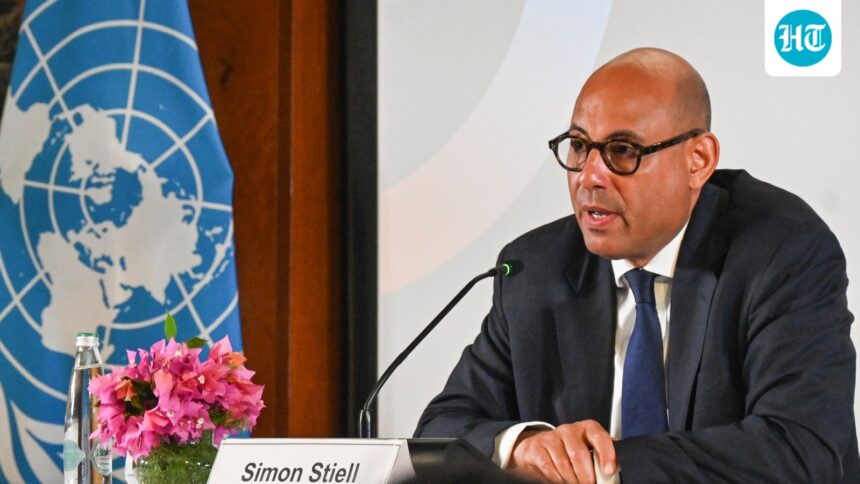
The upcoming UN Framework Convention on Climate Change (COP-31) should emerge as a platform for implementing important climate goals and targets, with India – one of the fastest-growing players in renewable energy – playing a key role, Simon Steele, Executive Secretary of the United Nations Framework Convention on Climate Change (UNFCCC), said on Tuesday.
During his visit to Delhi as part of a three-day official visit, Steele said in a press conference that the discussions with the Indian government have been fruitful so far and focused on identifying solutions and addressing the challenges facing the green transition in the future. “I have had very productive conversations with ministers and business leaders over the past two days, with more to come. There is a consistent theme running through the discussions: climate action is a game-changer for India, its economy and its people,” Steele said.
“Fossil-free energy now makes up half of India’s installed capacity – a feat it (India) achieved five years ahead of schedule,” he said.
Steele described the upcoming COP31 in Antalya in November as a platform to demonstrate implementation. “There are still things that need to be negotiated, and there always will be. But there is enough now to redouble implementation and, more importantly, how to move forward with the action agenda,” he said.
“We also need to start with NDCs and implement existing commitments,” he further stated, highlighting that India will play a key role in COP 31 as well.
“India is an important voice in this process, both in terms of its national representation, but representing many of the concerns of developing countries around the world, and therefore its voice in the negotiations, but also in terms of bringing to the table what is being achieved here locally,” he said.
Read also: India cannot separate climate action from health outcomes
Steele met Union Environment Minister Bhupinder Yadav on Monday, along with officials from the ministries of Environment, Energy and External Affairs (MEA), New and Renewable Energy (MNRE) and Niti Aayog.
“The discussions ranged from expectations and preparations for COP31 in terms of expectations, global expectations, expectations for India and how they will participate in the negotiations. But also, what is really interesting, is to get a deeper understanding of some of the incredible progress that is happening here in India in terms of the energy transition, electrification programmes, the big rollout of renewables,” he added.
Acknowledging the impact of climate-induced global warming, Steele said it was devastating, especially in Asia.
He added: “There are no monsoon rains, El Niño is severe, threatening crops to fail, and household costs to rise. Clean energy and resilience are vital parts of the solution. As Minister Pralhad Joshi said, renewables mean lower bills and increased energy security, which can boost food security and health.”
Read also: Simon Steele, UN High Commissioner for Climate, praised India’s new climate plan under the Paris Agreement
Regarding the success of the COP so far, Steele said before the Paris Agreement, the trajectory was such that the world would see up to 5 degrees Celsius of warming. A decade after the Paris Agreement in 2015, that rate had been cut in half – to less than 2.5°C, which is still far from the 1.5°C target needed for a habitable planet. He added: “So it is clear, based on what has happened before, and where we are now, that the Paris Agreement is working and pathways are being formulated to address the climate crisis. However, there is still a lot of work to be done.”
Regarding the challenges facing India, Steele said the discussions revealed that they range across a broad spectrum, from technical challenges such as network storage to financing. He said: “Efforts are being made to finance and invest, both at the public finance level, but also in the areas of private financing, and to support the energy transition.”