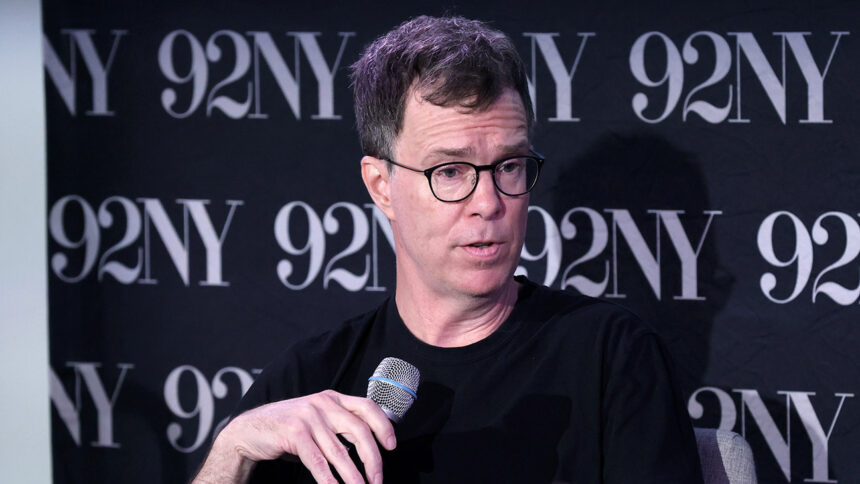
Ben Folds, a former artistic adviser to the National Symphony Orchestra, which was based at the Kennedy Center, has spoken out against Trump’s takeover of the institution, saying he fears political retaliation for artists who perform at the center.
“In the new toxic partisan environment under the current administration, I could not trust that the performers I booked at the Kennedy Center would be safe from retaliation if they said or sang something that might displease the president or his political cronies who now control the center,” Faulds said. He added: “I was unable to perform my job or the task for which I was assigned, and for this reason, with great sadness, I had no choice but to resign.”
He added: “These days, if an artist agrees to perform at the Kennedy Center, he risks being seen as openly endorsing the Trump administration and all of its policies. Declining the invitation to perform at the Kennedy Center would have equal and opposite political impact. There may be some artists who would thrive in this environment. Comedians come to mind, but most want nothing to do with it, and will choose to create and perform their art elsewhere, and they are, and the audience follows them.”
The folds appeared at a congressional forum on Tuesday held by U.S. Sen. Richard Blumenthal (D-Conn.) and U.S. Representative Robert Garcia (D-Calif.) titled “Big Waste: How Donald Trump is Spending Millions on Destroying American Monuments,” which also covered Trump’s renovation of the White House’s East Wing and the Lincoln Memorial Reflector, among other projects.
Speaking as one of the witnesses at the Democratic Forum, the pop singer and independent songwriter described how he was appointed the National Symphony Orchestra’s first artistic advisor under the first Trump administration, curating programming and bringing in artists like Jon Batiste and Sara Bareilles to perform alongside the orchestra.
Once Trump selected his board members for the Kennedy Center and appointed himself president, Foulds was one of several artists to resign, saying Tuesday that Trump’s political agenda had begun to creep in. “I think most of us understand that when you politicize art, you get publicity,” he said.
Trump has since attached his name to the building and announced that he intends to close the Kennedy Center for renovations for two years. A judge ruled in May that the renaming was illegal, and Trump ordered his name removed from the building, as well as a temporary halt to the planned closure, after a lawsuit filed by Congresswoman Joyce Beatty, an ex-officio member of the Kennedy Center Board of Trustees.
Trump has said that one of the reasons he took over the Kennedy Center was because it was in dire financial straits, but when asked about that assessment on Tuesday, Faulds said that was not the case.
“We’ve had live, sold-out shows at our programs, and as far as I know, at least several years in the black there. It’s really impressive, so no, I think the Kennedy Center has been having some golden years, in my opinion,” he said.
With the current closure in the air, and many artists withdrawing their programming from the Center, the future of the Kennedy Center and the National Symphony Orchestra remains uncertain.
“You have to wonder at anyone who thinks they can run the business of the Kennedy Center without any prior arts administration experience whatsoever. We can see that the result has been diminished audiences, the departure of the Washington National Opera, the dismantling of our national public educational outreach programs, and the demoralization of our National Symphony Orchestra. Many members of the NSO believe their jobs are in jeopardy,” Faulds said in his own statement.
He added: “So the takeover hampered the Kennedy Center, broke its proven business model, and compromised its original core mission. The illegal addition of the president’s name to the building’s facade further deteriorated the Kennedy Center. Despite the removal of its name, the future of the Center and the future of the National Recruitment Office remains uncertain. Our beloved institution needs revitalization.”
“We need a vibrant Kennedy Center, whose leadership once again understands how to run its business, who will keep politics at the door, and who will ensure that only the most qualified arts administrators are in charge. Because we can see the damage that happens when the arts are run by politicians and not by the people,” he concluded. “I can only hope that your concerns find their way into the hearts and minds of your colleagues on the other side of the aisle, who seem to be absent today.”