

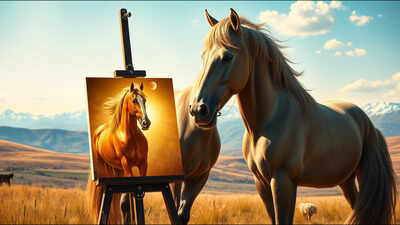
Quote of the Day by Xenophanes (Image: AI)
Xenophanes Colophon (c. 570 – 478 BC) was an ancient Greek philosopher, poet, and social critic. Born in Ionia (modern Türkiye), he spent most of his long life wandering around the Greek world as a traveling poet after the Persians conquered his birthplace.Unlike many thinkers of his time who focused solely on the physical sciences, trying to determine whether the world was made of water, air, or fire, Xenophanes was fascinated by human nature, culture, and religious belief. He was one of the first Western thinkers to criticize popular religion, social mores, and blind acceptance of tradition.“If horses or bulls or lions had hands and could draw with their hands and accomplish works like human beings, horses would draw the shapes of gods like horses, oxen like oxen, and their bodies would be made like the shape each has,” he said, unveiling a doctrine of human psychology that was ahead of its time.
He explained that everyone imagines everything the same as them.
The world of Homer and Hesiod
For the average Greek, religion came directly from the epic poems of Homer (the Iliad and the Odyssey) and Hesiod (theogony). These stories depicted gods such as Zeus, Hera, Poseidon, and Ares. But these gods didn’t just look like tall, attractive humans; They acted like them too. They would throw tantrums, cheat on their spouses, lie, fight out of jealousy, and hold petty grudges.
Xenophanes found this ridiculous. He said that Homer and Hesiod attributed to the gods “everything that is disgraceful and disgraceful among human beings: stealing, committing adultery, and deceiving one another.”This prompted Xenophanes to ask a deeper question: Where do our ideas of the divine come from? Do we discover the truth or do we make things in our own image?
What does Xenophanes’ famous quote teach us?
Xenophanes realized that humans are by nature driven by ego.
We assume that we are the standard for the universe. Because we have arms and legs and walk upright, we assume that God or God must look like a glorified version of us.By introducing horses, bulls, and lions into the equation, Xenophanes removes human arrogance. It shows that our mental image of God is not based on divine revelation; It is built on self-love. If the horse is believed to be the pinnacle of physical creation, then surely his god has hooves and a mane.Immediately after the horses and bulls passed, Xenophanes made another famous remark: “The Ethiopians say their gods are snub-nosed and black, and the Thracians say their gods are blue-eyed and red-haired.”He was pointing out that each culture paints God to look like its people. A northern European tribe sees a light-skinned god; African culture sees a dark-skinned deity. Xenophanes realized that religion is often just a mirror reflecting the culture that created it.Xenophanes was not an atheist. He did not use this argument to say that God does not exist. Instead, he called for humility. He believed that there was a divine truth, but that humans were too limited to see it clearly. When we try to envision God, we can only use our limited human experience as a model. By making God look and act like us, we reduce something broad and final to something small, familiar, and comforting.
A lesson in human psychology
While Xenophanes’ quote was about God, what he revealed applies everywhere. We constantly judge other people, animals, and nature through the narrow lens of human experience. Xenophanes was reminding us that the world does not revolve around humans. Before we claim to understand absolute truths, we have to take a step back and ask ourselves: Am I seeing reality as it really is, or am I just a horse drawing a picture of a giant horse?