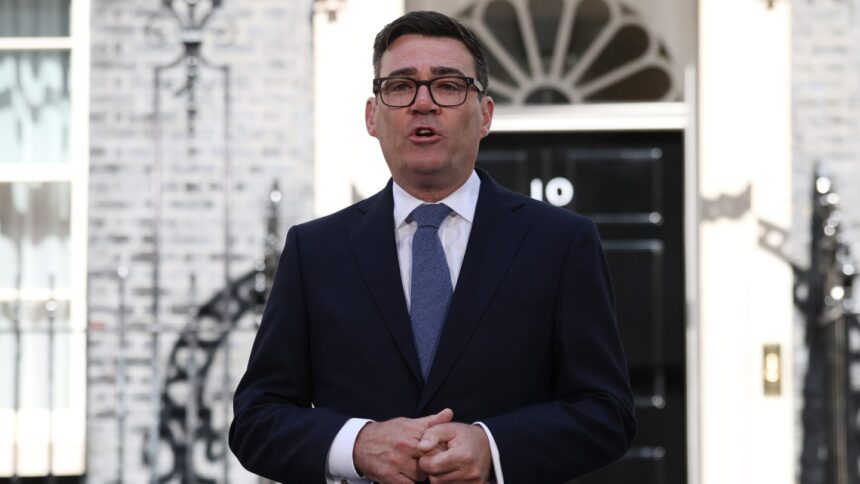
Andy Burnham is officially the seventh Prime Minister of the United Kingdom in 10 years.
56-year-old Hans has been appointed Britain’s new political leader and begins his term in office from Monday, following his appointment as leader of the Labor Party and meeting with the King, who invited Burnham to form a government. It is unclear whether Culture Secretary Lisa Nandy, currently responsible for shaping industry policy on British film and television and securing funding for the British Film Institute, will remain in her role in Burnham’s government. A cabinet reshuffle is imminent, but the two are long-time friends and allies in British politics.
The British knew that Burnham would be Prime Minister weeks before this announcement. His party pushed his predecessor, Keir Starmer, to resign after months of speculation that he was deeply unpopular among Labor ministers. Starmer’s critics said he tried too hard to appease conservative and reformist voters on issues such as Gaza and transgender rights, as well as immigration and measures to address growing inequality.
Ultimately, Starmer was simply not considered a strong leader for Britain. And here comes Burnham, whose supporters believe he can bring the fight to Nigel Farage’s far-right Reform UK Party in the next general election, while perhaps even winning over some Green Party voters while he’s at it.
Burnham was born in a suburb of Liverpool and joined the Labor Party when he was 15 years old. After studying at Cambridge University, he slowly rose through the political ranks in the United Kingdom and worked in government with former Prime Ministers Tony Blair and Gordon Brown. He later took on the roles of Shadow Secretary to Ed Miliband and Jeremy Corbyn, although during this time he also launched multiple (and unsuccessful) campaigns to become Labor Leader.
From 2017 until 2026, Burnham was Mayor of Greater Manchester, a position that earned him the image of a true “man of the people”. Over the past decade, his superpower has gained incredibly broad appeal throughout the north of England. Part of this is due to his instrumental role in introducing and passing the Hillsborough Act, legislation designed to prevent state cover-ups in the wake of disasters and public scandals. It takes its name from the Hillsborough disaster of 1989, which saw 97 Liverpool fans killed in a stampede at a football match, and the decades-long struggle by the victims’ families to extract the truth from the authorities.
He is closer to Corbyn than Starmer or Blair on the left, and has even been described as the “King of the North” for his anti-Westminster approach. This will be one of the main themes of the Burnham government: taking power out of London and into regional political centres, as well as boosting public transport to northern cities and tackling homelessness and social housing.
But Burnham will have to navigate some rough political terrain here in Britain, where far-right politicians are committed to weaponizing immigration policies and fanning the flames of division. Farage’s Reform Party, in particular, is looking to win the next election – which will be held no later than August 2029 – although Kemi Badenoch’s Conservative Party is increasingly taking a far-right stance on certain policies to win back some of those voters lost to Reform.
Burnham has wanted to lead Labor for most of his political career, and now faces an uphill battle in appointing a competent chancellor, allocating £9 billion ($12 billion) for Britain’s defence, protecting the NHS, building the 1.5 million homes Labor promised in its manifesto, and getting more than a million young people into work amid a brutal labor market.
Add to that the fine line he has to walk on immigration, the police, and Gaza, and Burnham would be forgiven for feeling a little apprehensive. He insists that it is not. “I hear you. We weren’t good enough, and we need to be better. We will be,” he said outside the Prime Minister’s official residence, 10 Downing Street, on Monday afternoon.
He added: “We will make this moment a circuit breaker for Britain and there will be a new political model.” “I will put the care of people at the heart of everything I do. I will do everything I can, and I ask you all to join me. Let’s build a new national sense of unity, common purpose and positivity. Let’s make this the moment Britain begins to believe again – the moment we restore hope.”