

For decades, scientists have tried to guess what the Sun will do next, and mostly failed. Why? Because the star’s magnetic tantrums appear in approximately 11-year cycles, and no two cycles behave the same way.
Some are fierce, others are mild. Sometimes surprises come that surprise scientists.Now researchers at the University of Warwick have developed a new way to predict the strength of the Sun’s next level of activity. Researchers have found a specific point where the Sun’s most violent space weather suddenly stops, like a switch. This ‘break’ point holds the key to predicting the strength of the next solar cycle up to seven years in advance. The results are being presented at the National Astronomy Meeting of the Royal Astronomical Society in Birmingham.
What the sun’s sleep cycle reveals about its next solar cycle
“The Sun doesn’t go to sleep gently and then gently wake up again. Instead, we discovered that the most extreme space weather suddenly stops at a specific point in each solar cycle. By identifying this point, we have found a new way to predict how active the next solar cycle will be,” Sandra Chapman, professor of physics and director of the Center for Fusion, Space and Astrophysics at the University of Warwick, said in a statement.She added that the team will be able to improve forecasts in about two years. That’s when solar cycle 25 reaches its newly defined “stop” point.
Within the solar cycle
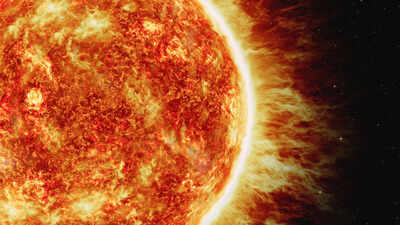
Scientists have revealed that the way the Sun goes to ‘sleep’ could tell us a lot about future space weather
” msid=”132511849″ Display title placeholdersrc=”https://static.toiimg.com/photo/83033472.cms” imgsize resizemode=”4″ offsetvertical=”0″ placeholdermsid=”47529300″ type=”thumb” src= “https://static.toiimg.com/photo/83033472.cms” class data-src = “https://static.toiimg.com/photo/msid-132511849/p-styleline-height1-38margin-right-3pthow-the-sun-goes-to-sleep-can-tell-a-lot-about-future-space-weather-scientists-revealpbr.jpg” data-api-prerender=”true”>
Our Sun follows a cycle of approximately 11 years. During this period, its magnetic field reverses its polarity, and the number of sunspots rises and falls. These sunspots are regions of intense magnetic activity, which can produce powerful solar flares and coronal mass ejections.
All of these factors contribute to space weather, which can also affect Earth. It can affect satellites, communications, navigation systems and power grids on Earth.
Although astronomers have studied sunspots for centuries, they have been unable to predict the Sun’s next cycle, as no two solar cycles are the same. There are differences in length and density.Here lies the importance of the new method. It builds on Chapman’s previous work that included what they called a “sun clock,” which charts the sun’s irregular cycles on a standard clock.
The new method revealed that the sun’s most extreme weather does not gradually fade away. It stops suddenly at a distinct moment in each solar cycle. The researchers found that the number of sunspots present at this breakpoint, when extreme space weather suddenly ends, is closely related to the peak number of sunspots in the next cycle.
By counting sunspots at this moment, researchers can predict the strength of the next solar cycle six to seven years before it reaches its peak, much earlier than traditional methods allow.
Sunspots are areas of intense magnetic activity on the surface of the Sun. The number of sunspots rises and falls over the Sun’s roughly 11-year activity cycle, and is one of the main ways astronomers track and predict solar activity.
” msid=”132511407″ width title=”Pic courtesy: NASA/SDO” placeholdersrc=”https://static.toiimg.com/photo/83033472.cms” imgsize resizemode=”4″ offsetvertical=”0″ placeholder=”47529300″ type=”thumb” src class=” “https://static.toiimg.com/photo/83033472.cms” data-src = “https://static.toiimg.com/photo/msid-132511407/brp-styleline-height-23pxsunspots-are-regions-of-intense-magnetic-activity-on-the-suns-surface-the-numbe It descends above the sun in an approximately 11-year activity cycle, which is one of the main ways astronomers track and predict solar activity. pbr.jpg” data-api-prerender = “true”>
Image courtesy: NASA/SDO
The new method also identifies a specific phase in the solar cycle when the magnetic field is created that drives the next cycle. This will help researchers understand the solar dynamo, the process that generates the Sun’s magnetic field.“We are about two years away from the starting point of current solar cycle 25. Right now, we have to estimate where that point is, but once we get there we can use observations alone to make a more accurate prediction of solar cycle 26.”
“This will still give us about seven years’ warning about how strong the cycle might be,” Professor Chapman said.This method successfully predicted that Solar Cycle 25 would be stronger than expected, and that it could produce spectacular auroras in recent years. The UK has seen a series of historic solar storms in 2024 as the cycle approaches its peak. Driven by a cluster of massive sunspots, these events produced the strongest geomagnetic disturbances to hit Earth in more than two decades. What followed was a display of bright aurora borealis across the UK, as far south as Devon and Cornwall, a rare sight in southern England.