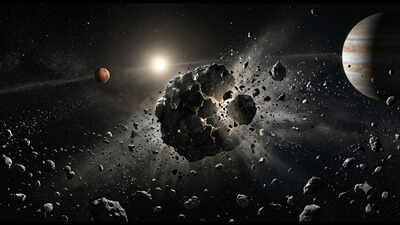
The disintegration of the asteroid 800 million years ago may have caused impacts on Earth, the Moon and Mars (artificial intelligence image)
A massive asteroid that broke up about 800 million years ago may have sent a large number of rock fragments toward Earth, the Moon and Mars, according to a new study by researchers at the Southwest Research Institute.Scientists believe the collision occurred in the main asteroid belt, the region between Mars and Jupiter where millions of asteroids orbit the sun. The shattered pieces may have traveled through the inner solar system over millions of years, causing a long period of collisions on many rocky planets.Researchers say this event could help explain why the moon contains so many large craters dating back about 800 million years.
They also suggest that the bombardment may have coincided with important changes in Earth’s climate and the evolution of life.
Looking for clues
Scientists have long known that asteroid impacts have shaped planets throughout the solar system. However, understanding how those impacts affected life on Earth has been difficult because much of the evidence has disappeared.“The Moon’s cratered surface is a reminder of large impacts in Earth’s past, but until now, only the Chicxulub impact event 66 million years ago has been strongly linked to a specific impact on life, the mass extinction of the dinosaurs,” said Dr. William Bottke, executive director of the Solar System Science and Exploration Division at Southwest Research Institute and lead author of the study.
Finding evidence of much older impacts on Earth is much more difficult. Over hundreds of millions of years, the Earth’s surface continues to change due to volcanoes, plate tectonics, and weather. These natural processes bury or erase ancient archaeological craters. For this reason, scientists often look beyond Earth for answers.
The moon has a missing record
Unlike Earth, the Moon does not have tectonic plates, flowing water, or a thick atmosphere that erodes its surface.
As a result, impact craters remain visible for billions of years.
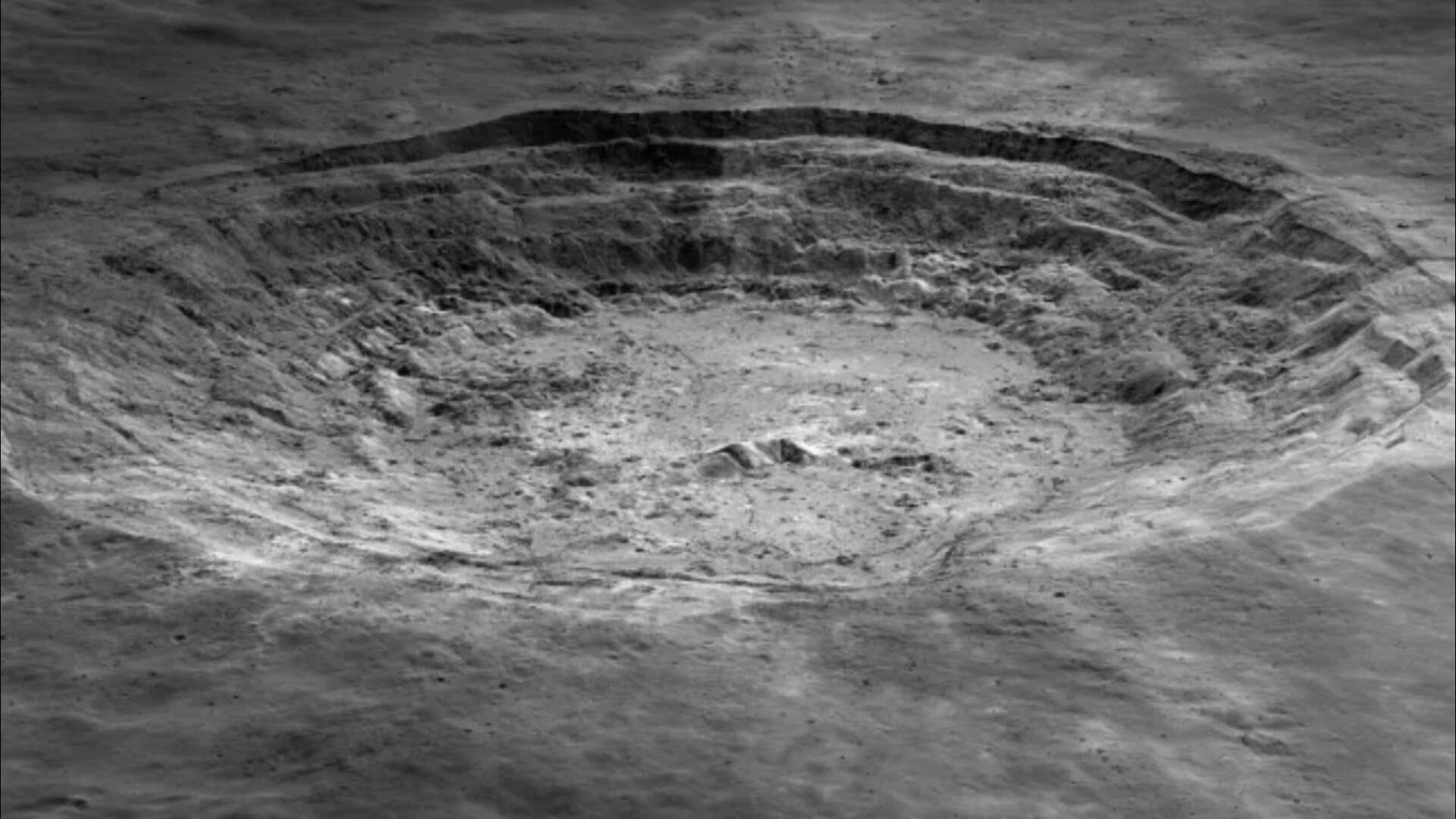
Aristarchus Crater on the Moon (NASA image)
Previous studies have suggested that the Moon experienced a rise in large impacts about 800 million years ago. Scientists came to this conclusion after studying the ages of major lunar craters and impact glass collected during the Apollo missions.Impact glass is formed when an asteroid hits the surface with enough force to melt rocks. As the molten material cools and turns into glass, it preserves chemical information and allows researchers to estimate when the collision occurred.
It might explain the asteroid family
The new study also points to the breakup of the Eulalia family of asteroids as a possible source. According to the researchers, a large carbon-rich asteroid, known as the parent body Eulalia, collided with another body in the main asteroid belt. The impact shattered the asteroid into countless fragments.“Our cosmic forensics team used collisional and dynamical models to link it to the formation of the Eulalia asteroid family, when a primitive carbonaceous chondrite-like body collided with another body,” Bottke said.Carbonaceous chondrites are among the oldest materials in the solar system. They are rich in carbon and can also contain water-bearing minerals and organic compounds, making them important to scientists studying the early solar system.
The role of Jupiter
The asteroid collapsed near a region called the J3:1 resonance, also known as the 3:1 mean motion resonance with Jupiter. This is a gravitational zone where the asteroid completes three orbits around the Sun for every orbit Jupiter completes.Although the name sounds technical, scientists describe it as a type of gravity portal. Jupiter’s strong gravity frequently attracts objects that pass through this region. Over long periods, these recurring tugs can push asteroids out of the main asteroid belt and onto paths that cross planetary orbits. It is believed that many near-Earth asteroids reached our region via this same route.
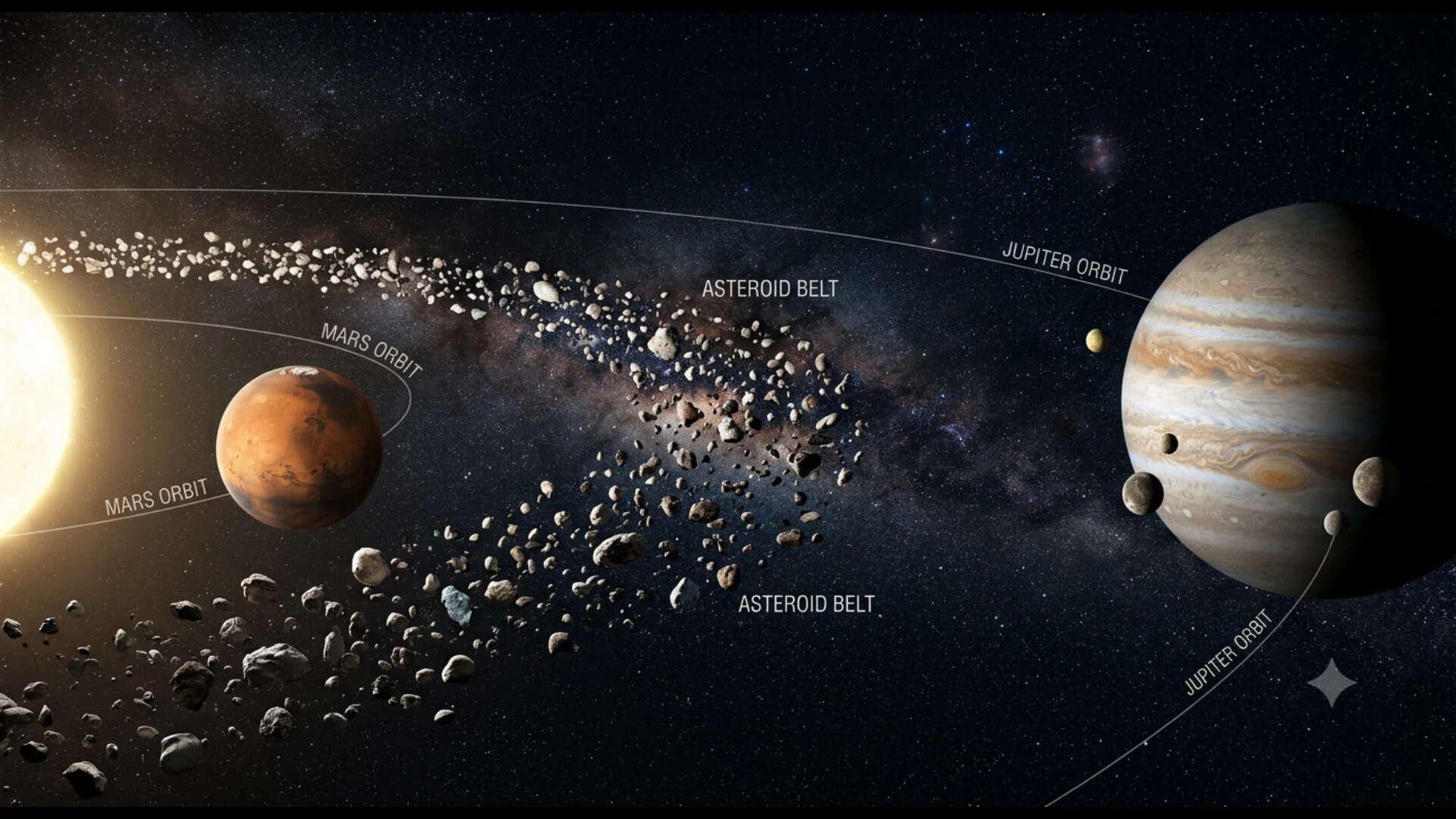
Scientists believe the collision occurred in the main asteroid belt, the region between Mars and Jupiter where millions of asteroids orbit the sun. (representational image)
Computer simulations conducted by the researchers indicate that about half of the fragments from Eulalia’s impact entered this gravitational path almost immediately. Those fragments were then scattered across the inner solar system, increasing the chances of impacts on Earth, the Moon and Mars.Over the next 100 to 150 million years, another quarter of the asteroid’s fragments slowly drifted into the same region due to the Yarkovsky effect.The Yarkovsky effect is a very small force created when an asteroid absorbs heat from sunlight and later releases that heat back into space in the form of infrared radiation. The uneven release of heat acts as a micro-push, slowly changing the asteroid’s orbit over millions of years.
Impact on the ground
The team’s models suggest that the breakup of Eulalia could explain the increase in large lunar craters seen about 800 million years ago.Because the Earth is much larger than the Moon and has a stronger gravity, it would have attracted more incoming objects.
Researchers estimate that for every large asteroid that hits the Moon, there may have been about 20 similar or larger objects that struck Earth. Most traces of those impacts have since disappeared because the Earth’s surface is constantly being reshaped.However, the period of increased impacts overlaps with evidence of widespread global cooling and major biological changes on Earth. The researchers say this does not prove that asteroid impacts caused these events, but they believe the interference deserves further investigation.“Given that the peak of this shower coincides with a period of widespread cooling and major shifts in our biosphere, it is tempting to suggest that the former produced the latter,” Bottke said.He added that the impacts would also have affected Mars.