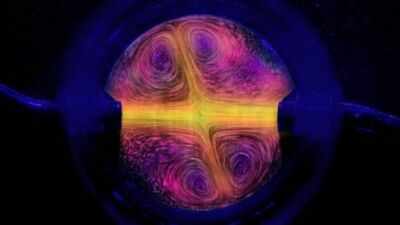
False-colored particles reveal the flow of water into the reverse sprinkler, making the otherwise invisible movement of the fluid clearly visible. Image source: NYU Applied Mathematics Laboratory
If you’ve ever seen a “silly sprinkler” in action (those bright, curvy gadgets that twist and spray water in wild patterns) you’ve probably seen them as summer fun.
But a group of mathematicians turned these backyard toys into tools to solve a famous physics puzzle that baffled even Nobel Prize-winning physicist Richard Feynman.This puzzle is known as the Feynman machine gun problem. In essence, it asks a simple question: What happens if you turn the sprinkler in reverse, so instead of spraying water out, it sucks the water in?For decades, the answer has been surprisingly difficult to pinpoint. Now, thanks to experiments with both standard sprinklers and “silly” sprinklers, researchers say they finally have a clear, tested explanation that tells us a lot about how moving fluids push, twist, and spin objects around them, according to Science Daily.
Question: What does a “reverse” sprinkler actually do?
A regular lawn sprinkler looks a bit like a rotating rocket: Water shoots out of its arms, and the reaction force makes the entire device spin. This part is self-evident. But what if you reversed the flow so that the water was drawn inward instead? This is what fascinated Richard Feynman in the mid-twentieth century. He tried the reverse sprinkler, which draws water in instead of pushing it out, but his attempts were inconclusive.
This problem became famous in the 1980s when physicists and students debated whether the sprinkler would spin, in which direction, and why.Recent experiments have shown that the reverse sprinkler rotates, but much more slowly than a regular sprinkler; About 50 times slower. The difficult part was understanding the mechanism behind this movement. Rockets from the inside out and the water jets collideTo see what’s going on, it helps to imagine the inside of a sprinkler.In the traditional sprinkler:– Water flows from the center to the outside through the arms.– As it travels, the flow carries momentum that pushes the arms in the opposite direction, making the device rotate.

In backspray:– Water flows from outside to inside through the arms.– The incoming jets meet in the central chamber where the arms connect. Most importantly, these jets do not collide completely head-on. There is a slight imbalance. Because of that:– Colliding water flows carry angular momentum, they rotate, not just collide straight up.– This swirling movement affects the torque (twisting force) on the sprinkler body.The sprinkler then rotates in the opposite direction compared to the normal “spray” mode. This idea, which focuses on how the momentum of the flow moves through the sprinkler, is called momentum flow theory. Previous research indicated it was the right answer, but it had only been tested on standard sprinklers with simple S-shaped arms. What about all the weird shapes we see in real life, like silly sprinklers with loops and twists?Here comes the role of new experiences.
Turn silly splashes into serious experiments
To push the theory further, the researchers built a set of sprinklers inspired by fun backyard designs, according to the report. They created devices with curved arms, loops, twists and unusual lines.Each sprinkler was then operated in two modes:– Front Mode – Sprays water outward, like a regular lawn sprinkler.– Reverse mode – drawing water in, like a reverse Feynman sprinkler. While operating the sprinklers, the team did the following:– Record how fast it rotates and in what direction.– Watch how the water flows in and out of the arms around the device.Torque and twisting force were measured by preventing the sprinklers from rotating and seeing how hard the water tried to rotate them. This setup allows them to check not only if the sprinklers are rotating, but also why they are rotating. Different shapes mean different flow patterns, making it a good test of competing theories.
Old ideas versus new evidence
Over the years, several explanations have been proposed for how backflow sprinklers work:Mach theory (1880s)Physicist Ernst Mach suggested that the fluid itself rotates in one direction while the spray rotates in the other.
It was a great idea, but it didn’t fully explain the details of counter-rotation or the torque measured in modern experiments.Feynman era theorySome later arguments focused on the movement of water near the outer edges of the sprinkler arms, claiming that the flow around those tips controlled the motion.The new experiments tested these ideas by: changing the shapes of the arms to alter the outward flow while keeping the inner jets similar, and measuring whether the changes outside the arms made a difference in rotation or torque.They found that:– Flow near the outer parts of the arms did not significantly affect movement or twisting forces. – Mach’s interpretation could not match the observed behavior for both forward and backward modes.Instead, the results are consistent with momentum flow theory:– Regardless of the shape of the arm, the key factor was how the water jets carried their angular momentum through the central chamber of the spray.– When shooting forward, the jets act like a rocket exhaust, rotating the machine gun in one direction.– When operating in reverse, the incoming jets collided off-center inside the chamber, pushing the sprinkler in the opposite direction.Importantly, this applied to all the different “ridiculous” designs tested, showing that the theory was not just a special case of a particular shape.
Why is this important beyond backyard physics?
On the surface, Feynman’s machine gun problem appears to be a specialist curiosity; Something to spark a mystery in the classroom or at a summer barbecue. But basic physics is useful on a broader scale. Common problems arise when designing machines that interact with flowing fluids. Likes:– Turbines and hydroelectric systems – converting the momentum of flowing water into rotational energy.– Pumps and filtration devices – managing the movement of fluids through pipes and chambers.– Energy harvesting techniques – obtaining energy from ocean currents, rivers or industrial flows.Understanding how fluid momentum is translated into torque and rotation helps engineers:– Predict how components will perform in different flow configurations.– Improving the shapes of blades, arms or channels to achieve higher efficiency.
Avoid unexpected behaviors that waste energy or damage equipment.Experiments with silly sprayers have shown that changing the shape of the arms can control and redirect jets, providing a kind of “design dial” to manage how fluids push and twist structures.By emphasizing that momentum flow is key to the Feynman problem across many forms, the research enhances a general framework that engineers can use in real-world applications.
A fun being, a profound lesson
There’s something almost poetic about solving a long-standing physics question using toys that kids pass around on hot days. It reminds us that serious science doesn’t always start in high-tech laboratories; Sometimes it starts with simple, familiar things and a stubborn curiosity about how they really work. In the n Hey, the Feynman reverse jet spins not because of mysterious forces at the tips of its arms, but because of how the water’s momentum flows and collides inside its core.
The silly twists and loops help show that this principle holds true no matter how complex the arms.Next time you see a sprinkler spinning in the yard, especially a sprinkler, will it change the way you see it when you learn that the same playful jets helped answer a decades-old question in physics about how the motion of water can turn a simple device into a rotating machine?