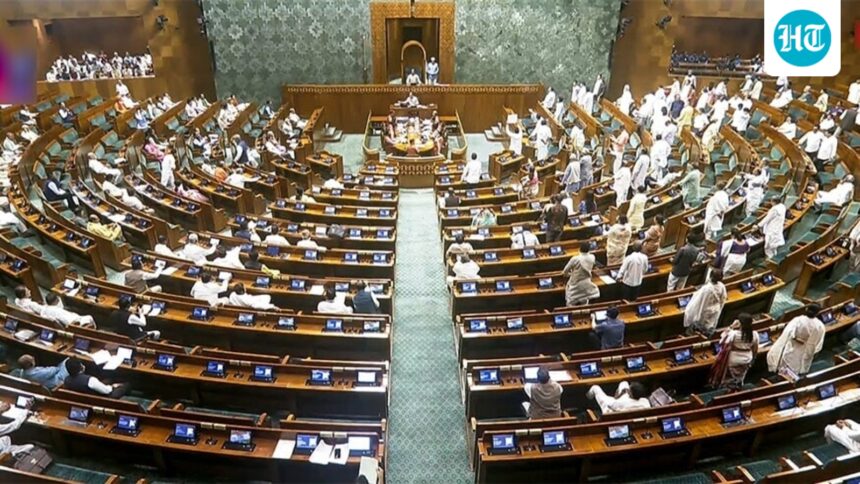
Lok Sabha Speaker Om Birla on Saturday approved the merger of six Shiv Sena (Uddhav Balasaheb Thackeray) legislators with the Shiv Sena and allocated a separate seating arrangement for the 20 rebel Trinamool Congress (TMC) MPs.
The decision came two days before Parliament’s seasonal session, which begins on Monday. The TMC rebels’ plan to secure recognition as members of the National Citizens Party of India (NCPI), a mainstream party based in West Bengal, is still awaiting approval from the top office in the Lok Sabha.
A senior official said that the issue of merger of the TMC rebels is “under study” and “an appropriate decision will be taken soon.” Two TMC rebels told HT they hoped it would be approved within a day or two.
An internal circular issued by the Lok Sabha table office on Saturday said: “As a result of the change in party affiliation of six members of the Shiv Sena UBT in the Lok Sabha, the revised party position has been included in the 18th Lok Sabha.”
The post showed that the Shiv Sena has 13 legislators and the Sena (UBT) with three. The post also added that 20 rebel TMC members will sit separately. The changes come ahead of an all-party meeting on Sunday morning. The government has already invited rebel TMC leaders to attend the meeting as representatives of the NCPI.
“Recently, you and 19 other MPs have joined NCPI and have already requested the Hon’ble Speaker Lok Sabha to recognize it and it is under his consideration,” said a letter from Parliamentary Affairs Minister Kiren Rijiju to rebel TMC leader Sudeep Bandopadhyay. Bandopadhyay also met Prime Minister Narendra Modi on Saturday evening.
The Sena is now the largest NDA party in the Parliament of Maharashtra. It had originally won seven seats in 2024. But in June, six Sena (UBT) Lok Sabha members — Sanjay Jadhav, Bhausaheb Wakshwar, Sanjay Deshmukh, Nagesh Patil Ashtekar, Umraji Nimbalkar and Sanjay Patel — joined the Shiv Sena in the presence of party president and Deputy Chief Minister Eknath Shinde, strengthening the party’s regional presence in Parliament and supporting the national party. Democratic Alliance figures: “The required operation has been completed. All six MPs have joined the Shiv Sena. Shinde had at that time declared Operation Tiger a success.”
If NCPI’s move is approved, the NDA will have 319 MPs in the Lok Sabha, which is still 41 short of the two-thirds majority mark of 360 in the House. The Sena is currently the ruling coalition’s second-largest ally after the LDP, with 15 members – 13 in the Lok Sabha and 2 in the Senate.
The Shiv Sena welcomed the Speaker’s decision. “These MPs were ignored by their leaders (in the UBT)… They have taken the right decision by joining us. We will welcome them to the Sena,” Shrikant Shinde, leader of the Shiv Sena parliamentary party, said. [inUBT)TheytooktherightdecisionbyjoiningusWewillwelcomethemintheSena”ShivSenaparliamentarypartyleaderShrikantShindesaid
The Shiv Sena (UBT) said it would consider the Speaker’s order and decide the next course of action. “We don’t know on what basis they were recognized. We will wait to get a copy of the order. Then we will decide the course of action and when to move the court,” Arvind Sawant, leader of the Shiv Sena parliamentary party, said.
TMC’s Rajya Sabha floor leader Derek O’Brien criticized the Speaker’s decision to allow separate benches. “Mockery of our democracy. Speaker referred to 20 traitors as still TMC MPs. Minutes later, Modi Minister Shah called the traitors to an all-party meeting and referred to them as NCPI,” he posted on X.
The TMC rebels, led by Sudip Bandopadhyay and Kakoli Ghosh Dastidar, had met with Birla on June 14 to apply for merger. Around the same time, six Sena rebels met with Birla for a similar purpose.
Birla later met the TMC leadership, including party leader Abhishek Banerjee, and the Sena Congress (UBT).
Earlier this week, Dastidar told HT that the Speaker had assured the group that they would get a separate office and seating arrangements in Parliament, which was an indirect acknowledgment of the merger with NCPI.
The development came amid speculation that the government may reintroduce the Constitution Amendment Bill to implement reservation for women and fix limits which failed to get the required two-thirds majority in the Lok Sabha in the previous session. The government has certainly given no indication yet that it is preparing to introduce a revised draft law.
There is also a buzz that the NCP’s (Sharadchandra Pawar) partner of the Maharashtra opposition party, Maha Vikas Aghadi (MVA), has been gradually moving closer to the ruling NDA. NCP chief Sunetra Pawar opposes the move, according to people familiar with the developments. Supriya Sule, leader of the National Socialist Congress Party, also denied such speculations.
HT reported earlier this week that there was a possibility that the government could revise the text of the proposed bill to include a reference to the 50% relative increase in seats for each state, a person familiar with the details said. According to this person, the Union government was keen to submit the draft law “on the condition” that it had numbers.
The Constitution (One Hundred and Thirty-One Amendment) Bill, 2026 and the Delimitation Bill, which sought to redraw boundaries based on the 2011 Census and is a prerequisite for implementing 33% quotas for women in legislatures, were introduced in the Lok Sabha in the previous session. But the Constitution Amendment Bill failed to obtain a two-thirds majority in the House of Representatives, where it was defeated by 298 votes to 230. At that time, the Nationalist Congress Party (SP) and the Sena Party (UBT) voted against the bill.
The government’s legislative push included raising the maximum seats in the Lok Sabha from 550 to 850, with seats allocated to states, reserved constituencies and their boundaries to be determined by the Delimitation Commission on the basis of the last census, which means the 2011 census in this case.
But the Opposition remained unconvinced, pointing out that the government’s assurances of a uniform 50% increase in Lok Sabha seats in every state were verbal and were not mentioned in the text of the bills. In his speech at the time, Union Home Minister Amit Shah tried to turn the tables on the opposition, offering to bring forward a formal amendment indicating a 50% increase in Lok Sabha seats in exchange for support for the Women’s Reservation Bill. But the bill was still defeated.