
Left image is for representation purpose only (generated by artificial intelligence)
There was a time when calling customer service always meant waiting to talk to someone. Today, that experience looks very different. Whether you’re tracking a late package or reporting a failed payment, your first conversation will likely be with a chatbot or AI-powered voice assistant.
Many routine problems are now solved without any human joining the conversation.For customers, this often means faster responses and around-the-clock support. For businesses, it promises lower costs and faster service. But the transformation goes beyond comfort. As AI takes over repetitive tasks, it is reshaping India’s business process outsourcing and customer service industry, pushing human agents toward more complex work while raising new questions about jobs, skills and data privacy.So, does AI signal the beginning of the end for traditional contact centers, or is it simply redefining what customer service will look like in the coming years?
Artificial intelligence already answers before humans
The shift to AI-powered customer service is no longer a prediction of the future; It’s already underway.Across industries, customers are increasingly greeted by chatbots or AI-powered voice assistants before they reach a human agent.Today, AI can direct customers to the appropriate department, create support tickets, summarize past interactions, translate conversations across multiple languages and complete post-call documentation, automating many repetitive tasks that previously required human agents.
Explaining how AI decides whether to continue the conversation or engage a human, data scientist Vishnu Prasad Sharma says the decision depends on two factors: “whether the MBA is confident enough in its answer given the data it has retrieved, and whether the conversation itself is of a nature that warrants a human.” He explains that chatbots use intent recognition and retrieve relevant company documents or previous interactions before generating a response.For businesses, this means shorter wait times, around-the-clock support, and lower operating costs, while customers often receive faster responses.The pace of adoption is accelerating. According to research firm Gartner, 85% of customer service leaders are either exploring, piloting, or deploying AI-powered chatbots, while 71% of CRM leaders plan to increase investments in AI.
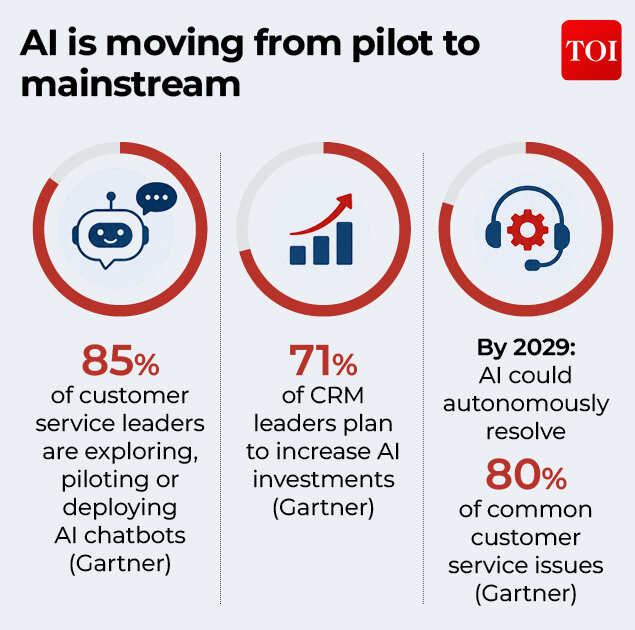
Gartner also estimates that by 2029, AI can autonomously solve nearly 80 percent of common customer service problems, reflecting the increasing trust companies are placing in the technology.However, automation has not eliminated the need for humans. Instead, it has shifted humans towards handling cases that AI cannot solve – complex issues that require judgement, problem-solving or empathy.This style is already familiar to many customers. Mohit Kumar, a Delhi-based public relations professional, says he usually prefers AI-powered support for simple requests because it provides quick answers. However, while trying to book a stay during a trip to Varanasi, he was connected to an automated voice assistant that repeatedly failed to understand his questions about room availability and check-in times. Frustrated by this experience, he eventually chose another accommodation. “AI works well for simple queries, but when the conversation becomes more detailed, talking to someone still makes a huge difference,” Mohit told TOI.
The biggest shift is not fewer calls, but different calls
The biggest change in customer service may not be the number of calls that are answered, but the type of calls that reach human customers.Tasks that used to occupy a large portion of a customer service representative’s day, such as answering frequently asked questions, processing refunds, tracking orders, or helping customers reset passwords, are increasingly being handled by AI-powered systems.What amounts to the human factor today is often more complex. These conversations may include situations where clients feel frustrated and expect someone to listen, understand, and judge.
In such cases, problem solving is only one part of the interaction; Building trust and reassuring the customer can be equally important.
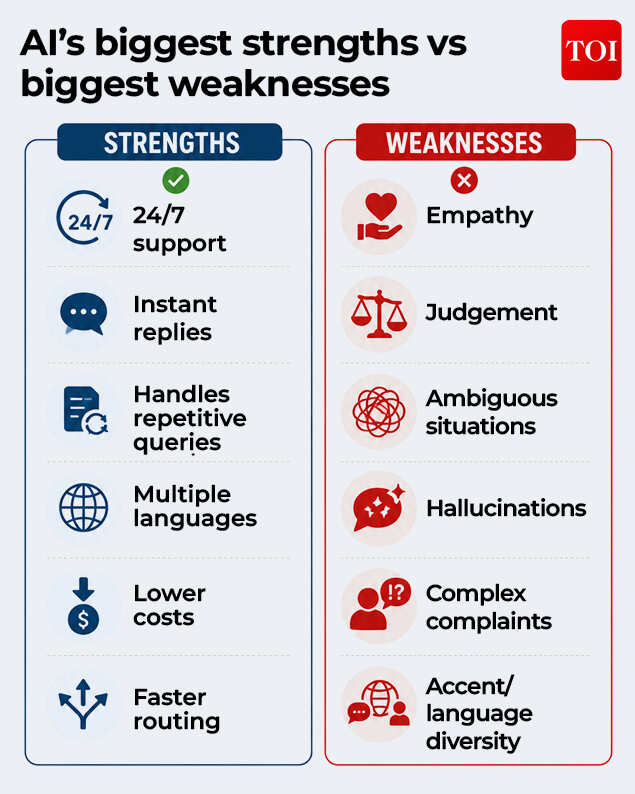
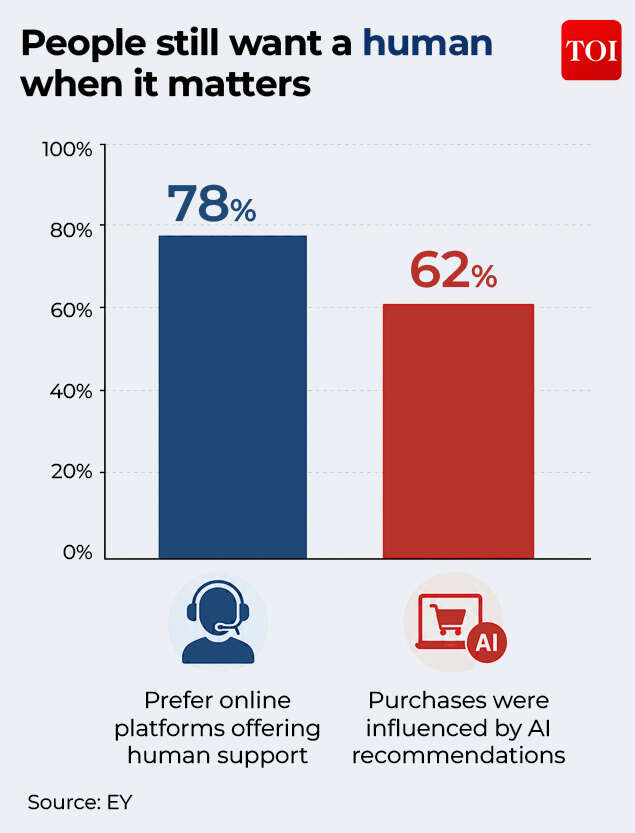
Research supports the value of this human connection. A Harvard Business Review The study found that customers who had positive emotional experiences with a business were 3.5 times more likely to make another purchase and five times more likely to recommend the business to others. While AI can provide speed and consistency, customer loyalty is often built through empathy, active listening, and personalized support, qualities that remain difficult to fully replicate through automation.This shift is also reflected in the experience of people who have worked in customer support. A former customer executive at a fintech company, who requested anonymity, said customer expectations have changed dramatically as more people now prefer AI-powered chatbots, FAQs and online support channels for simple queries as they offer instant responses. “However, I don’t think these channels have completely replaced human support. When customers face complex issues, need personal guidance or deal with sensitive financial matters, they still prefer to talk to a customer care representative,” she told TOI.Artificial intelligence may solve problems faster. But in many situations, people still look to humans to solve them better.However, the challenge is not always whether customers are talking to the AI or to a human, but whether someone is taking charge of the problem. Another PR professional, Durgesh Kumar Jha, told TOI that while he still contacts customer service first, he often turns to social media if the issue remains unresolved. In one recent case involving a coffee shop chain, he had to explain his complaint again, even after the company’s support team contacted him and received no follow-up. “Whether it’s AI or a human executive, it doesn’t matter as much as someone who actually understands the problem and follows through until it’s solved,” Durgesh said.
The BPO industry in India is at a turning point
For decades, India has been the global preferred destination for customer support and business process outsourcing (BPO) services. Strong English language skills, a large talent pool, and competitive operating costs have helped the country build an industry that today employs millions Yin people in customer support, data processing, and back office operations. According to industry estimates, the BPO sector alone employs about 1.65 million people in voice support, data processing, and administrative roles.Cities like Bengaluru, Hyderabad, Pune, Chennai, Gurugram and Noida have emerged as major outsourcing hubs.But this model is beginning to develop. As companies increasingly deploy AI-powered chatbots and virtual assistants to handle routine interactions with customers, hiring across parts of the industry has begun to slow. Companies are experimenting with AI agents that can answer common queries, while customer service teams are being redesigned to take on more specialized roles. Instead of hiring large numbers of agents for repetitive voice operations, organizations are focusing more on employees who can solve complex problems, oversee AI systems, and deliver higher-value customer experiences.This shift does not necessarily signal the end of the BPO industry in India. Rather, it signals a shift in the type of work the sector will require. For a workforce that has long relied on communication skills and process efficiency, adaptability, digital literacy and the ability to work alongside artificial intelligence are becoming equally important.Therefore, the question is no longer whether AI will change customer service jobs. This is what those jobs will look like in the coming years.
New skills have become as important as communication skills
For many years, success in the customer service industry has relied largely on clear communication, patience, product knowledge, and the ability to follow well-defined processes.As AI becomes part of daily operations, these expectations expand. Agents are increasingly expected to work with AI-powered tools, verify AI-generated information, handle escalated cases, and make decisions when automation fails.
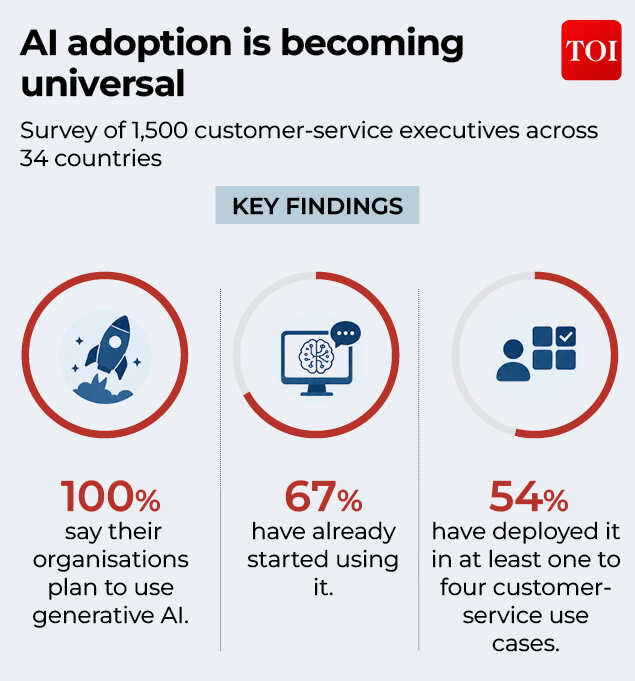
Instead of spending time on repetitive tasks, many focus on problem solving, critical thinking, quality assurance, and providing personal support during complex interactions.This shift also creates new responsibilities within customer service teams. Experienced agents help monitor automated interactions, review AI-powered responses, identify errors, and ensure customer conversations meet quality and compliance standards. As organizations continue to integrate AI into their workflow, the role of the human worker is gradually shifting from executing routine processes to supervising and completing them.Communication remains essential, but today it goes hand in hand with digital literacy, adaptability, and the ability to collaborate with artificial intelligence.Drawing on her experience, the former employee said that AI can efficiently handle routine requests such as password resets, account-related queries, basic troubleshooting and service requests. “However, situations involving complex problem solving, complaints, exceptions, or emotionally disturbed customers still require human support. Empathy, active listening, and the ability to make judgments are qualities that AI cannot fully replace,” she added.The headphone does not disappear. But the work behind it is changing.
Artificial intelligence still has limits
Despite rapid progress, artificial intelligence is not without shortcomings. Although they perform well at handling structured, repetitive inquiries, customer service becomes much more difficult when conversations involve ambiguity, emotions, or situations that fall outside pre-established patterns.AI systems can generate incorrect or misleading responses, a phenomenon known as “hallucinations.” They may misunderstand the context of the conversation, have difficulty interpreting humour, sarcasm or cultural references and have difficulty responding appropriately when clients feel upset or are dealing with sensitive issues. In such cases, human elements are often required to intervene.
Language remains another challenge. India is home to hundreds of languages, dialects, and dialects, making speech recognition a complex task. According to Probir Roy Chowdhury, Partner at JSA Advocates and Solicitors, one of the biggest privacy risks is that people often end up sharing much more personal information with AI chatbots than they realise. “In India, the primary responsibility typically lies with the company deploying the chatbot to consumers, because they control the customer interface, determine the purpose and means of processing personal data, and represent the service to the consumer,” explains Chaudhary.AI still faces difficulties when conversations require context beyond the information available to the chatbot, Sharma says. “There are also times when the LLM answers confidently, i.e., hallucinates even though that is not what the user requested,” he says, explaining why human agents remain necessary for complex or sensitive conversations.
So…will AI replace call centers?
For many years, customer service has followed a simple model: a customer calls, a human answers, and technology works quietly in the background.This balance is now changing. AI is increasingly becoming the first point of contact, handling routine inquiries, triaging requests, and resolving live issues before they reach anyone.
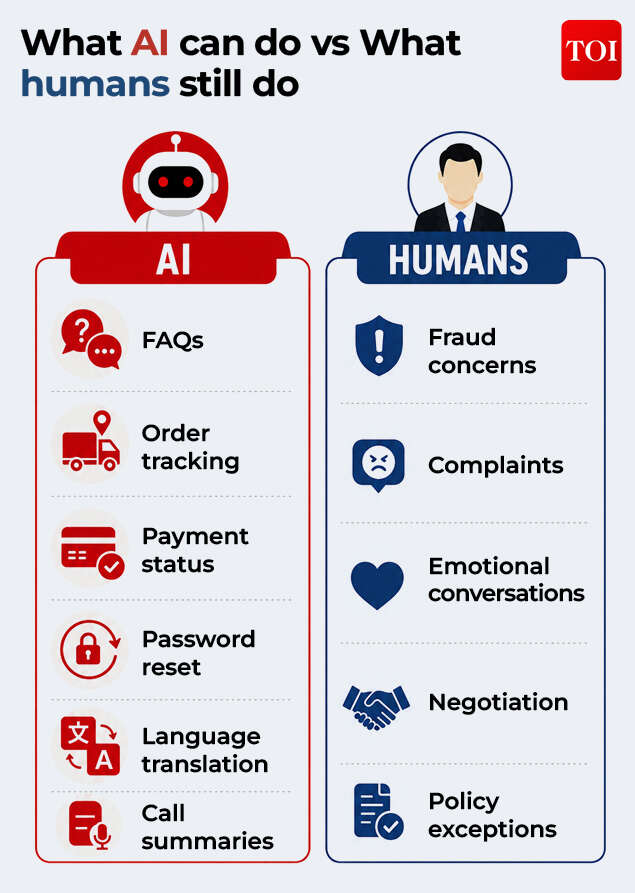
Human agents only intervene when conversations require judgment, empathy, or problem-solving beyond what algorithms can provide.This does not necessarily mean the disappearance of call centers. Instead, the nature of work is changing.
While AI handles repetitive, rule-based tasks, humans handle a smaller but more complex share of interactions.This also means that companies will need to invest in improving employee skills alongside responsible deployment of AI, ensuring that people and technology evolve together.The challenge is no longer choosing between humans and machines, but rather determining how the two can work together effectively.So the future of customer service is unlikely to be determined by humans versus AI. Instead, it is increasingly AI-first, with humans providing expertise, empathy and oversight that technology still cannot fully emulate.