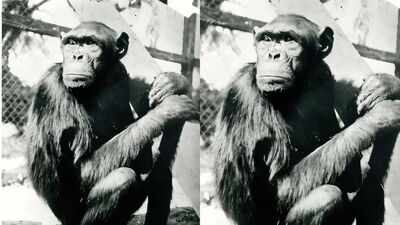
Sultan of the Chimps (Image credit: Zentrum für Geschichte der Psychologie, Julius-Maximilians-Universität Würzburg via University of Auckland)
More than a century ago, a small group of chimpanzees helped revolutionize the way scientists understand intelligence. Through a series of pioneering experiments on the Spanish island of Tenerife, these apes have demonstrated that they can solve problems using insight rather than relying solely on trial and error – a discovery that challenges long-standing assumptions about the uniqueness of human thinking.However, while their scientific achievements became famous, the fate of the chimpanzees themselves remained largely ignored. According to Dr. Javier Verrues Ortega’s study entitled “The Fate of the Sultan’s Clan”, published in the European Psychologist, newly examined archival records reveal what happened to this famous chimpanzee after she was transported to Berlin.
The chimpanzee who changed psychology
The Prussian Academy of Sciences established the Human Research Station on Tenerife in 1913, and the German psychologist Wolfgang Kohler served as its director from 1914 to 1920.
During this period, he conducted pioneering experiments that would reshape scientific understanding of animal intelligence.To answer this question, Kohler designed a series of experiments involving a group of chimpanzees that included Sultan, Rana, Chica, Grande, Terceira and Chigo. Instead of teaching them through repetitive rewards, present them with unfamiliar problems that require planning and creativity.
In one of the most famous experiments, bananas were hung out of reach while wooden boxes were scattered around a fence. Instead of making endless failed attempts, some chimpanzees stacked boxes to create a platform and climbed to get to the fruit. Another notable experiment involved placing sticks near food that is out of the animals’ reach. It is known that Sultan realized that two short sticks could be joined together to make a longer tool capable of bringing food together.
These solutions seem to have emerged through sudden understanding, or “insight,” rather than gradual trial and error. These experiments became landmarks in comparative psychology and helped prove that chimpanzees possess sophisticated cognitive abilities, radically changing scientific thinking about animal intelligence.
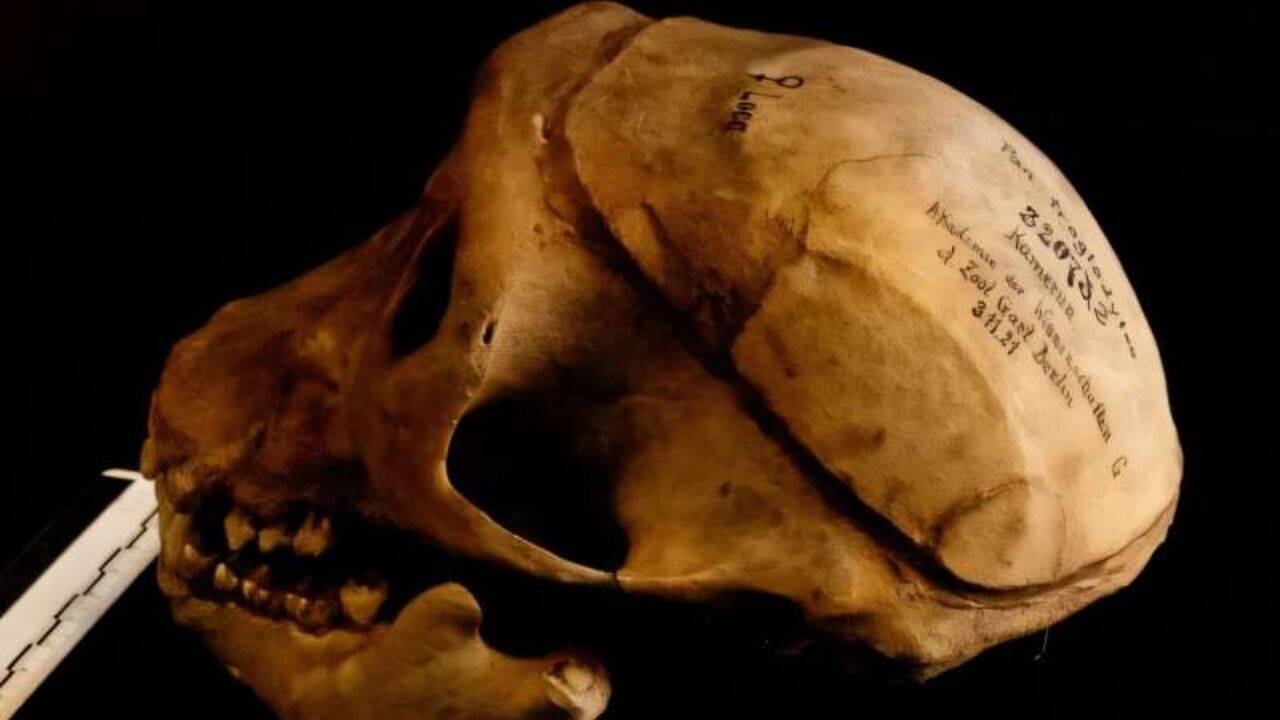
Skull of a chimpanzee named Rana Loka (Image source: Javier Virués-Ortega via University of Auckland)
From scientific stars to forgotten lives
Although Köhler’s experiments became world famous, the chimpanzee’s subsequent lives received little attention.When the Tenerife research station closed in the 1920s, the six remaining chimpanzees were transferred to the Berlin Zoo. For decades, historians knew very little about what happened after their arrival.New research pieces together their fate using zoo records, correspondence and other historical evidence. The findings reveal that life in Berlin was a far cry from the carefully managed research environment of Tenerife.
Born in the tropical forests of Cameroon, the chimpanzees struggled to adapt to Berlin’s harsh winters. The zoo also faced severe financial difficulties after World War I, which resulted in inadequate heating and a poor, starch-rich diet of bread and potatoes rather than fresh fruit.
Combined with illness, pregnancy, and social disturbances within the group, these conditions are thought to have contributed to the premature deaths of many chimpanzees.Researchers also rediscovered the preserved remains of several members of the Sultan clan in the Nature Museum in Berlin, where they remained unidentified for decades. Modern DNA analysis of these remains may help researchers better understand chimpanzee origins and genetic relationships, while preserving an important part of the history of psychology.The study also documents how chimpanzees endured economic hardship in the interwar period, which further affected conditions at the Berlin Zoo.
Their welfare has steadily declined, and the chimps who once helped reshape psychology have disappeared, one by one, from the historical record. Only later did researchers begin to reconstruct their forgotten stories through archival evidence.
Why is their legacy still important?
The researchers believe that remembering the lives of chimpanzees is no less important than celebrating the scientific achievements that made them possible.Today, studies continue to show that chimpanzees use tools, cooperate with each other, plan ahead, and exhibit complex social behavior.
Many of these discoveries build on the foundations laid by Köhler’s pioneering work on Tenerife.However, new historical research reminds us that scientific progress often depends on living animals whose well-being deserves equal attention. By tracing the lives of the Sultan clan outside the laboratory, the researchers highlight the need to acknowledge not only their role in the advancement of knowledge, but also the difficulties they faced after the experiments ended.More than 100 years later, the story of Sultan, Rana, Chica, Grande, Terceira, and Chigo stands as a landmark in the history of psychology and a powerful reminder of the ethical responsibilities that accompany scientific research. Their remarkable intelligence has changed the way humans think about the minds of other animals, while their largely overlooked final years underscore why compassion and animal welfare should remain central to modern science.