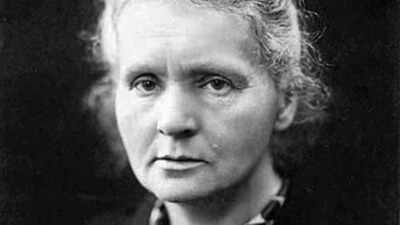
Marie Curie and her husband spent nearly four years boiling seven tons of pitchblende in a leaky, unventilated Parisian shed to isolate a tenth of a gram of radium chloride.
Today, the notebooks they kept during those years, between 1899 and 1902, are kept in lead-lined boxes in the National Library of France. Anyone who wants to see them must sign a waiver and wear protective gear beforehand. The same goes for her cookbooks, furniture, door handles to her old apartment, and even her coffin.The radioactivity she and Pierre extracted from eight tons of Bohemian pitchblende in a leaky Parisian shed has a half-life of 1,600 years, and will still be measurable when the person reading this is just dust.
Half-life is the amount of time it takes for a radioactive nucleus in a sample to decay into a more stable element. The pair spent nearly four years grinding, boiling, melting and recrystallizing what became about a tenth of a gram of radium chloride, less than a grain of rice.
The shed on Lomond Street
Their workspace was not the modern laboratories that scientists are accustomed to these days. It was an abandoned dissection room behind the Municipal School of Physics and Industrial Chemistry, with a glass roof that leaked when it rained, and no smoke hoods of any kind.
In the summer, bread. In the winter, the Curies wrote about their fingers going numb around iron stir bars.Pitchblende is a dense, black-tar uranium ore. The Curies, through microelectrometer measurements that Pierre refined with his own piezoelectric instruments, concluded that pitchblende was more radioactive than the uranium it contained. Something else has to be there. Something rarer and stronger.The Austrian Imperial Government agreed to ship the waste ore remaining after uranium extraction for glassmaking to the Curie family. Eight thousand kilograms of it arrived on carts dumped in the courtyard, mixed with pine needles coming from the Bohemian forests. Mary processed it in batches of twenty kilograms. “I had to spend a whole day mixing a boiling mass with a heavy iron rod about my size,” she later wrote. “I will feel tired at the end of the day.
“
Koreans work
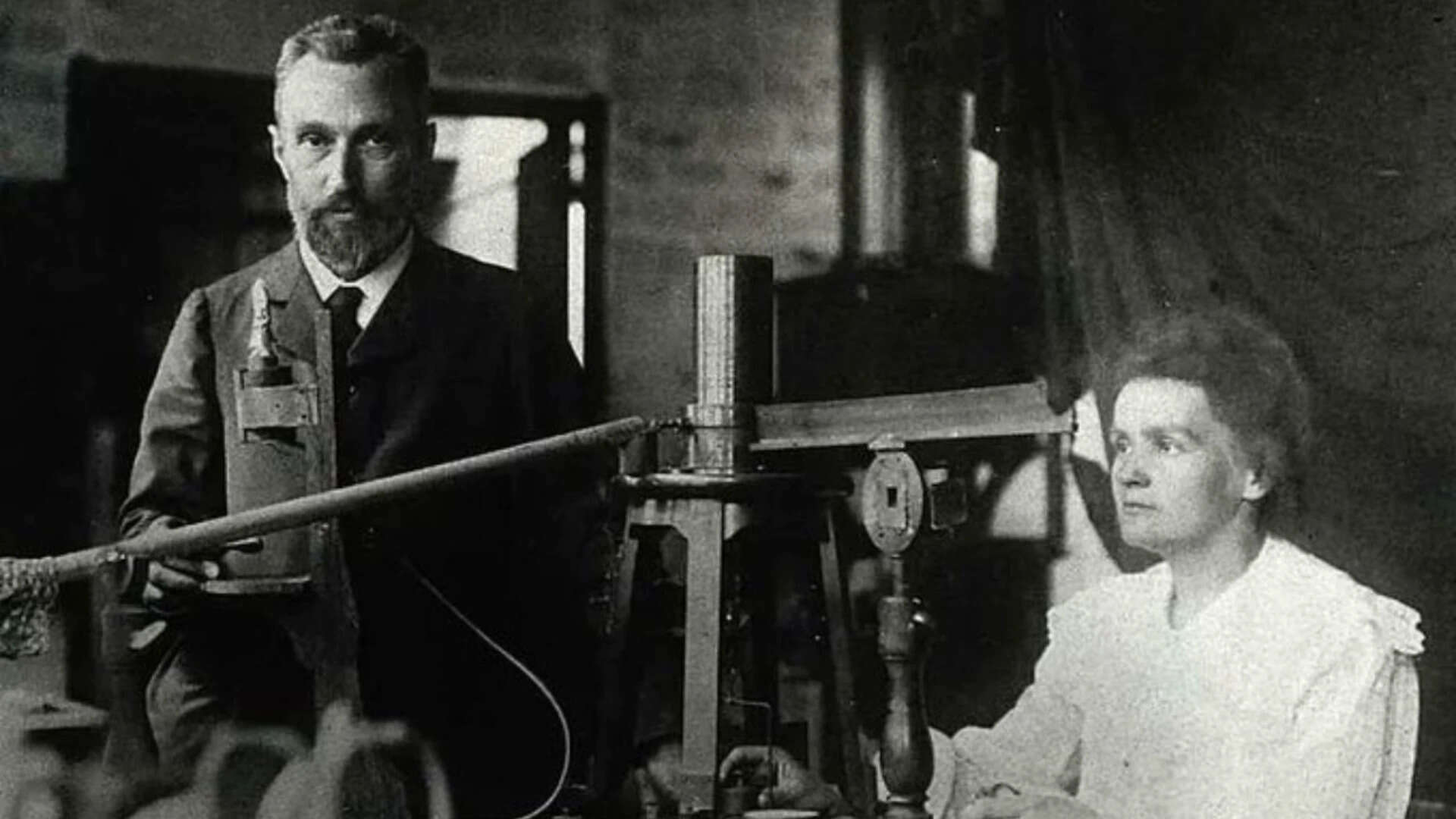
Mary had to perform thousands of partial recrystallizations, exploiting the small difference in solubility between radium chloride and barium chloride in hydrochloric acid.
The chemistry was just brutal repetition. Dissolve pitchblende in hydrochloric acid. Precipitates sulfides. Separate what stays active from what doesn’t. Then do it again with the active fraction. Over and over again. Radium behaves chemically just like barium, which is why the ore contains radium at all, and why isolating it was so painful. Mary had to perform thousands of partial recrystallizations, exploiting the small difference in solubility between radium chloride and barium chloride in hydrochloric acid.
Each cycle concentrated the radium a little more and took hours.By 1902, she had her own decigram. She measured the atomic weight of radium at 225, which is close to the modern value of 226. The material glows in the dark, warm to the touch, and gives off heat with no obvious fuel. Pierre carried a small vial of it in his waistcoat pocket to show to visitors. By then, their fingertips had become raw and inflamed, and so were hers.
Some doses of radium
In 1990, people did not understand ionizing radiation the way they do today.
The Curies knew that radium caused burns, so Pierre deliberately taped a sample to his arm to monitor the lesion. They knew it could destroy cancer cells, which is why radium therapy became one of the first cancer treatments.What they don’t get is cumulative exposure, inhaling alpha particles like radon, beta particles from decay products deposited in bones, and gamma rays that pass through everything. Mary stored radium samples in her desk drawer at home.
She and Pierre described the shed years as “the best and happiest of our lives,” and would return in the evenings to watch the tubes glow on the shelves like “dim fairy lights.”It became such an integral part of their lives that she died in 1934 at the age of 66 from aplastic anemia. Even her daughter Irene, who worked with her at the Radium Institute, died at the age of 58 from leukemia. Both diseases were consistent with prolonged radiation exposure.
Radioactive objects
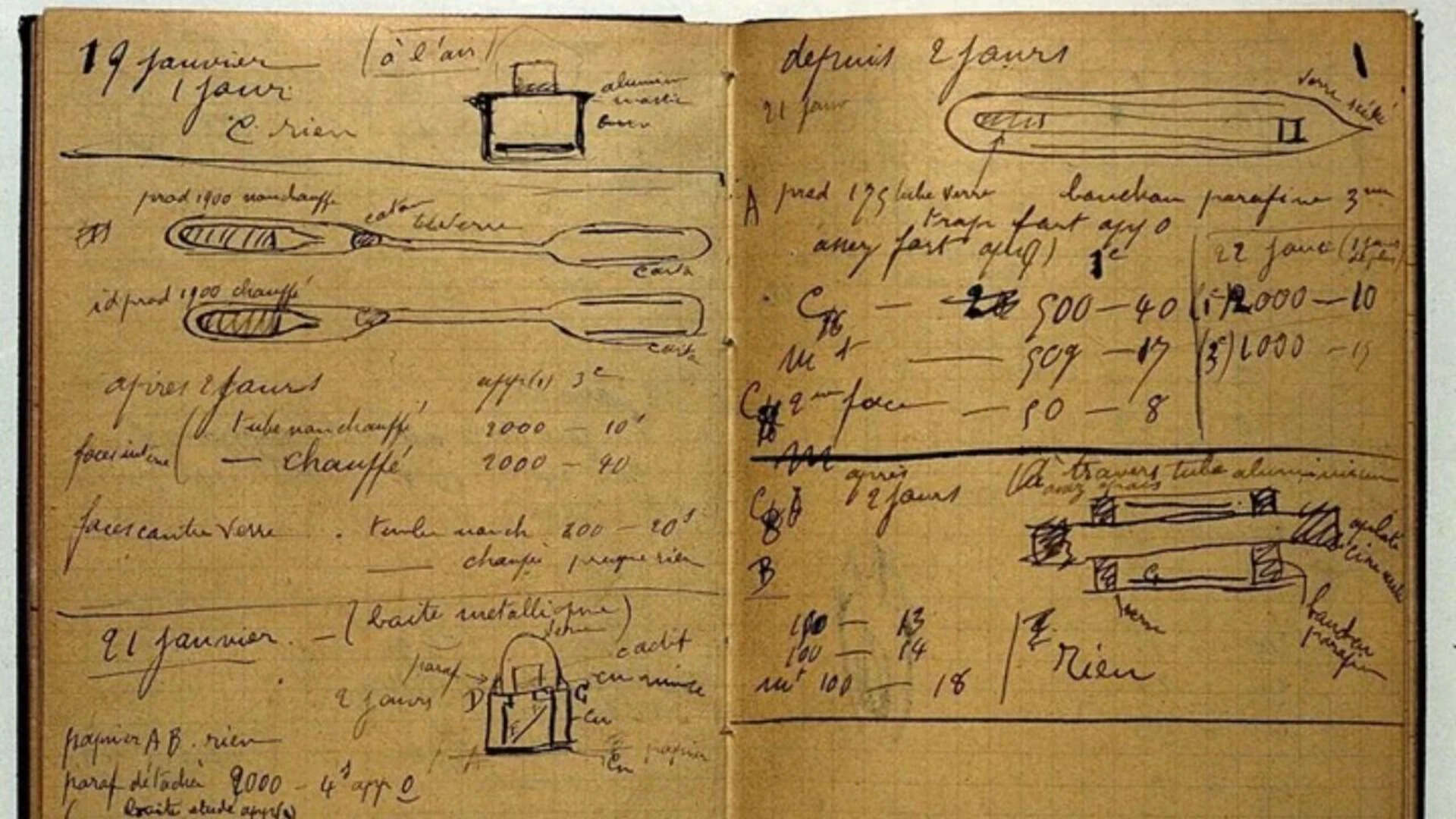
The radium contamination that Mary traced on her fingertips in her laboratory notebooks in 1902 had decayed by less than five percent in the intervening years.
The half-life of radium-226 is about 1,600 years. Which means that the radium contamination that Mary traced on her fingertips in her laboratory notebooks in 1902 has faded in the intervening years by less than five percent. It’s basically as radiant as it was the day it was written.Today, the French National Library keeps its papers in lead-lined boxes. Researchers who wish to consult them must sign a disclaimer and handle the pages with protective equipment.
Not only books, Marie’s personal belongings at the Curie Museum in Paris, such as furniture, chairs and cookbooks are also protected in this way.In 2025, the BBC followed radiological surveyors tracking the Curie family’s movements around Paris, and they still found contamination in plaster and floorboards in buildings where the couple had worked more than a century earlier.Her body itself was buried in a lead-lined coffin. When her remains were transferred to the Pantheon in 1995, the first woman to be buried there on her own merit, the coffin was protected by a lead lining because her bones remained noticeably radioactive.
Two nobles and a radiant notebook
The Curies were so enamored with science that when advised they refused to patent the extraction process. Radium belongs to science, Mary said. In 1903, the Nobel Committee awarded the Physics Prize jointly to Henri Becquerel and Pierre and Marie Curie for their work in the field of radioactivity, a word coined by Marie. She was the first woman ever to win a Nobel Prize. Corey did not attend the ceremony. Pierre was ill and Marie was recovering from her miscarriage.Three years later, on April 19, 1906, Pierre stepped off the sidewalk on the Rue Dauphiné in the rain and was struck by a horse-drawn carriage. The wheel crushed his skull. The Sorbonne handed Marie the teaching position, making her the first woman ever to hold a professorship at the ancient university. In 1911 she won her second Nobel Prize, this time in chemistry, for isolating radium and discovering polonium, named after her occupied homeland.
She remains the only person to have won the Nobel Prize in two different sciences.The shed on Lomond Street is gone. The Radium Institute, which she founded, still exists, and is now part of the Curie Institute, one of the world’s leading cancer research centres. The gram of radium she brought with her from the United States in 1921, after a fundraising tour organized by American journalist Mary Meloni, remains in the institute’s collection, stored under heavy armor.The use of radium has largely ceased, but portable computers still exist. If you visit the National Library and request to see Marie Curie’s manuscript pages, the librarian will bring you a Geiger counter reading along with the request form. In the year 3626 AD, when the radium they smeared on the pages had decayed by half, the pages would still bear what they had discovered.