The launch vehicle is capable of carrying payloads weighing up to 350 kg to a low Earth orbit with a length of 450 km and an inclination of 60 degrees.

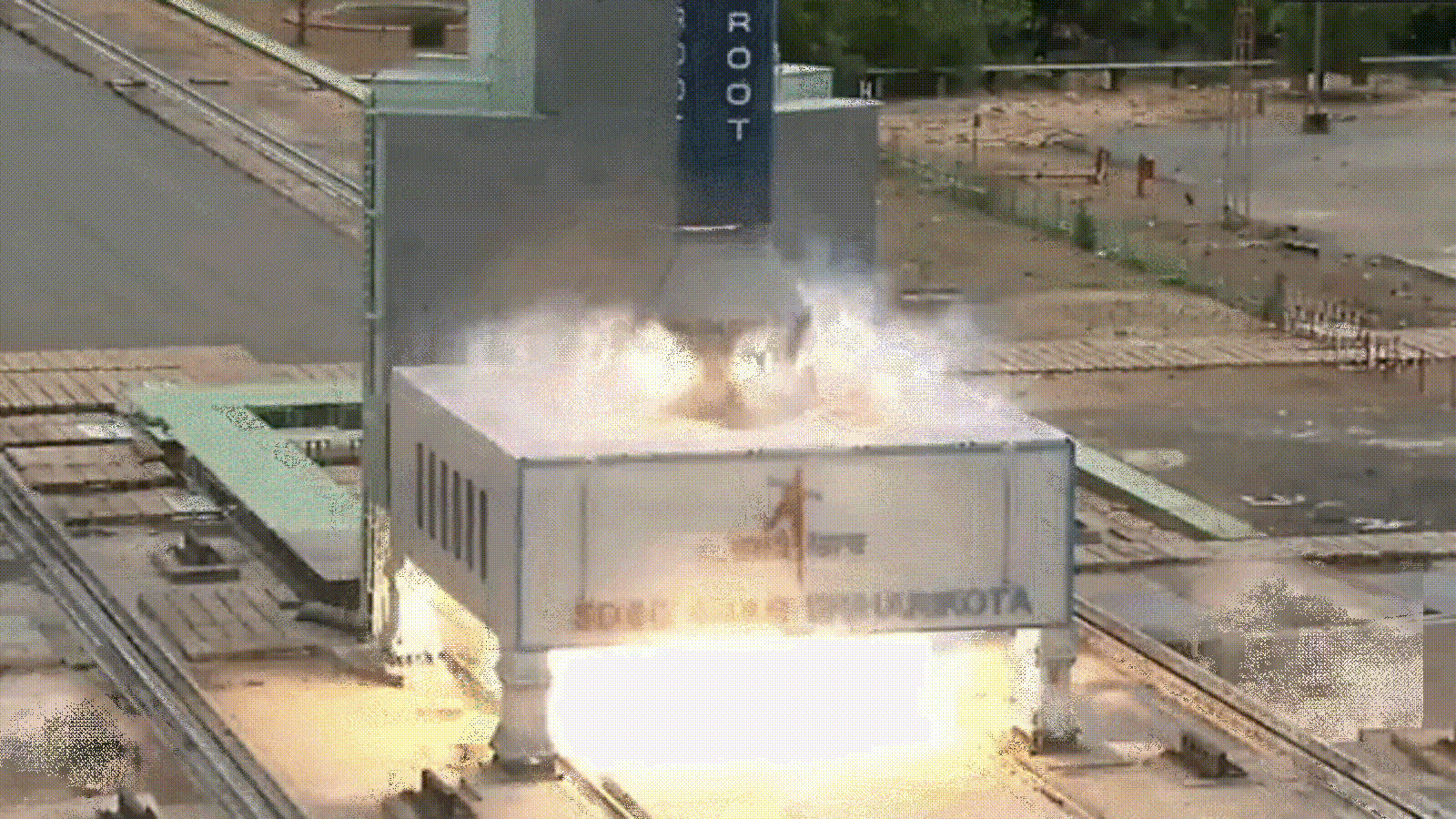
India’s first specially developed orbital rocket, Vikram-1, lifted off from the Satish Dhawan Space Center in Sriharikota on Saturday. It is a major milestone for the country’s private space sector and its commercial launch ambitions.
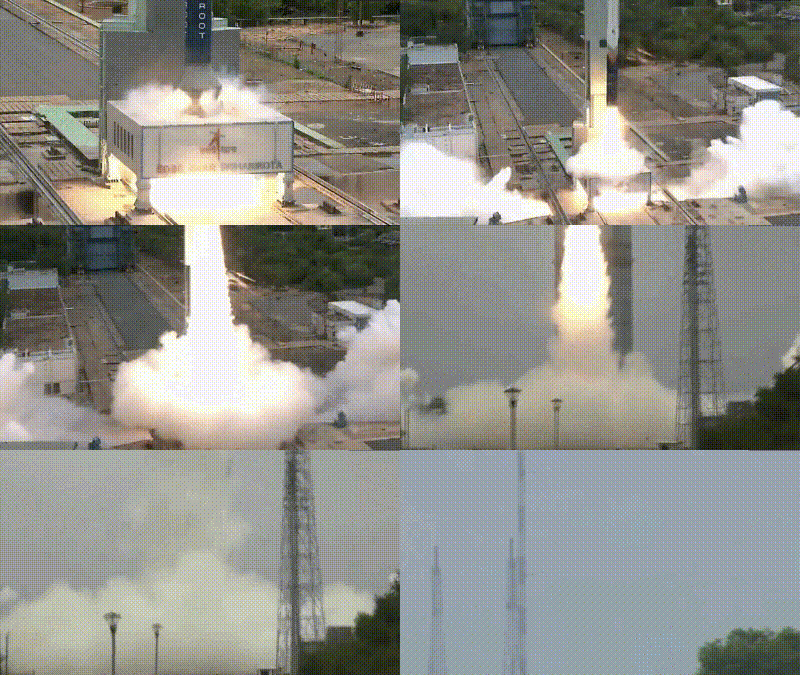
The mission developed by Hyderabad-based Skyroot Aerospace, called Mission Aagaman, is the first attempt by a private Indian company to place satellites in low Earth orbit (LEO).
Skyroot founders Pawan Kumar Chandana and Naga Bharat Dhaka, both former ISRO scientists, witnessed the launch from the Mission Control Center along with ISRO Chairman V Narayanan. Former ISRO chiefs, astronaut Shubhanshu Shukla and Andhra Pradesh Minister Nara Lokesh were also present.
Modi called the founders of Skyroot Aerospace to congratulate them on the successful launch, PTI reported.
Successful launch after planned delay
The launch saw a brief delay after the mission control team put a countdown to the planned wait just minutes before the scheduled 11.30am liftoff. The launch was later completed successfully at 12:05 PM.
This launch has already secured its place in the history of the Indian space programme. This is the country’s first attempt by a private company to put satellites into orbit.
Read also | PM Modi Wishes Skyroot Success Ahead of Vikram-1’s First Orbital Launch: ‘A New Historic Frontier for India’
“History is being made”
Skyroot Aerospace wrote on the
In another post, they wrote: “Hello space, we are here! The test flight of Vikram-1 has completed its mission. India’s first ever private sector launch has been successfully launched.”
Successful deployment of payloads
After liftoff, Vikram-1 inserted multiple payloads into a 450 km low Earth orbit. The mission carried technology demonstration payloads from Grahaa Space, Cosmoserve Space, DCUBED, and Skyroot Aerospace’s indoor SCOPE satellite.
The rocket also carried several souvenir payloads, including a handwritten postcard from Modi with the message ‘Vande Mataram’, postcards from Indian engineers, scientists and astronauts, an 18-carat gold miniature rocket, and a small art installation, according to a government statement.
The fine art load features miniature sculptures by Vikram Sarabhai, Sir CV Raman and APJ Abdul Kalam. According to Skyroot, the artwork honors the three pioneers whose works laid the foundation for India’s science and space programmes.
Mission statements to support future launches
Skyroot Aerospace said data generated during the first flight will be analyzed to evaluate the missile’s guidance and navigation systems and support improvements for future commercial launch missions.
The successful mission also demonstrated the performance of Vikram-1’s lightweight all-carbon composite structure and 3D printed engines under actual flight conditions.
A milestone for the private space sector in India
The flight is Skyroot’s transition from suborbital to orbital launch. While Vikram-S successfully completed a suborbital mission in 2022, Vikram-1 became the company’s first rocket to put payloads into orbit.
Loads on board
The mission carried Embrace by Cosmoserve Space, an in-orbit demonstration of robotic arms designed to clear future space debris; Solaras from Grahaa Space, a small satellite that tests new technologies in low Earth orbit; and SCOPE, Skyroot’s experimental payload developed to validate technologies for future missions.
Also on board were Cosmic Bloom, a technical diamond produced in the lab by Cosmos Diamonds, and DCUBED’s German technology demonstration payloads uD3PP and mD3RN.

Follow the latest breaking news, key developments and agenda-setting stories from India and around the world with Hindustan Times Newsdesk. Operating around the clock, the bureau brings together experienced editors, reporters and correspondents to deliver fast, accurate and contextual reporting across topics affecting public policy, governance, business, society and international affairs. The HT Newsdesk covers politics, elections, government policy, economics, business, markets, science and technology, environment, law and order, infrastructure, education, climate issues and geopolitics, while closely tracking developments across countries, institutions and global capitals. The team also leads coverage of major breaking news events, policy announcements, court proceedings, natural disasters, public emergencies and significant international developments. Reports published by the News Desk are based on information gathered from reporters on the ground, official statements, government agencies, court records, regulatory files, recognized institutions and other official sources. Stories undergo editorial review and verification to ensure accuracy, fairness and appropriateness, and are updated as events develop and additional information becomes available. Whether covering a major policy decision in New Delhi, an economic policy shift affecting millions, a landmark court ruling or a major global event, the HT News Desk aims to provide readers with trusted, fact-based journalism that provides not only the latest developments but also the context and analysis needed to understand their wider implications.Read more