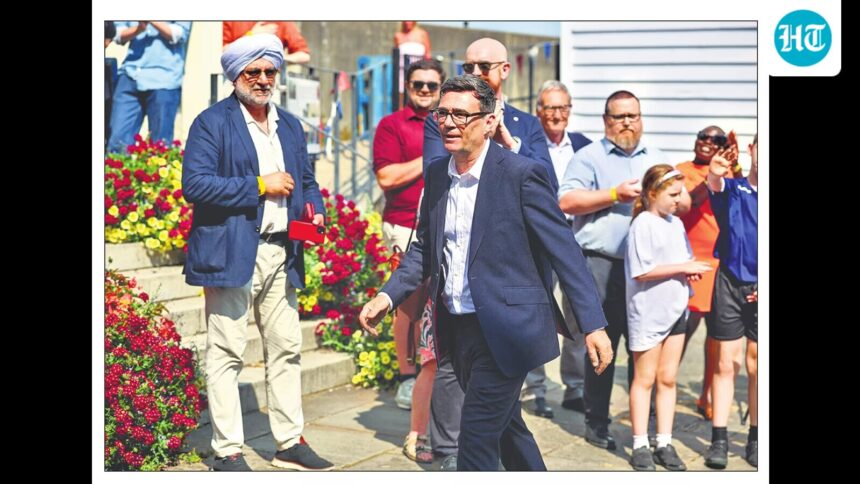
Labour’s Andrew Murray Burnham, 56, known as Andy, will on Monday become Britain’s 59th Prime Minister after a mandatory audience with Britain’s King Charles III. In a somewhat revolving door scenario, he would be the seventh incumbent in a decade.
Burnham was elected Labor leader by acclamation – meaning a coronation rather than a traditional contest – with nearly 90% of his party’s MPs rallying behind him, leaving no room for another candidate. Under Labour’s rules, a candidate needs the support of at least 20% of MPs to be eligible to run for party leadership.
On Friday, in his first speech as outgoing Prime Minister Keir Starmer’s official successor and prime minister-in-waiting, Burnham said net migration – a thorny issue – “must go down further”. He spoke of “returning power to societies” and adopting a new path from “the past forty years.” He said his approach would be “distinctly Labor, unashamedly Labour”, pledging more “general control” of the British economy and “re-industrialisation”.
To achieve his goal, Burnham would need financial resources, which suggests high indirect taxes. There is buzz about the appointment of Pakistani-born Interior Minister Shabana Mahmood, a lawyer, as a potential Treasury adviser. What ministerial portfolio will be allocated to Lisa Nandy, the half-Indian who is now Culture Minister and Burnham’s ally, is another topic of discussion.
If India is interested in the continuity of London’s policies – in light of the trade agreement – New Delhi may be reassured that Burnham will not want anything other than successful trade relations. In fact, there is talk in the corridors of Whitehall that he may lead a trade mission to India this year itself to strengthen economic ties.
The administration of US President Donald Trump – amid tense Anglo-American relations – will be a priority. This may be a challenge, because in the eyes of the White House occupant, Burnham is more liberal than Starmer.
As Mayor of Greater Manchester, Burnham was impressed by China’s high-speed rail network. As prime minister, he will have to balance economic benefit against security risks. Relations with Russia will remain in a frozen state until a settlement is reached in Ukraine. He is expected to adjust Britain’s Palestine policy to make Israel more accountable – as Starmer’s softness towards Tel Aviv has cost Labor traditional left-wing and Muslim support.
More importantly, as Starmer plans, Burnham is likely to reverse Brexit to the point of restoring frictionless trade in goods with the EU. It is conceivable that this will reignite Britain’s stagnant economy.
Burnham will inherit an economy in better shape than the Tories left it two years ago; But there is still a little room to spend. It needs much faster GDP growth, lower costs of living, and greater investment in the National Health Service (NHS) to witness the unprecedented rise of the far-right Reform Party in the UK.
Unlike the half-dozen Oxonians who preceded him in the past 10 years, Burnham – an Everton Football Club fan who still dribbles enough at weekend matches – reads English at Cambridge, loves poetry and insists on writing his own letters.
Burnham is no stranger to London. In 2001, he was elected MP for his home city of Leigh in Greater Manchester. He served as Secretary of State under Tony Blair, before being promoted to ministerial positions in Gordon Brown’s subsequent government, first as Secretary of State for Culture, Media and Sport, and then Secretary of State for Health. After Labour’s defeat in 2010, he unsuccessfully contested twice to become party leader. He resigned as an MP in 2017 to become the first elected Mayor of Greater Manchester, where he has by all accounts been a huge success.
In 2024, Starmer led Labor to a landslide victory and a remarkable comeback after the party’s devastating defeat five years earlier, when the radical leftist Jeremy Corbyn was in power. But in May, voters, increasingly frustrated with Britain’s stagnant economy, inflicted heavy losses on Labor in local and regional elections, including ousting it in Wales for the first time since devolved government emerged there in 1999.
The question therefore became not whether Starmer would step down, but when. The answer was given conclusively when Burnham returned to Westminster with an unequivocal victory in the parliamentary by-election in Makerfield, in the backyard of his Greater Manchester home, on 18 June. Burnham succeeded in turning the tide against Reform – which swept the council in local elections in the same area in May – by attracting more than 54% of the vote.
Burnham’s ambitions to run the Labor Party, and thus the UK Prime Minister, were clear at the party’s annual conference last autumn. He has refused to rule out aspirations for the top job, even criticizing the fiscal benchmarks set by Starmer and his adviser Rachel Reeves by suggesting the government is “burdened” on bond markets. Burnham began his career as a Blairite centrist, but has since shifted steadily to the left. He therefore appears to be more socialist than Starmer. He called for the renationalization of water and energy to reduce the burden on consumers.
His critics described Burnham as a weathervane, bending with the political winds to seize his opportunities. He clearly did not fit in with Corbyn’s hard-left side, but served in his shadow cabinet. Without confrontation, he made the smartest decision of his career to withdraw into local government, resulting in a successful job as Mayor of Greater Manchester, not to mention being approved by voters three times.
The mayoralty as a stepping stone to the role of head of national government is more of a phenomenon in continental Europe than in Britain. Konrad Adenauer, Willy Brandt, and more recently Olaf Schulz have followed this path in Germany. In France, Jacques Chirac was the mayor of Paris before becoming president of France. Turkish President Recep Tayyip Erdogan was the mayor of Istanbul. In the United Kingdom there is no such example. The Mayor of London, Sir Sadiq Khan, has just been pushed to the top floor of the House of Lords, making him ineligible to occupy 10 Downing Street.
UK Prime Ministers have praised it mostly from England. Arthur Balfour, Ramsay MacDonald, Alec Douglas-Home and Gordon Brown were Scottish. David Lloyd George was from Wales. Even within England, men and women who came from or settled in the prosperous South rather than the poor North enjoyed this honor. Burnham will be the first northern Englishman to serve as Prime Minister since Labour’s Harold Wilson in the 1960s and 1970s.
This is important because the north of England has for decades been a Labor stronghold, but has recently been undermined by Reform’s inroads into the white working-class vote. This part might be too cozy for Burnham, a self-proclaimed northerner who can be embraced as one.
Amid growing irreligiosity among British Christians, the majority of Britons, if anything, adhere to the Church of England; Historically, most British prime ministers have embraced this faith, even if they have not practiced it. Burnham describes himself as having been raised Catholic, but “not particularly religious.” This will have little importance in today’s multicultural Britain, even if it is threatened by the racism of reform, as long as it achieves its goals, especially on the economic front.