After every acting job, Scoot McNairy likes to get a haircut, head to the store to buy some new shirts, and wash whatever photo he just came out of while getting ready for the next movie. with The Life and Deaths of Wilson Sheddafter the actor took on the most intense leading role of his career, the motivation was stronger than ever: “I remember Insistently “I want to cut my hair after this job,” he says, laughing, in his first conversation about the film, which sources confirm to Hollywood Reporter It will premiere later this year. “It amazed me for a while – and it still amazes me now when we talk about it.”
Tracks it Wilson Shade Directed by a great actor in Tim Blake Nelson, who has also directed features like Gray area and Grass leaves Over his decades in the business. The film is a major showcase for its stars – McEnery, who is known for supporting roles in films such as Argo and Completely anonymousmakes transformative work as the title character, Amanda Seyfried, emerges from the wilderness Anne Lee’s testimony and the maid To one of the most emotional roles of her career. The group is filled with actors like Wonmi Mosaku, Elizabeth Marvel, Missy Pyle, and more.
“I want every actor I respect or love in my life to work with Tim Blake Nelson, because this is so far beyond any experience I’ve ever had with a director,” Seyfried says. “I trust him more than I trust any director I’ve ever worked with. It’s almost sacred to be on set with him.”
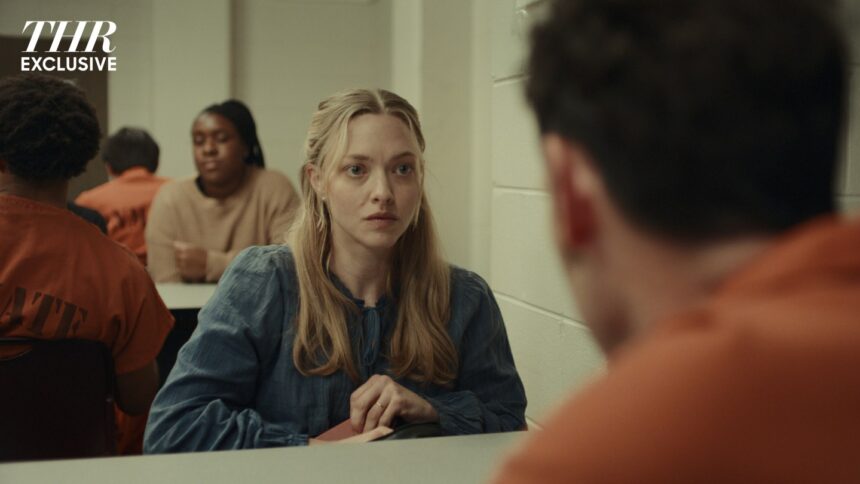
Wilson Shade The film deals with the complex relationship between Karen (Seyfried), the new English teacher at an Oklahoma prison, and the incarcerated student she is attracted to (McEnery). The project has been in development for more than a decade, and Nelson was first inspired to write it after the national frenzy over the prison break at Clinton Correctional Facility in Dannemora, New York. Ben Stiller later made his own miniseries based on those events, Escape in DannemoraJust as Nelson’s idea evolved anyway, as he conceived and expanded the story.
“This film aims to address, on all levels, the things that we as human beings can do to each other,” Nelson says. The film progresses non-linearly between three timelines, anchored by the evolving, complex, and ultimately tragic relationship between Karen and Wilson. They are both desperate characters searching for their own escape; Trapped in a physically abusive marriage to drunken Kenneth (Grant Harvey), Karen finds real connection and dangerous opportunity in Wilson.
In fact, their growing bond fuels the film like a thriller — even though we barely see them alone together. “This kind of approach, which involves a story being told out of sequence and requires a level of trust in the audience’s ability to put things together without it being handed to them, really requires a balance between the two characters and their paths,” Nelson says. “It really interested me in trying to make a movie where the two main characters only have one scene together.”

More often than not, Karen and Wilson recognize each other in the classroom, exchanging glances, written notes, and cryptic comments. Remarkably, though, Seyfried and McEnery only overlapped for three or four days Wilson Shade It depends entirely on their dynamic. “It was frustrating, but there was something cool about it because I didn’t really know him,” Seyfried says. “We had to work harder.” Their one scene together, the Oscar nominee continues, was “the most exciting experience in a scene I’ve ever had in my career…. The script is full of tension and excitement, but also danger. And in that moment, it was all there.”
“You come across someone who is one of the scariest people in the world — someone who has nothing to lose,” says McNairy. “When he meets Karen in that prison for the first time, does he really love her? Maybe, but thinking about his idea of a relationship – what is the illusion in his psyche, because he’s so damaged at the end of the day?”
Nelson, a published novelist, also has his fill Wilson Shade With his deep love for literature. The works of Ernest Hemingway and Emily Dickinson both literally and dramatically shape the plot, while the work of Flannery O’Connor shaped the screenplay — most directly, the short story “A Good Man Is Hard to Find,” which inspired a harrowing main interlude centered around a family (whose parents are portrayed by William Jackson Harper and Devin A. Tyler) that clashes with the main story.
“It was definitely in me,” Nelson says. “Those references are essential to me.”

As the protagonist, Wilson poses a unique challenge to the audience; Nelson and McEnery are not shy about revealing the reason for his conviction, nor his history of violence. “It’s not based on the character’s innocence or repentance — that puts a lot of pressure on the lead actor because you need to shame him and sympathize with him,” says the director. “I can think of few actors who can strike that balance the way Scott does. The fact that he’s unknown in the lead actor field is incredibly beneficial to the film.”
“Here’s a guy who’s done some really terrible things…He’s been so damaged, but he doesn’t even know how to ask for redemption,” McEnery explains. “I’ll be honest with you, I don’t really get opportunities to play like these guys.”
Nelson has repeatedly collaborated as an actor with the likes of Steven Spielberg and the Coen Brothers; His screen history indicates an interest in complex characters and visceral filmmaking. This is increasingly evident in Wilson Shadeespecially when it comes to the depiction of violence – cruel, if not completely gratuitous.
“If the violence had not been depicted responsibly, but also depicted so blatantly, this particular film would not have had the power it has,” Nelson says. “There is an element of suspense to the film, and through that engagement, I think the film engages the audience in a way that makes them able to examine some deeper themes.” “I hate filming it,” Seyfried says of her most physically brutal scene. “I know I’m not able to hold back when I’m acting. … Grant and I definitely accidentally hurt each other’s genitals that day.” “But Tim is also incredibly protective of us from all angles.”
Wilson Shade It develops into a stark meditation on tolerance, with Nelson pulling back from his literary references while ultimately letting his flawed and fascinating protagonists lead the way: “If the characters are surprising me with their actions, they’ll probably surprise the audience too if I can put them in the right ways,” he says. The final act confronts the cancerous system and its most controversial and confusing elements, with Nelson bringing viewers into these scenes with unflinching realism.
“I wanted to take the harder and more treacherous path,” he says.
The substance bounced back on Seyfried, who is no stranger to dark materials. “It was very difficult to get that excited and upset — and that vulnerable. It was very difficult emotionally,” she says. “There’s always a bunch of things in every movie where I’m like, ‘I shouldn’t be doing this anymore.’ Those are the scenes that you eventually try to forget, and then the ones that will haunt your dreams. That still haunts me. So I’ll see how I feel about it when I see it.”
Then you make sure to add, “Listen – I’m glad I did that.”