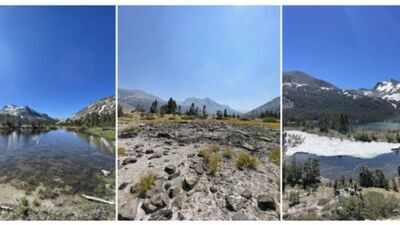
Sierra Nevada pond during low and high snowfall years, showing how snow levels change the landscape. (Photo: Christine C. Bonadonna)
High in California’s Sierra Nevada Mountains, small ponds may seem peaceful and untouched. Surrounded by rocky peaks and open skies, it seems peaceful during the summer. But below the surface, these shallow bodies of water are constantly changing.A new study finds that these mountain ponds are among the most thermally altered freshwater ecosystems on Earth. The water temperature can change by more than 36 degrees Fahrenheit or 20 degrees Celsius within a single day. Researchers say that one of the main factors behind these dramatic changes is not the summer weather, but rather the amount of snow that fell months ago during the winter.The study, published in the journal Ecosphere and published by Science
It affects their size, water temperature, nutrient levels, and even the small animals that live in them. The results also suggest that as climate change reduces snowfall, these ponds could become warmer, smaller and more nutrient-rich.
30 ponds, four summers
The research began when two graduate students working in high-altitude pools realized their studies were connected. Christine Bonadonna, then a doctoral student at the University of California, Irvine, and Mary Jade Farrugia, then a doctoral student at the University of California, Davis, joined forces to better understand these often overlooked ecosystems.
Together, they studied 30 mountain ponds across the Sierra Nevada over four summers. Their research covered drought years and one of the highest snowfall years on record.The ponds are located at altitudes ranging from about 2,300 meters to more than 3,400 metres. This allowed researchers to compare how different snow conditions affected ponds across the mountain range.
Falling snow forms puddles
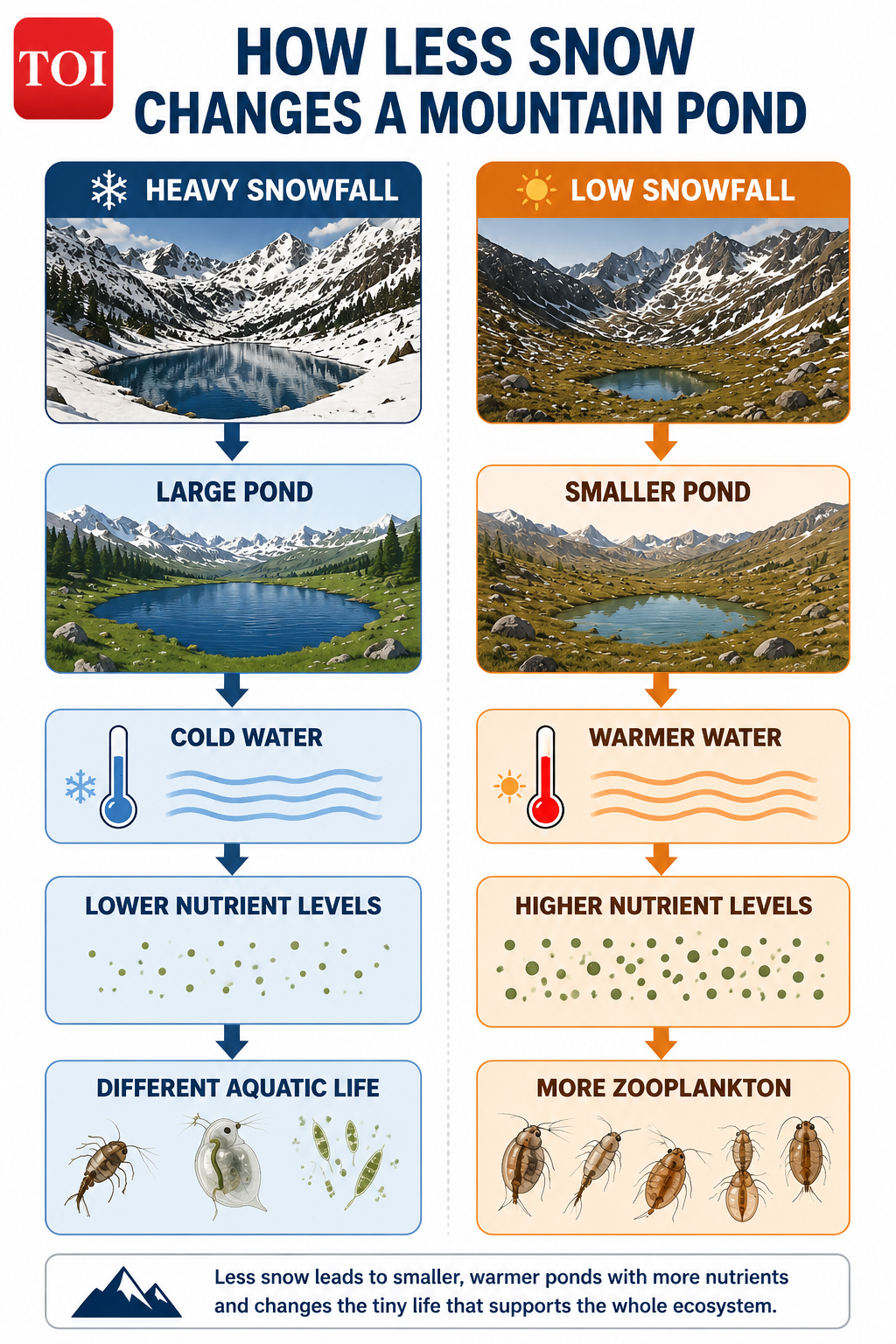
The researchers found that winter snowfall acts as a “primary driver” of pond conditions during the summer.In years with heavy snowfall, the melting snow kept the ponds larger, colder and more diluted. As a result, nutrient concentrations remained lower.But during years with less snowfall, the ponds became smaller and warmer. Nutrients become more concentrated due to less available water.These changes also affected the animals living in the ponds. Warmer years and less snow supported greater zooplankton populations.
These microscopic animals are an important food source for many larger aquatic species.
.
Sudden daily cycle
The study also revealed another unusual feature of these mountain pools. Researchers found that the pond water mixed almost every night during the summer.As temperatures drop after sunset in the high mountains, surface waters cool and subside. This makes the entire pond rotate causing the water to mix from top to bottom.This daily mixing contributes to the large temperature fluctuations seen in ponds. It differs from many basins at lower elevations, where warm water usually stays near the surface while cold water stays below in separate layers.Scientists say that this constant mixing is one of the reasons why these small ponds undergo such extreme changes within a single day.
Impact of climate change
These results come at a time when scientists expect a significant decrease in snowpack across the Sierra Nevada due to climate change.According to the climate forecasts mentioned in the study, the region may lose up to 70% of its snow mass by the end of this century.If this happens, many of the mountain basins that still exist will likely become warmer, experience greater temperature fluctuations, and contain higher levels of nutrients.Such changes could reshape the plant and animal communities that depend on these freshwater habitats.
Small pools, bigger role
Although these ponds are small and often receive little scientific attention, researchers say they are important parts of mountain ecosystems.Farrugia, now a postdoctoral researcher at the Arctic and Alpine Research Institute at the University of Colorado Boulder, said the study highlights their ecological importance.“This work highlights that although these ecosystems are small and often not formally studied, they are important components of our mountain ecosystems,” Farrugia said, quoted by ScienceX.“Ponds are ubiquitous across the landscape, processing nutrients, cycling carbon and contributing to biodiversity at levels that cannot be ignored.”She added that more research is needed to understand how these ponds will respond as climate conditions continue to change.