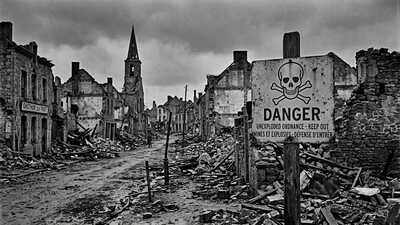
During World War II, a small, uninhabited island off the northwest coast of Scotland became the site of one of Britain’s most secret military experiments. In 1942, Gruinard Island was deliberately contaminated with anthrax spores as part of a secret biological warfare program designed to test whether the deadly bacteria could be used against enemy livestock.
The experiments proved devastating, not only to the animals used in the tests, but to the island itself. Anthrax spores have been present in the soil for decades, making visiting the island extremely dangerous. According to BBC Culture, Gruinard Island became known locally as the “Isle of Death”, remaining under official quarantine for 48 years before the UK government finally declared it safe in 1990.
Why did Gruinard Island become Britain’s “Island of Death”?
In 1942, as Britain searched for ways to counter the threat posed by Nazi Germany, scientists at Porton Down, the United Kingdom’s military science facility, launched secret biological warfare experiments under a program known as Operation Vegan.
Gruinard Island, located off the coast of Wester Ross in Scotland, was chosen because of its isolation and limited human activity.Scientists released anthrax spores on sheep placed on the island to study how effectively the bacteria spread. Within days, the exposed animals died, underscoring the devastating potential of anthrax as a biological weapon. Although Britain never deployed the weapon in practice, the experiments had an unintended consequence: millions of powerful anthrax spores contaminated the island’s soil.
According to BBC Culture, the germs proved so resilient that Gruinard was immediately closed to the public and warning signs were placed around its coast.
How long did anthrax remain on Gruinard Island?
Anthrax is caused by the bacterium Bacillus anthracis, which forms hardy spores capable of surviving in the soil for decades under suitable conditions. Early attempts to clean up the island after the war were largely unsuccessful.Tests conducted in the 1970s found that although surface contamination had decreased, viable anthrax spores remained buried beneath the soil, meaning anyone visiting the island could still be exposed to it.
As a result, the quarantine remained in place.Public interest returned in 1981, when an environmental protest group calling itself the Dark Harvest Commandos removed soil from Gruinard Island and deposited it outside Porton Down to pressure the government to carry out a proper clean-up. According to BBC reports, the protest led to the acceleration of official procedures. In 1986, scientists began a large-scale decontamination program, spraying approximately 280 tons of formaldehyde diluted with seawater across contaminated areas while removing and burning severely damaged topsoil.
After years of environmental monitoring, the UK government officially declared Gruinard Island free of anthrax on April 24, 1990, ending nearly 48 years of quarantine.
What the research says about Porton Down and Long-term health effects
The experiments conducted on Gruinard Island formed part of a much wider program of chemical and biological weapons research based at Porton Down, where thousands of British military personnel subsequently volunteered to take part in controlled exposure studies.One of the largest investigations into the long-term health of these volunteers was published in 2023 in the International Journal of Epidemiology. Led by Dr Gemma Archer from the King’s Center for Military Health Research at King’s College London, in collaboration with Thomas J Keegan (Lancaster University), Lucy M Carpenter and Catherine M Venables (University of Oxford), and Nicola T Fair, the researchers followed more than 35,000 British veterans for an average of 48.1 years.The study found that veterans who participated in the Porton Down Service volunteer program experienced a 6% higher rate of all-cause mortality than veterans who did not participate. However, the researchers found little evidence of an overall increase in cancer cases, concluding that while some health risks appear to be modestly elevated, the results do not suggest widespread increases in cancer cases associated with participation.
The authors emphasized that the diverse range of chemicals tested and incomplete historical exposure records make it difficult to trace results back to specific substances.
Why does Gruinard Island remain a biological warfare warning?
Although Gruinard Island was officially declared safe in 1990, its history still demonstrates how the consequences of biological and chemical warfare research can persist long after the original experiments have ended. The island contamination has shown that biological agents such as anthrax can remain dangerous in the environment for decades, creating risks that extend far beyond war aims.The program’s legacy has also prompted decades of research into the long-term health of participants in British chemical and biological weapons tests. The authors stressed that because participants were exposed to many different substances and detailed historical exposure records were limited, it was not possible to attribute the modest increase in mortality to any specific chemical or biological agent.
They concluded that continued long-term monitoring is important for understanding the health effects of military research programs.Today, Gruinard Island serves not only as a reminder of the environmental risks posed by biological weapons, but also of the importance of transparency, long-term scientific follow-up, and careful oversight when using hazardous agents in research. Her story continues to shape discussions about biodefense, public health, and the enduring responsibilities that accompany military testing.