
The world of science is full of mysteries and astronomers explore these mysteries every day. In the latest update, astronomers recently conducted one of the most detailed radio searches ever on the exoplanet K2-18b, considered by many to be one of the most promising places to look for life outside our solar system.
What they find will surely surprise your senses. Scroll down to find out.According to research published in The Astronomical Journal, researchers used powerful radio telescopes and advanced data analysis techniques to explore the exoplanet K2-18b. The study does not rule out the existence of life on planet K2-18b, but it helps improve future searches for intelligent civilizations, and shows how quickly the search for extraterrestrial intelligence (SETI) is progressing.
What’s so special about K2-18b?
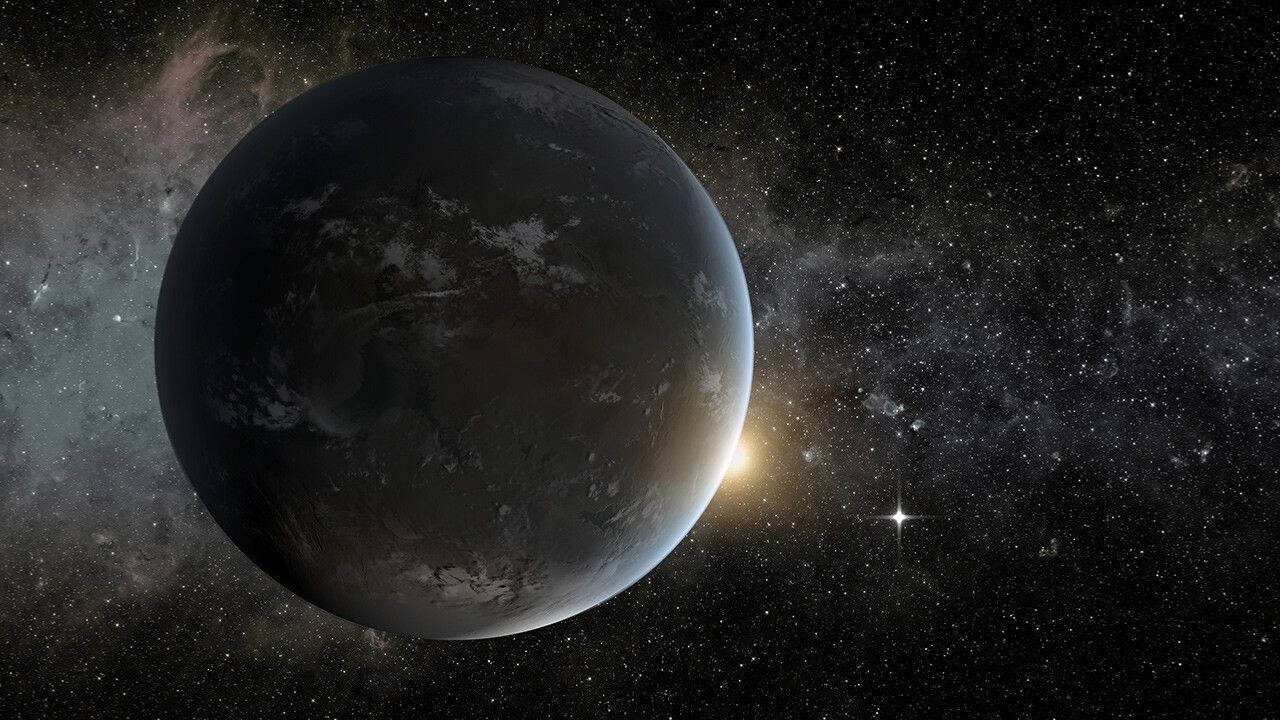
For starters, K2-18b is much larger than Earth, and is now one of the leading candidates for what scientists call a Hessian world — a planet that may contain a massive global ocean beneath a hydrogen-rich atmosphere. K2-18b has gained more attention since the James Webb Space Telescope detected signs of gases, including methane and carbon dioxide, in its atmosphere. These discoveries have led to speculation that microbial life, or even more complex ecosystems, may exist on the planet.
Listening to alien technology
Listening to alien technology
According to experts, the latest study was not about searching for biological signs, but rather for technological fingerprints, which are signals that could indicate the presence of advanced technology. The study notes that scientists used two of the world’s best radio observatories: the Karl J. Jansky Very Large Array (VLA) in the United States, and the Meerkat radio telescope in South Africa. The duo studied K2-18b across a wide range of radio frequencies, using advanced software to comb through the millions of signals they detected.
The motivation was to search for narrow-band radio emissions or other anomalous signals that are difficult to explain within the framework of natural astrophysical phenomena.
Millions of signals, but no aliens
If we follow published research, radio telescopes have received huge amounts of radio signals during observations, but almost all of it turns out to be radio frequency interference from ground-based technology such as satellites, communications systems and electronic devices.
Later, the researchers carefully filtered out these false positives using sophisticated algorithms and there was no convincing evidence of artificial transmission of K2-18b.Finally, the search ended without detecting any extraterrestrial signals. But if scientists are to be believed, even silence is an important and necessary part of SETI research, as this silence also helps improve detection techniques for the future.
The importance of silence

According to the researchers, the lack of detectable radio signals does not mean that K2-18b is lifeless. In explaining the importance of silence, scholars say so “If it has life, it may be microbial, not intelligent. Even if there is an advanced civilization, it may not use wireless communications, or it may broadcast on frequencies not covered by scanning. Scientists also point out that humans have not been emitting detectable radio signals until about a century ago, so discovering another civilization depends on the two civilizations using compatible technology during overlapping time periods.
Hence, SETI scientists are careful not to interpret the silence too strongly as evidence of the absence of intelligent life.
How can it be an achievement?
While no strange message has been found, researchers say the project is an important technological breakthrough. According to experts, the techniques developed in this research are now applicable to many other potentially habitable planets, and will make future SETI observations even faster and more efficient.
The search continues
Recently, astronomers have discovered thousands of exoplanets, many of which remain promising targets for the search for extraterrestrial life. K2-18b remains one of the most interesting worlds due to where it is located, what it is made of, and the possibility of it being rich in oceans.