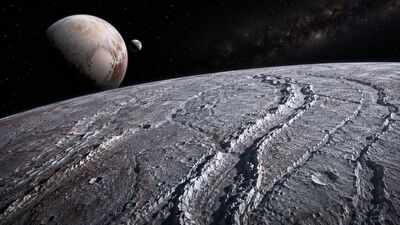
For decades, Charon was often viewed as the quieter half of the Pluto system, a frozen world marked by craters, fractures and vast plains. However, the surface imaged by NASA’s New Horizons spacecraft has continued to reveal hints that its history was much more dynamic than previously thought.A new study published in the journal Nature Communications, titled “Early tidal rotation history recorded in the Oz-Terra tectonics, Charon,” suggests that some of the Moon’s oldest landscapes may contain evidence of a process known as “rotation,” when a celestial body gradually slows its rotation over time. According to the research, widespread tectonic features in Charon’s northern hemisphere appear to preserve a record of this ancient change, which may offer a glimpse into the early evolution of the Moon after its formation.The results point to a period when Charon was rotating much faster than it does today, before it became tidally locked with Pluto and always showed the same face to its home world.
Scientists have discovered unusual mountain ridges in Sharon Terra geese region
The investigation focused on the Uz-Terra region, a rugged highland area in Charon’s northern hemisphere. Scientists examined a series of long, curved, mountain-like features that jut out from the surrounding terrain.According to the study, these structures differ from the fractures and troughs that were previously linked to crustal expansion.
Instead, their shape resembles landforms created by compression, where parts of the planetary crust are pushed together rather than pulled apart.Some of the ridges extend for more than 200 kilometers and show distinct asymmetry, with one side sloping gently and the other sloping more steeply. The researchers believe this pattern is consistent with buried thrust faults, where one block of crust is superimposed over another.The team also identified modified archaeological pits associated with the mounds. One crater appears only partially preserved, while the other contains features that may have formed when tectonic forces reshaped the landscape after the impact. According to the authors, these details strengthen the argument that pressure forces have been active in this region for a long time.
how despinning It may have formed the surface of Pluto’s moon Charon
The concept at the center of the study is troubling. As moons interact gravitationally with larger objects, tidal forces can gradually reduce their rotation rates.
Over time, this process may leave stresses in the Earth’s crust.Researchers have long speculated that slowing down rotation should create distinct tectonic patterns. However, clear geological evidence linking surface features to rotation has remained difficult to find anywhere else in the solar system.According to the study, the arrangement of the ridges in Terra Oz closely matches the pattern expected from a body whose rotation has slowed dramatically.
The observed structures are concentrated at low latitudes and follow trends predicted by flight-related stress models.The study also notes that features near Charon’s polar regions appear broadly consistent with rifting expected from the same process, suggesting a widespread tectonic signature across the moon.
The study indicates that Pluto’s moon Charon completed a full orbit in just 14 hours
Using topographical measurements and computer modeling, the researchers estimated the amount of pressure recorded in the hills.
From this, they reconstructed how Charon’s shape changed as its rotation slowed.According to the study, calculations indicate that Charon could have had an initial rotation period of about 14 hours. Today, it takes the Moon about 153 hours to orbit once, the same time it takes to orbit Pluto because the two objects are tidally locked.If the interpretation is correct, tectonic structures preserve evidence from a very early stage of Charon’s history, perhaps within the first few million years after its formation.The researchers suggest that the slowing of the Moon’s rotation occurred before other major geological events that subsequently reshaped parts of its surface, including episodes of global expansion and possible cryovolcanic activity.
Sharon Old ice shell Provides new evidence for its early history
In addition to reconstructing Charon’s rotational history, this work may also provide insight into what was happening beneath its icy surface billions of years ago.The geometry of the tectonic features suggests that Charon had a relatively thick and solid ice crust when the ridges formed.
Researchers estimate that the crust may have been at least 30 to 36 kilometers thick at that time.This conclusion supports the idea that Charon began its existence in a relatively cold state rather than as an extremely hot body. The authors argue that rotation, combined with a modest amount of global contraction, could explain the observed tectonic patterns preserved at Oz Terra.While questions remain about the full geological history of the Moon, the study presents one of the strongest cases to date that ancient rotational changes can leave permanent marks on the planet’s surface.