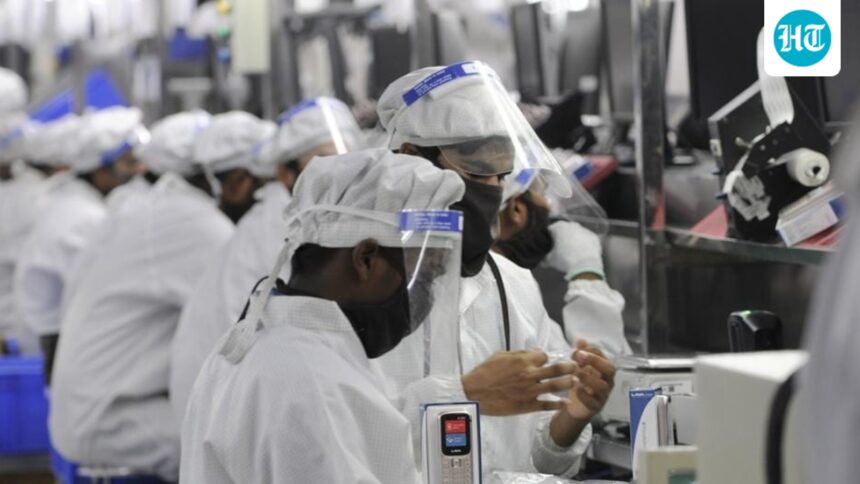
Today, Wednesday, the Federal Cabinet approved A $Rs 62,500-crore Mobile Phone Manufacturing Scheme (MPMS) to deepen mobile phone manufacturing in India, which is now the second largest mobile phone manufacturer in the world.
The scheme comes amid an accelerating transformation in the industry as multinational manufacturers build their capabilities outside China to hedge against geopolitical risks and exposure to tariffs. India has emerged as the main beneficiary, also partly due to the incentives provided by the government to the electronics sector.
The MPMS, planned over a five-year period starting from FY 2026-27 to FY 2030-31, is expected to be notified within 20 days.
Promoting ‘Make in India’: PM Modi
Prime Minister Narendra Modi described the project as a “huge boost to ‘Make in India’ and our electronics manufacturing ecosystem”, writing that the scheme “will scale up production, deepen domestic value addition, strengthen supply chains and create a globally competitive ecosystem in India. Over the next few years, the scheme is expected to generate numerous employment opportunities for the youth.”
Over the five-year program period, the government expects the MPMS to create 60,000 direct jobs in the mobile manufacturing and allied sectors. The cumulative production of mobile phones aims to reach all parts of the world $39 lakh crore during the MPMS period, as compared to $22 lakh crore under the Production Linked Incentive (PLI) scheme, while exports are expected to double to about $15 lakh crore of $7.5 million crores.
The scheme is not an extension of PLI.
“A device as small as a phone requires the industry to pack the power of a data center into a single device. This requires precision. This industry is also leading many other industries,” Ashwini Vaishnau, IT Minister, said at a Cabinet press conference on Wednesday.
The scheme offers incentives on eligible sales at varying rates ranging from 2.25% to 5% for mobile phones manufactured in India. An additional 1.5% is available for local sourcing of key components and sub-assemblies, and – to encourage Indian brands – an additional 3% on eligible sales of product design and R&D.
IT Ministry officials pointed to Nokia’s exit from India in early 2010 to underscore the challenges faced by the country’s mobile phone manufacturing ecosystem. The next challenge is to build an Indian mobile phone brand, which will require local companies to invest heavily and compete with Chinese phone makers in terms of quality and cost, officials said.
Domestic value added in mobile phones in China is now about 38%, a level that took about 35 years to reach, according to one official. In comparison, the proportion in India reached 23% in just seven to eight years.
The government now aims to add 40-50% local value over the next four to five years. The official explained that the cost of the phone is a premium $100, approximately 35-40% can be the profit margin and the design value is another 20%. This leaves about 50% where manufacturing value can be added. India now accounts for about 23% of this share, while China accounts for about 38% to 40%.
At the Cabinet press conference, Vaishnaw explained why mobile phones are so important in driving the electronics sector in India. Smartphones, which were not among India’s top 100 single export items in 2014-15, ranked first in 2025-26. Mobile phones now represent 48% of electronics manufacturing and 61% of electronics exports, compared to about 10% and 4%, respectively, in 2014-2015. The mobile device manufacturing ecosystem has also expanded from about two units in 2014 to more than 300 units in 2026, according to a government presentation.
“In 2014, electronics accounted for only 1.7% of India’s total exports. In 2025-26, this share has risen to 11%,” Vaishnau said. “This is a big jump.”
About 99.2% of phones used in India are made locally. This sector has created 12 thousand additional job opportunities $Rs 19,090 crore of PLI incentives have been disbursed. The government estimates that the electronics ecosystem has attracted investments worth $14 billion, generating approx $25,000 crore in direct taxes and around $3 lakh crore in GST collections.