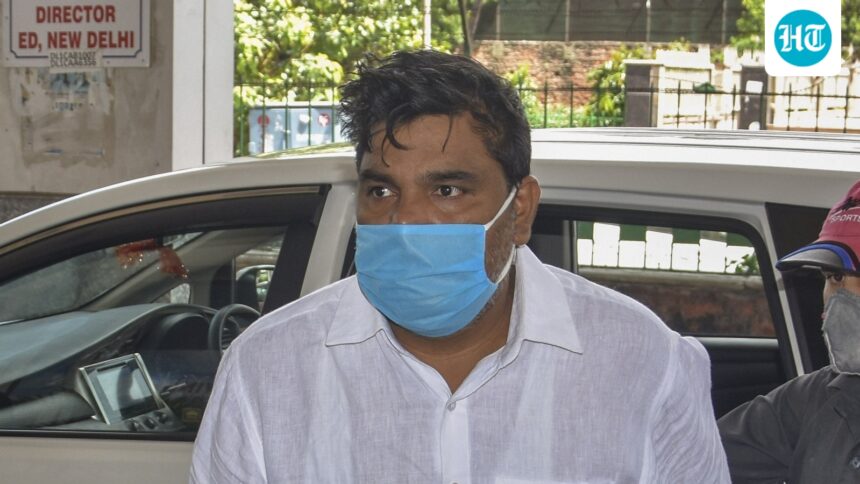
A day after a Delhi court convicted former Aam Aadmi Party (AAP) councilor Tahir Hussain for the murder of Intelligence Bureau (IB) officer Ankit Sharma during the 2020 northeast Delhi riots, it held that Hussain, along with an “armed” mob, carried out a “brutal” and “relentless” attack against Sharma. The court set next July 23 as the date for the next session to hear arguments regarding the amount of the penalty.
What did the court say?
In the detailed 320-page judgement, Additional Sessions Judge Parveen Singh of the Karkardooma Courts on Tuesday observed that based on the testimonies of three important eyewitnesses, the prosecution had proven beyond reasonable doubt that Hussain was part of an “unlawful assembly which gathered, with animosity (bad faith) against Hindus, at Chand Bagh Pulia with a common aim to commit rioting, looting, arson and to cause hurt to Hindus”. Hindus and their property.”
“The members of this assembly, who were heavily armed, used violence and indulged in rioting, arson and looting. It has also been established that the members of this assembly surrounded and dragged Ankit Sharma towards Chand Bagh Pulia and thus kidnapped him where they then killed him in a brutal and relentless assault on his person.”
The fact that this mob, armed with weapons, dragged Sharma into their midst and then launched an attack with lathi, danda and sharp weapons “reflects the intention to kill Ankit Sharma or at least cause injuries to him, sufficient to cause his natural death,” the court said.
Conspiracy charge
It rejected Hussein’s defense that he himself was a victim of sectarian violence. However, the court continued to dismiss Hussein’s role as the alleged instigator. The reason for this is that although surveillance cameras around the area were damaged, covered up or moved away, “indicating prior planning”, and thus the fact that “a conspiracy may have been afoot”, the prosecution failed to prove this.
“The State has not produced any evidence to prove when, where and how this conspiracy was formed and who are all the conspirators and, therefore, there is no evidence against Tahir Hussain and against any of the accused in this matter, which could lead to their conviction u/s 120B (criminal conspiracy) IPC,” the ruling said.
The court also acquitted him of charges under Section 109 (abetment) and 505 (making statements causing public hurt) of the Indian Penal Code (IPC).
On Monday, the court issued a ruling convicting Hussain and four others in the Sharma murder. Six others were acquitted of all charges in the case.
Background of the case
According to the prosecution, Ankit was allegedly killed near his home in Khajuri Khas on February 25, 2020, after he encountered clashes between two groups in the Chand Bagh Pulia (bridge) area. While trying to calm both sides, he was allegedly kidnapped, assaulted and stabbed several times by a mob of 20 to 25 people. His body was recovered the next day from a sinkhole in the area.
Reacting to the conviction, Prime Minister Rekha Gupta on Tuesday said the RJD should explain its “political affiliation” and “patronage” of a person who was convicted of “inciting riots, murder and large-scale violence in Delhi.”
“Arvind Kejriwal, Sanjay Singh and Manish Sisodia should clarify when the people of Delhi will receive answers to the entire episode,” she said at a press conference.
She said the ruling represents an important step towards achieving justice for families affected by the violence, adding: “Those responsible for the riots must be punished in accordance with the law.”
Separately, in a post on X, BJP IT cell chief Amit Malviya described Hussain as a “close associate” of Kejriwal.
In response, Kejriwal said on Show X: “We expelled him from AAP long ago. Didn’t he join one of the sister organizations of Chanda Chor Party?”
Hussain, who was elected to the AAP council from north-east Delhi in 2017, was suspended by the party following his arrest in connection with multiple cases arising out of the 2020 riots.