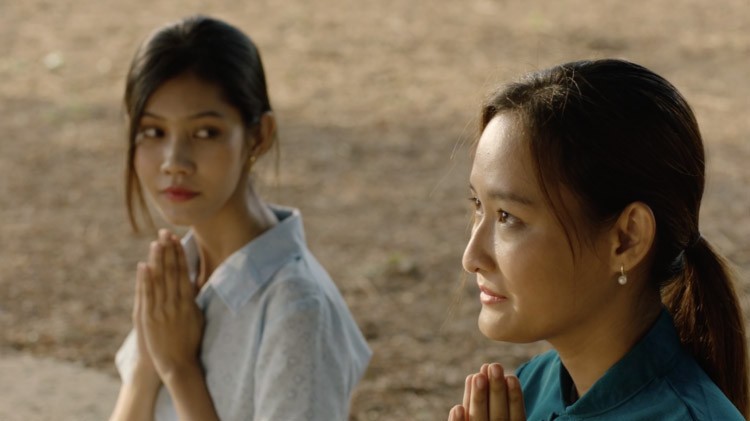
Caught between rural roots, urban opportunities, familial duty, friendship, and forbidden carnal desire, young woman San Kyi (Nandar Myat Aung) struggles to find her place in… Fruit collectiona sensitive co-production between Myanmar, the Czech Republic and France that has just won the Karlovy Vary Grand Prix.
This is an impressive achievement for Burmese writer-director Aung Phui, making his debut after several short films. His flair for blending real-life drama with more poetic and formal imagery makes for a dreamy and hypnotic viewing experience, tempered by the confident and extroverted performance from Nandar Myat Aung in the lead role. Fruit collection It will be ready for selection at more festivals, especially those specializing in Asian and/or LGBTQ+ cuisine, and perhaps specialty distribution will follow.
Fruit collection
Bottom line Juicy but not too sweet.
place: Karlovy Vary Film Festival
ejaculate: Nandar Myat Aung, Nandar Myint Lwin, Tin Tin Ee, Theda Swe Khant, Wout Yit Kyaw, Htet Aung Lin, Khet So Myat, Min Nyo, Zone Point View
Director/screenwriter: Aung Phui
1 hour and 37 minutes
San Kyi moved with her mother (Tin Tin Ee) and grandmother from the countryside to industry-rich Yangon, and has so far managed to resist her mother’s pressures to marry or pursue a career in something high-end like technology. Instead, Sun-ki, eager for a job that doesn’t require much thought, works in a huge clothing factory, where she stitches seams all day in an environment so noisy that the supervisor gets snotty if she takes a bathroom break without getting permission first.
By the way, although the factory does not look attractive, the conditions do not seem so bad compared to those seen in old documentaries about sweatshops in East and South Asia. It’s comparable to what’s shown in Chinese director Wang Ping’s doc, for example youths But without company-owned residential housing. Workers are at least allowed to submit petitions circulated by labor organizers demanding better wages and more safety measures, although San Kyi refuses to sign for fear of being fired for doing so. Union leader Wutt Yee Kyaw pours scorn on her for not showing more solidarity with her colleagues.
Later, after she injures herself in a sewing accident, Sun-ki will rethink her stance on workers’ rights, but industrial relations in the textile industry are not the main focus of the film. They’re all background colors, as much a part of the lively landscape as the interludes in which we see Sun-ki back home visiting the mango plantations and spiritual dance ceremonies of her farming childhood.
At least in this factory, San Kyi meets Thent Oo (Nandar Myint Lwin), a young co-worker about the same age as San Kyi with a radiant smile and a street-on-fire vibe. The two young women start hanging out together during their lunch break but soon become inseparable. The text suggests early on that Theint Theint might be the type who always forgets to bring enough money for dinner. A darker interpretation might assume that she sees San Ki as nothing more than a mark, but the truth probably lies somewhere in a grayer area.
Either way, by the time Sun-ki buys almost identical blouses for the two to wear while strolling around town, it’s clear that she’s smitten with Theint Theint. The latter is vaguely flirtatious and keen to sleep at night with vulnerable girls in the same bed, but she is also open about the fact that she has a man in the background, who is always away on business in another country. Fearing the loss of her new object of desire, Sun-ki considers going abroad with Then-Ki to work as a housekeeper or factory worker in a wealthy place like Singapore or Malaysia.
It is clear that things are going downhill when San Ki-Thint lends Thint a large sum of money. Somehow, the tension is heightened by the fact that Theint Theint is getting closer to San Kyi’s family, even accepting a job offer that comes through the local man who San Kyi’s mother has been trying to set San Kyi up with as a potential husband. All of this highlights how narrowly defined female relationships are in Myanmar’s deeply traditional and painfully patriarchal society. The intense feeling between these two young women could never be overtly romantic, although no one draws attention when they walk side by side in the streets, just as Queen Victoria is said to have refused to sign legislation banning homosexuality because she would not admit that such a thing existed.
Ong Phui suggests the chaotic, uncontrollable nature of desire through some slightly heavy images of flooded apartments and erotic, watery and somewhat soluble images. But the story changes abruptly midway through and becomes less concerned with the relationship between the two women and more concerned with San Ki’s personal development, especially after some powerful blows change her worldview.
Often, the camera will linger on a small detail such as a vase that has some emotional significance, or light coming through a window. There is a slight hint that these cinematic still images are seen through San Ki’s eyes, like scenes in a book told through a limited third-person point of view. In fact, there is a weak literary quality in the filmmaking, as if it was inspired by romance and high-level fantasy, but Ong Phui’s touch is as soft as a feather, as gentle as the soft sound of a mango falling from a tree.