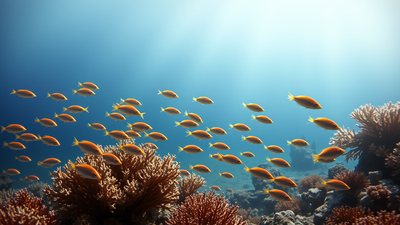
Not only are marine animals struggling when ocean temperatures rise, they are actually shrinking, and a massive new study shows that this pattern has been repeating for nearly 450 million years.
The researchers have built one of the largest marine body size datasets ever, drawing on nearly 9,000 recorded variations and more than 1.6 million individual measurements taken from fossils, historical records, and living animals. What they found was striking: marine organisms shrunk more severely during periods of extreme global warming than during crises caused by cooling or falling oxygen levels. This suggests that the shrinkage already being measured in fish and shellfish today is not a new and isolated trend, but part of a pattern written deep into the planet’s history.
What is it Lilliput effect In marine animals
Paleontologists have been giving this shrinking pattern a name for a while, calling it the Lilliput effect, a reference to the little people in Gulliver’s Travels. This pattern tends to emerge after most major mass extinctions in the fossil record, with surviving animals becoming noticeably smaller for a period before slowly rebounding once conditions stabilize. Paulina S. Natscher, the paleobiologist who led the study at Friedrich-Alexander-Universität Erlangen-Nürnberg in Germany, and her team sorted thousands of records into three categories: quiet background periods, severe ecological crises, and recovery periods that followed each category.
Why warming crises are hitting life in the oceans harder
To date, most evidence for this contractionary pattern has come from single species studied at single sites over fairly short time periods, leaving considerable room for doubt as to whether it is a true biological basis or just a sporadic coincidence. By combining records from oceans around the world, this new data set helps settle that debate. Cold-blooded marine organisms, including mussels, crustaceans, and fish, continually shrink whenever a crisis occurs, regardless of whether it is caused by overheating, cooling, or decreased oxygen.
But when the researchers specifically separated out climate-related crises, the downturn was about twice as strong as other types of disasters.
True dwarfism versus species turnover
An important detail here is that the researchers are describing true dwarfism, meaning that individual animals within a species were actually growing to smaller adult sizes, rather than simply dying off the larger species and leaving the smaller species behind. These effects tend to be twice as strong during warming events as during other types of environmental stressors, noted study co-author Kenneth DeBaets.
When the team compared each ancient warming event with how sharply temperatures rose at that time, the biggest jumps in temperature consistently matched the steepest declines in body size, although the relationship wasn’t entirely precise, suggesting that other factors associated with warming, especially lower oxygen levels in seawater, were likely making the shrinkage worse as well.
Why warm water makes animals grow smaller
Scientists already have a fairly solid explanation for why this happens in living oceans today.
Warmer water simply has less dissolved oxygen, and at the same time, a warmer body burns oxygen faster just to keep it functioning. For cold-blooded animals that continue to grow throughout their lives, this creates a real bottleneck, as their gills eventually cannot pull in enough oxygen to support a larger body.
Staying smaller becomes a simple way to relieve this pressure, which is why many marine species stop growing sooner and stabilize at a smaller size when the waters warm.
What does this mean for fish size and fisheries
Wolfgang Kiesling, who leads the paleoenvironmental research group at the University of Florida, believes ancient warming events like this could serve as a preview of what warmer oceans might bring in the coming decades. This isn’t just a theoretical concern either: One current study of thousands of surveys of reef fish across Australia found that average fish length decreased by about five percent for every two degrees Fahrenheit rise in ocean temperature.
Since body size directly affects how much an animal eats, how many offspring it can produce, and how much food it provides to other species, a widespread shift toward smaller bodies has the potential to spread across entire ocean food webs, ultimately affecting the fisheries that coastal communities and commercial industries depend on for food.
A warning written in the fossil record
What makes this study particularly important is that it shows, for the first time on a truly global scale, that ocean warming is leaving a distinct imprint on marine life, one that is stronger and more volatile than the effects of other environmental crises, and one that is consistent across hundreds of millions of years of Earth’s history. The shrinkage already seen in today’s warming seas appears to follow a pattern deep in geologic time, and the researchers suggest that animals are likely to continue to shrink as ocean temperatures continue to rise, until warming eventually stops stunting growth and begins pushing species toward extinction altogether.
The full results were published in the journal Proceedings of the National Academy of Sciences.